The useful product is the shelf, not an npm package
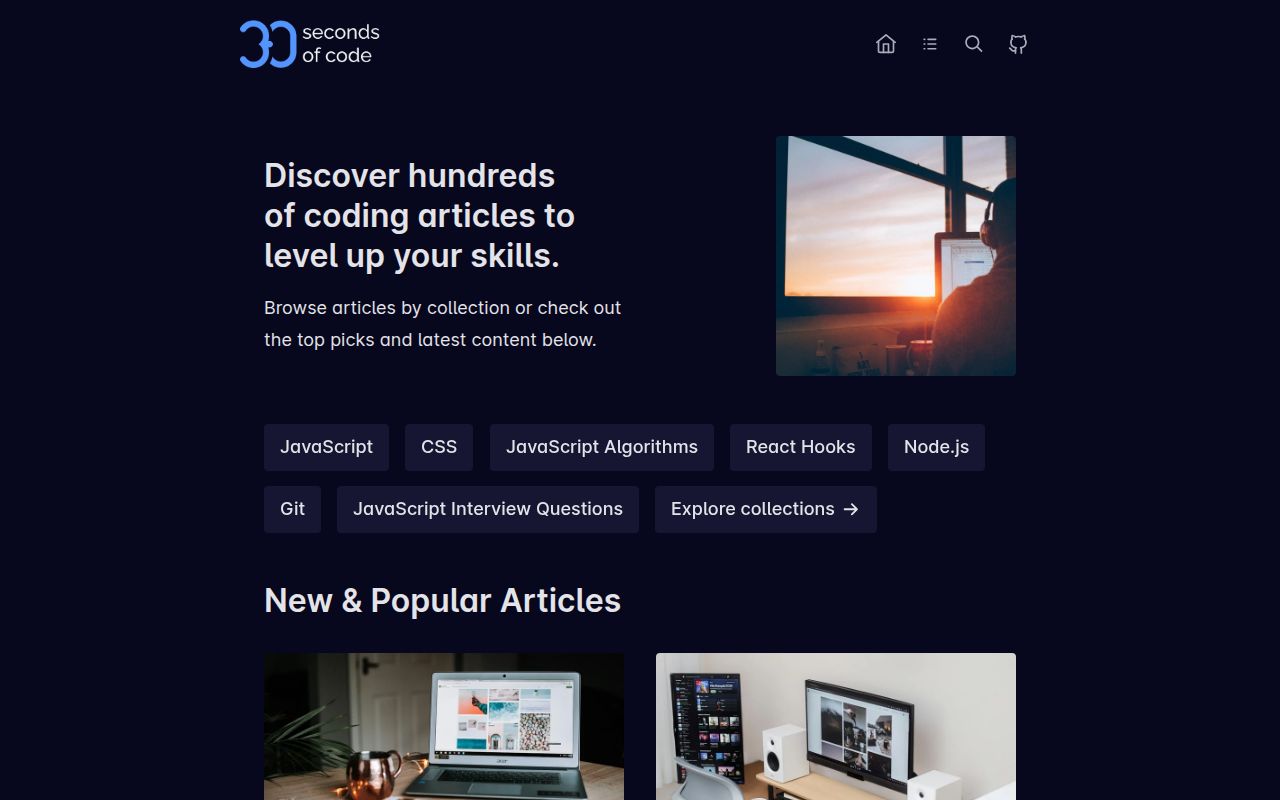
30 seconds of code is a website full of short programming articles, snippets and collections. Search accepts names, tags, languages and descriptions, then each result opens into an explanation, code and examples. That makes the project handy when you know the shape of a problem but cannot recall an API or compact implementation. It is closer to a well-indexed engineering notebook than a course.
The repository can mislead anyone arriving through GitHub. Its package is marked private, and the scripts build an Astro website. There is no general-purpose library to install into an application. The 413.8 MB checkout contains the articles, images, site code and tooling that produce 30secondsofcode.org. If you only want to look up a snippet, the hosted search saves a large clone and 454-package install.
Search beats a fixed curriculum for experienced readers
The browsing model works best when you can name what you need. A developer looking for an array operation, CSS pattern or command-line technique can jump to a matching card, read a brief explanation and decide whether the example suits the current code. Collections group related material without forcing every reader through the same sequence.
That same design is weaker for a first encounter with a language. Short, independent articles do not establish prerequisites or guarantee that one idea appears before another. A beginner can find a correct answer and still miss why it is safe, idiomatic or appropriate in a larger program. Use the snippets as recall aids and starting points, then check the relevant platform or language documentation before shipping consequential code.
What happened when we ran it
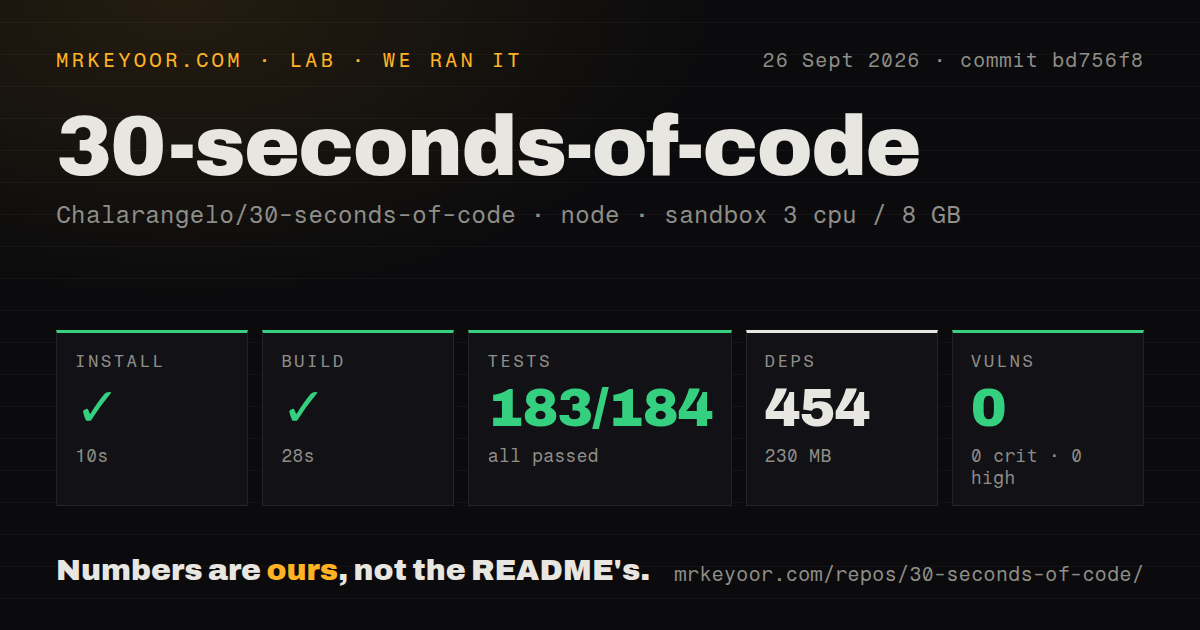
Our sandbox installed 454 npm packages in 10 seconds and used 230 MB on disk. The production build passed in 28 seconds. Vitest finished in 6 seconds with 183 tests passed, 0 failed and 1 skipped out of 184. Npm audit reported 0 known vulnerabilities at commit bd756f8.
Those results are unusually tidy for a content-heavy site. The checkout held 3,300 files and about 9,859 lines of source, with 4 CI workflow files and a tests directory. We found no Dockerfile, but the omission is not a serious obstacle here. The documented development path is Node.js and npm, and the package requires Node 22.14 or newer.
The clean run tells us that a contributor can reproduce the build in a fresh unprivileged Debian container. It does not test whether every article's advice fits your production stack. A green site build proves the content pipeline can parse, render and exercise its tested behavior. It cannot turn thousands of context-dependent snippets into drop-in guarantees.
Contributions are for corrections, not new tutorials
The README closes one door plainly: new content contributions are not accepted. Issues may report website problems or suggest improvements, and the contribution guide allows fixes or improvements within existing snippets and collections. That is a sensible maintenance boundary for a large editorial archive, but it matters if your reason for visiting GitHub is to publish a fresh lesson.
The writing guide is far more specific than the short README. It asks for American spelling, short sentences, active voice, descriptive headings and a Grade 10 reading level or lower. Code should use official names and appropriate language highlighting. These rules explain why the articles tend to scan quickly. They also give correction pull requests a clear house style instead of leaving reviewers to argue about tone.
The license does not cover the whole 413.8 MB checkout
Reuse needs careful reading. The README says code snippets use CC BY 4.0 unless a snippet says otherwise. It separately says the text, images, website source, logos, names and trademarks cannot be used without explicit owner consent. The repository metadata may look simple, but the README draws a narrower boundary around what a reader may copy.
That distinction rules out cloning the site as a ready-made content property. It still leaves the most useful unit, an attributed code snippet, available under the stated terms. Check the specific item before republishing it, keep the attribution required by CC BY 4.0 and do not assume the surrounding prose or photography shares the snippet's license.
Current maintenance is visible in code and issue activity
GitHub showed 129,240 stars, 5 combined open issues and pull requests, and a last push on September 25, 2026. The open queue we inspected was dominated by dependency update pull requests, including updates for Astro, Vitest, SVGO and js-yaml. That is evidence of active maintenance work, although stars measure attention rather than editorial accuracy.
The latest tagged release is v14.0.0 from May 7, 2025. It redesigned search, added keyboard navigation and navigation hotkeys, replaced the code highlighter and updated content-authoring components. More recent pushes show that work continued after the tag, so the release date alone would give the wrong health signal.
30 seconds of code earns a bookmark because retrieval is its strongest feature. Our 28-second build and 183 passing tests also make the source credible for people fixing the site. Read it in small doses, verify a snippet against current primary documentation and leave the full checkout to contributors who need the Astro pipeline.