mrkeyoor.com_
Sat 26 Sept 16:11 UTC
Dev Toolsevaluationupdated 26 Sept 2026

devops-exercises review

DevOps Exercises is a large English-language collection of questions and hands-on tasks covering Linux, networking, cloud platforms, containers, CI/CD, security, SRE, and related work. It is best used as a prompt bank for finding gaps in your knowledge, not as a course that teaches each subject in order. A small Flask challenge inside the repository asks learners to repair an app, containerize it, and add CI.

Verdict

Our Flask challenge install took 6 seconds and added 42 packages, but pytest collected 0 tests and exited 5, so DevOps Exercises works better as study material than as a verified software project. Use the repository to expose what you cannot yet explain, then confirm the answer and build something small around it. Choose a structured roadmap if you need sequence, and do not reuse this material in a commercial course without separate permission.

We ran it

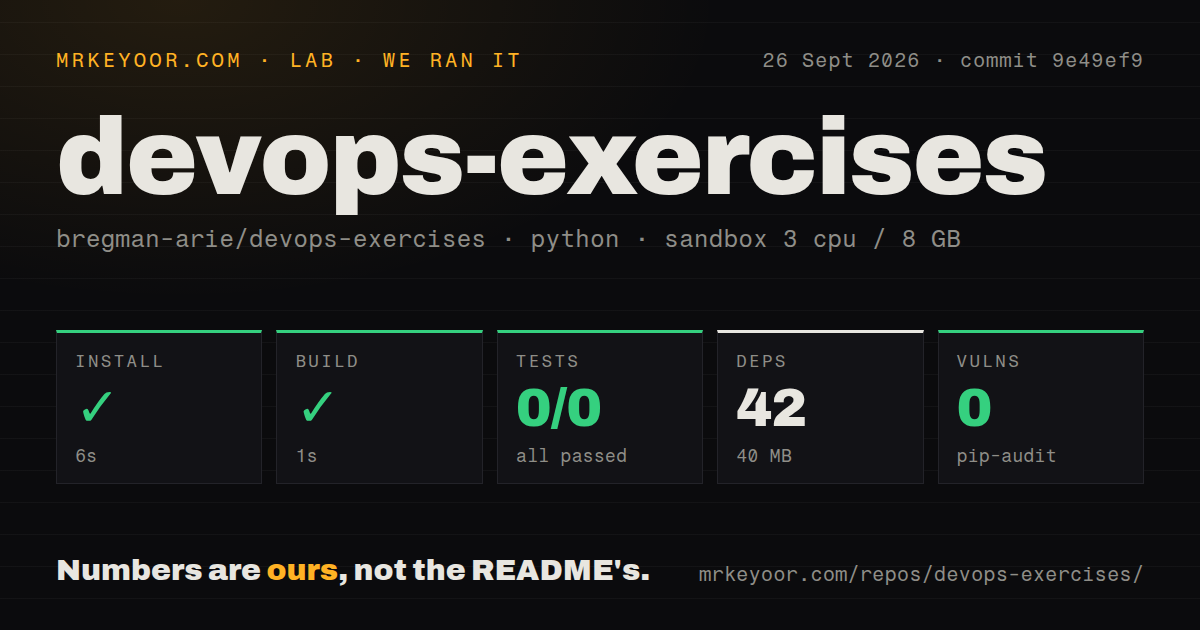
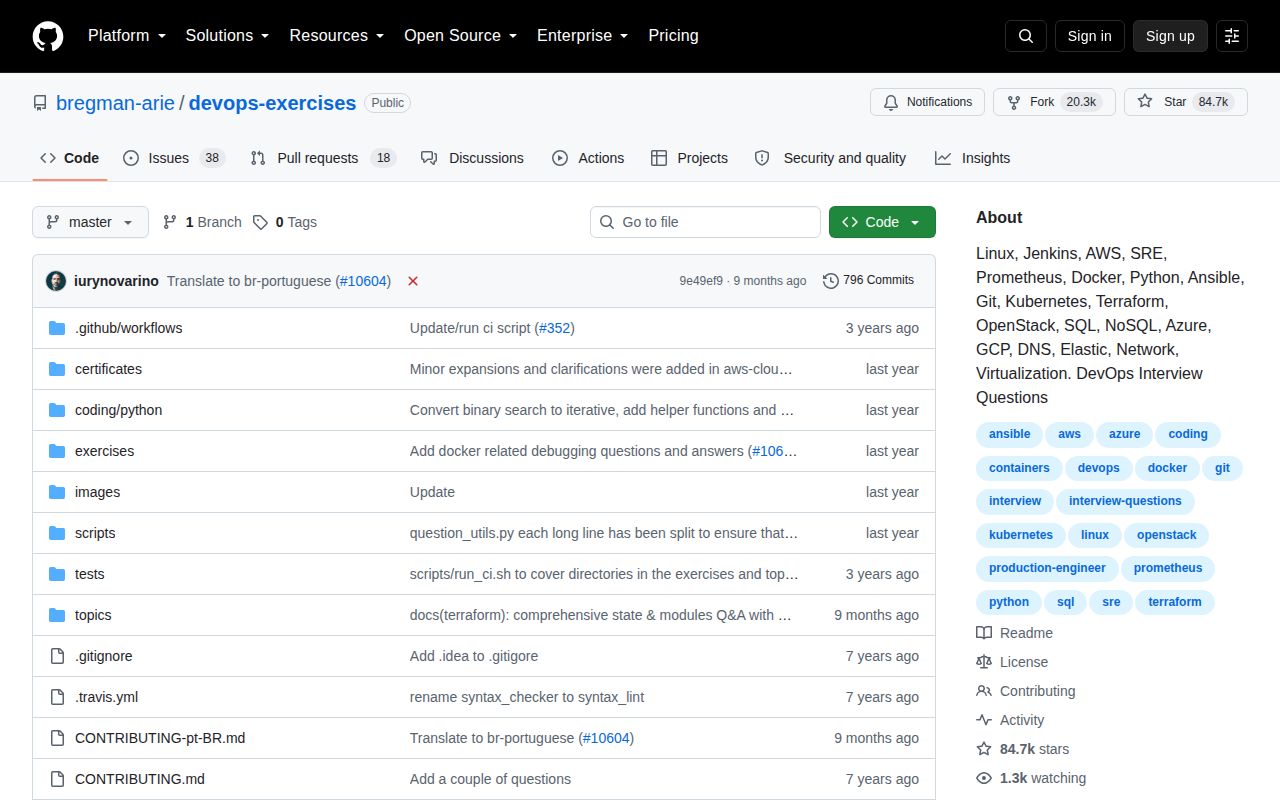
Lab card: what happened when we ran devops-exercisesScreenshot of devops-exercises (github.com/bregman-arie/devops-exercises)
Install✓ · 6s42 packages · 40 MB
Build✓ · 1s
Tests✗ · 2s0 passed · 0 failed of 0 (pytest)
Known vulns0(pip-audit)
Repo429 files~1,015 lines of source · 7 MB · 1 CI workflows · tests dir

Answers from our run

Does devops-exercises build from source?

Dependencies installed in 6 seconds (42 packages), and the build succeeded in 1 seconds. We cloned commit 9e49ef9 into a clean Debian container with 3 CPUs and no project-specific setup.

Do devops-exercises's tests pass?

Yes: 0 of 0 passed when we ran the project's own test command (pytest). Some failures need services or credentials a bare container does not have.

Does devops-exercises have known vulnerabilities in its dependencies?

pip-audit found none in the dependency tree at the time of our run.

Who should not use devops-exercises?

Beginners seeking a linear curriculum: the README presents 2,624 questions across many topics and warns that learning every listed technology is not the goal.

What are the alternatives to devops-exercises?

90DaysOfDevOps, DevOps Roadmap, Test Your Sysadmin Skills. Our Flask challenge install took 6 seconds and added 42 packages, but pytest collected 0 tests and exited 5, so DevOps Exercises works better as study material than as a verified software project.

Setup3/5Browsing is immediate. The Flask challenge needs repair and CI work
Docs4/5Broad topic index and candid FAQ, with many answers still missing
Community4/584,660 stars and current issue activity, though merges have slowed
Maturity3/5Large established collection with uneven answer and exercise upkeep

Who it’s for

DevOps and SRE candidates who want a large bank of questions for self-testing or peer practice.
Working engineers who can research missing answers and turn weak areas into lab work.
Interviewers who need topic prompts and will verify the expected answers independently.
Study groups that want to pick one subject, discuss it, and build a practical follow-up exercise.

Who it’s NOT for

Beginners seeking a linear curriculum: the README presents 2,624 questions across many topics and warns that learning every listed technology is not the goal.
Learners who need an answer beside every question: the FAQ says many answers are missing and directs readers to documentation, search, and communities.
Commercial training publishers: the repository's Creative Commons terms and FAQ prohibit use aimed at commercial advantage, including ad-supported reuse.
Candidates expecting a faithful preview of their next interview: the README says most entries do not represent an actual interview.
Developers expecting the measured Flask challenge to pass a normal pytest run: our command collected 0 tests and exited 5, while its README specifically instructs users to run python tests.py.

Setup reality

Our sandbox installed the Python project under topics/flask_container_ci/ in 6 seconds, adding 42 packages and 40 MB. Its build step succeeded in 1 second. The test step failed with exit code 5 after 2 seconds because pytest collected 0 tests, reporting no tests ran in 0.00s.

That subproject needs Python, a virtual environment, and the packages in its requirements file. Its exercise then asks you to fix the Flask app, create a Docker or Podman image, and supply a CI definition. No hosted credentials are required for the starting app, but the CI service you choose may need its own account and configuration.

The missing Dockerfile is intentional exercise material, not a packaging oversight. The repository spans 429 files, while our measured Python target lives in one subdirectory. Pip-audit reported 0 known vulnerabilities in the installed environment, but the provided test command is python tests.py, not pytest's default discovery path.

The 2,624 entries work better as prompts than lessons

DevOps Exercises opens with a claim of 2,624 exercises and questions across Linux, networking, cloud providers, containers, Kubernetes, CI/CD, databases, security, observability, and soft skills. That breadth makes it useful when you need to test recall across a job description. It also makes the repository a poor place to begin at page 1 and read straight through. The README itself says becoming a DevOps engineer does not mean learning every tool listed.

Many entries use expandable question-and-answer blocks, while others stop at the question. The FAQ explains that missing answers are partly a contributor shortage and partly an invitation to search documentation or ask a community. That can produce good practice for an experienced engineer. A beginner who cannot judge the sources may simply replace one unknown with an unchecked answer from a search result.

Interview practice comes with an explicit accuracy warning

The README says most of its questions and exercises do not represent an actual interview. That warning is unusually useful. A bank this large can help you rehearse subnetting, container behavior, failure diagnosis, or design tradeoffs, but no hiring team will sample all 2,624 prompts. The separate interview guide tells candidates to start with the job description, their resume, and the employer's process.

That makes the collection strongest as a gap detector. Pick a topic you claim to know, answer without opening the disclosure, and note where the explanation turns vague. Then check vendor documentation or reproduce the behavior. The FAQ favors practical work, reading, community participation, and sharing. Its own Flask challenge turns that advice into a small repair task instead of another definition to memorize.

What happened when we ran it

Our sandbox targeted topics/flask_container_ci/, not all 429 files in the repository. Installation succeeded in 6 seconds with 42 packages and 40 MB on disk. The measured build step then completed in 1 second. Pip-audit found 0 known vulnerabilities in that installed Python environment.

The test command failed after 2 seconds with exit code 5. Pytest reported 0 passed, 0 failed, and 0 collected, ending with no tests ran in 0.00s. That is a discovery result, not evidence that the Flask behavior is broken. The exercise README tells learners to run python tests.py, and the repository supplies a unittest file under that name. Our generic pytest step did not execute it.

The checkout at commit 9e49ef9 occupied 7 MB and contained about 1,015 lines classified as source by the lab. We found 1 CI workflow, no Dockerfile, and a tests directory signal. The lack of a Dockerfile matches the assignment, which asks the learner to create one and test it in CI. Treating that absence as a project defect would miss the point of the exercise.

The Flask task gives you requirements, not a finished reference

The challenge asks for a running Flask API with /users and /users/<username> routes, ordered usernames, and responses without internal user IDs. After repairing the app, the learner must containerize only what is needed at runtime, add an automated test for the Dockerfile, and contribute another application test. A notes.md file is suggested for explaining decisions.

This is closer to a take-home assignment than a tutorial. The repository does not walk through the repair or choose a CI provider for you. That freedom is useful if you already understand Python packaging, containers, and pipelines. Someone learning all 3 at once may spend more time guessing the expected environment than examining the tradeoffs. A finished solution branch or grading script is not presented in the challenge README.

Missing answers and restrictive reuse terms limit classroom use

The main FAQ is candid that many questions lack answers. It also says repeated questions may be intentional when they test the same idea from another angle. That creates useful spaced recall, but it complicates automated importing or deduplication. Instructors should curate a smaller set and verify each answer rather than treating the repository as a ready-made syllabus.

The license deserves the same attention. GitHub reports no recognized SPDX identifier, while the checked-in Creative Commons text requires attribution, bars use aimed at commercial advantage, and restricts adaptations. The FAQ reinforces that users may copy questions with credit only for noncommercial use. A company can study the material internally, but anyone packaging it into paid training should obtain legal advice or separate permission.

Default-branch work stopped in December while submissions continued

The last push to the default branch was December 27, 2025, and the repository has no GitHub release record. On September 26, 2026, GitHub showed 84,660 stars and 56 open issues and pull requests. Issue and pull-request activity continued into September, but the recent queue also contained off-topic titles and contributions that had not reached the default branch.

That combination is more precise than calling the project dead or healthy. The material remains widely used, and people still submit changes, yet the published branch had gone about 9 months without a push. Use the questions as prompts, verify claims against current product documentation, and keep your own notes. If you want a guided sequence, 90DaysOfDevOps or DevOps Roadmap is easier to follow. For a narrower knowledge check, Test Your Sysadmin Skills cuts the scope to Linux operations.

Alternatives

ProjectWhat it isPick it when
90DaysOfDevOpsA structured, multi-year DevOps learning map organized around day-by-day material.pick this instead when you want an ordered study path rather than a large question bank.
DevOps RoadmapA current DevOps roadmap that links skills to selected learning resources.pick this instead when deciding what to learn next matters more than drilling interview prompts.
Test Your Sysadmin SkillsA narrower collection of Linux system administration questions and answers.pick this instead when you want a focused Linux and operations check with answers close at hand.

What people are saying

  1. [github-trending] bregman-arie/devops-exercises

Sources

  1. DevOps Exercises README
  2. DevOps Exercises FAQ
  3. Flask container and CI challenge
  4. DevOps interview preparation guide
  5. DevOps Exercises license

More dev tools reviews

terminal-browser · fearless_simd · scriptc · 30-seconds-of-code · styleguide · just · the whole board →