Seventeen guides turn recurring review debates into written policy
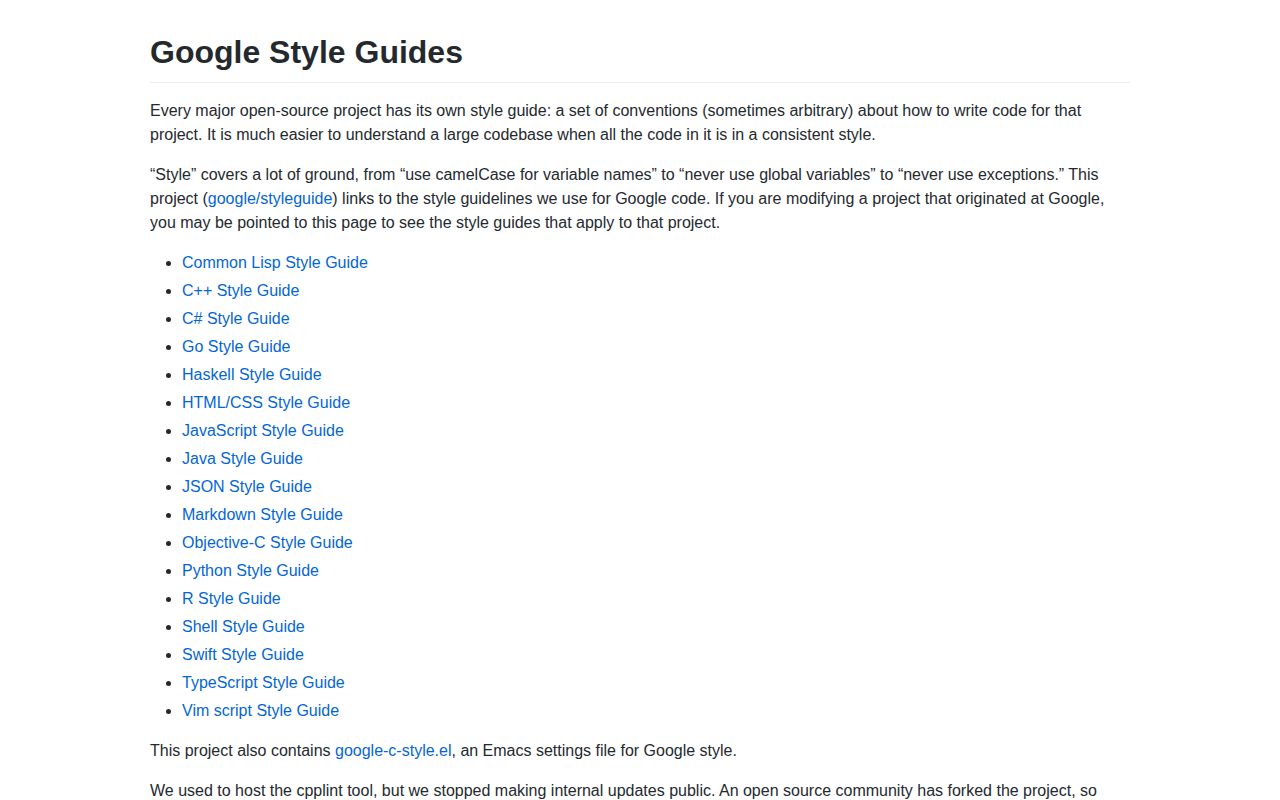
The README links 17 primary guide files and pages, covering languages from C++ and Python to TypeScript, Shell, Markdown, and Vim script. Three more, for Angular, Dart, and Kotlin, live on other official sites. The decisions range from naming choices to global state, exceptions, imports, type annotations, and language features that can affect correctness or maintenance. A team can point to a rule and its reasoning instead of replaying the argument in every pull request.
This breadth does not make the repository a universal standard. The 17 primary links at commit 543fe20 are copies of Google's internal guides, according to the README. That makes them especially relevant when contributing to Google-originated open source. For an unrelated product, select rules that solve known review problems, document local exceptions, and leave behind advice built for a different organization.
Google's scale explains both the detail and the restrictions
The C++ guide says Google's codebase exceeds 100,000,000 lines and supports thousands of engineers. Its rules favor consistency, visible ownership, and code that an average engineer can maintain after a team changes. That context makes restrictions on namespaces, tricky constructs, and surprising behavior easier to understand. It also explains why a rule that is cheap at Google may feel heavy inside a five-person service.
Specific technical rules can age quickly. At commit 543fe20, the C++ document targets C++20 and excludes C++23 features. The TypeScript guide says its external copy is pushed on demand by volunteers and warns that Google's internal environment has different constraints. Check the current page before turning a sentence into a permanent CI rule, particularly where compiler versions and language syntax move faster than a team handbook.
What happened when we ran it
Our lab did not run google/styleguide at commit 543fe20 on 2026-09-26. GitHub identifies the repository's primary language as HTML, and there is no Dockerfile. The harness therefore found no supported install, build, or test path. The absence of a run is the expected result for a repository that publishes documents and small configuration files. Inventing a build command would say nothing about whether the guidance is useful or internally consistent.
The sandbox allocation was 3 CPUs and 8 GB of RAM, but neither resource was used for a product run. There are no package counts, build times, test totals, or vulnerability results to report. Readers should not infer that the style rules were machine-checked by our lab. Our result establishes only that commit 543fe20 is a documentation repository outside the executable ecosystems supported by the harness.
Enforcement support depends on the language
Python gets 2 repository files alongside the prose: a pylint configuration and Vim settings. Its guide also notes that teams use Black or Pyink to avoid formatting disputes. The tree includes Emacs settings for C and editor files for Eclipse and IntelliJ. These assets can shorten adoption for the covered workflows, though each still needs a deliberate place in local development and CI. A written recommendation has no effect when the team's formatter or linter disagrees with it.
Our 3-CPU lab found no combined checker to invoke at commit 543fe20 because enforcement coverage is uneven. The README says cpplint used to live here, but Google stopped publishing internal updates and now points users to the community-maintained cpplint repository. Many rules have no matching checker in this project. If automatic compliance is the goal, pair the selected guide with language-native formatters, linters, and a short local document that records which recommendations your team changed.
Maintenance is current while contribution remains closed
GitHub showed 39,629 stars and 170 open issues and pull requests combined on September 26, 2026. The repository was pushed that day with updates to the Objective-C and R guides, and another recent commit retired the old ES5 JavaScript guide. Open issue 976, about inconsistent fenced code formatting, had six comments and was updated on August 29. Those dates show active maintenance and issue discussion rather than a frozen document dump.
The contribution model is still one-way. The README says external pull requests are not accepted and may be closed without comment because changes happen internally first. Issues that identify mistakes or make a technical case can receive attention, but Google decides according to its own needs. There is also no GitHub release to pin. On 2026-09-26, teams that need an auditable policy snapshot should record a commit hash or vendor the chosen documents instead of following the branch silently.
Adopt the rules that match your codebase
The CC BY 3.0 license lets teams share adapted documents with attribution. Start with one language and one source of recurring friction. If Python imports or C++ ownership cues keep consuming review time, adopt that section, configure the matching tool where one exists, and write down exceptions. That route preserves the explanations while making ownership clear. Linking every developer to a 17-guide index without choosing policy leaves the same disagreements unresolved.
commit 543fe20 gave our 3-CPU sandbox nothing honest to run. Judge Google Style Guides by the reasons behind its rules and whether its assumptions fit your team. If you need open governance or immediate CI enforcement, choose a narrower community guide or a linter.