ICMP, UDP, and TCP traces share one terminal
Trippy runs repeated traces and turns each hop into live statistics for sent and received probes, loss percentage, recent and average latency, jitter, and status. It supports IPv4 and IPv6 over ICMP, UDP, or TCP. The terminal interface can trace several targets, display multiple hosts at one hop, isolate individual flows, plot round-trip-time history, and show a GeoIP map when a local database is configured.
The export story makes it useful beyond an interactive incident. JSON, CSV, Markdown tables, Graphviz DOT, and flow reports can run for a configured number of cycles. Version 0.13.0 added start and end timestamps to JSON reports and exposed DSCP and ECN values from returned packet headers. A saved trippy.toml can hold tracing strategy, columns, theme, bindings, timezone, DNS resolver, and report choices.
Raw sockets determine where Trippy can run
A basic trace in the README uses sudo trip example.com. On Linux, an administrator can instead grant the binary CAP_NET_RAW; Trippy says it drops all capabilities after creating its raw sockets. Windows requires Administrator privileges. The documented unprivileged mode supports ICMP, UDP, and TCP only on macOS, and it excludes the Paris and Dublin ECMP strategies because they need header control.
Containers inherit the same constraint. The official image normally receives raw-socket capability on Linux Docker, while restrictive runtimes may need --cap-add=NET_RAW. Docker Desktop on macOS resets outgoing TTL values to 64 according to the guide, preventing discovery of intermediate hops. Windows users must also allow inbound ICMP in Defender Firewall or the interface can sit at Awaiting data... despite sending probes.
What happened when we ran it
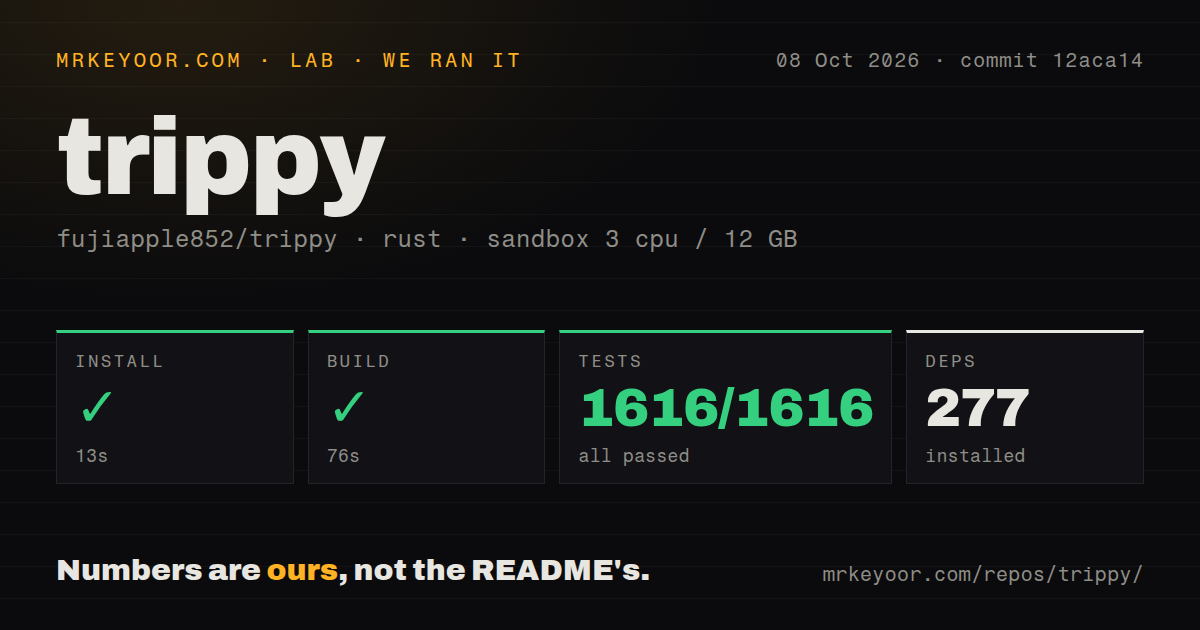
Our sandbox installed commit 2e69fcf in 22 seconds and added 272 Rust packages. The build completed in 87 seconds. We used an unprivileged container with 3 CPUs, 12 GB of RAM, no secrets, and the lab Rust image. Those timings describe repository setup and compilation rather than a live trace across the internet.
Cargo test finished in 50 seconds with 1,616 passed and 0 failed out of 1,616. The checkout contained 328 files, roughly 32,584 lines of source, and occupied 33.5 MB. It had 3 CI workflow files and a Dockerfile. There was no tests directory, which is unsurprising for a Rust workspace whose unit tests can sit in source modules. We did not measure probe latency, route accuracy, or packet-loss behavior.
Loss columns need protocol context
Trippy defaults to ICMP, which often gives one easy-to-read path. Its own recommendations warn that routers may rate-limit ICMP responses, making intermediate Loss% and receive counts easy to misread. ICMP may also take a different ECMP path from an application using UDP or TCP. The status column distinguishes target loss from intermediate responses, but the operator still has to choose a probe that resembles the traffic under investigation.
UDP with the Dublin strategy can keep source and target ports fixed while encoding sequence information elsewhere, which helps stabilize one forward path. Paris offers a similar approach, although the guide says NAT commonly rewrites the UDP checksum it depends on. Return paths remain uncontrolled for every strategy. Trippy therefore recommends tracing both directions for a fuller view, a step that requires access to a host at the far end.
QUIC and high-descriptor embedding have open limits
Open issue 1791 reports that UDP traces to port 443 end with an unknown destination hop for several HTTP/3 services on both IPv4 and IPv6. Issue 1834 asks to raise the maximum packet size from 1,024 to 1,248 octets so a probe can carry the minimum 1,200-byte QUIC Initial payload plus headers. Until that work lands, Trippy is a poor choice for proving that a path reaches a QUIC service itself.
The trippy-core crate can also be embedded, though issue 1790 documents a panic when its host process already has more than 1,024 open file descriptors. The report attributes this to the select() descriptor ceiling and uses a child process as a workaround. Most people running the CLI will never meet that condition. High-concurrency services should reproduce it before placing the crate inside a long-running process.
A September 2 push outweighs the older 0.13.0 tag
GitHub recorded a push on September 2, 2026 and listed 79 open issues and pull requests. The latest tagged release, 0.13.0, dates to May 5, 2025, yet current dependency updates, packet-parser work, locale additions, and protocol discussions show that development continued after the tag. The open count combines issues with pull requests and should not be read as 79 defects.
Trippy earns a place beside MTR when a route needs more than one protocol or a screenshot. The 1,616-test run, platform packages, protocol guidance, and machine-readable reports reduce trial risk. Administrative privileges and trace interpretation remain part of the job. Install the native package, match the probe to the application, save a short report, and confirm suspected loss from the destination before blaming an intermediate router.