
TorrServer feeds a player while the torrent is still arriving
TorrServer lets a media player request a file over HTTP while the server fetches and caches its torrent data. You don't have to wait for the whole file before opening it. That is useful when a TV or player understands ordinary stream URLs but isn't a torrent client. The README documents local and remote use, an adjustable cache, and a web interface for managing what the server streams.
Our checkout contained 572 files and about 61,780 lines of source in 139.4 MB. The Go project lives under ./server/, with a separate web application. This is a manageable repository to inspect, though the user experience spans torrent retrieval, HTTP delivery, and whatever player receives the URL. A successful server command establishes only part of that chain. Your device's format support and the torrent's available peers still affect whether playback is useful.
What happened when we ran it
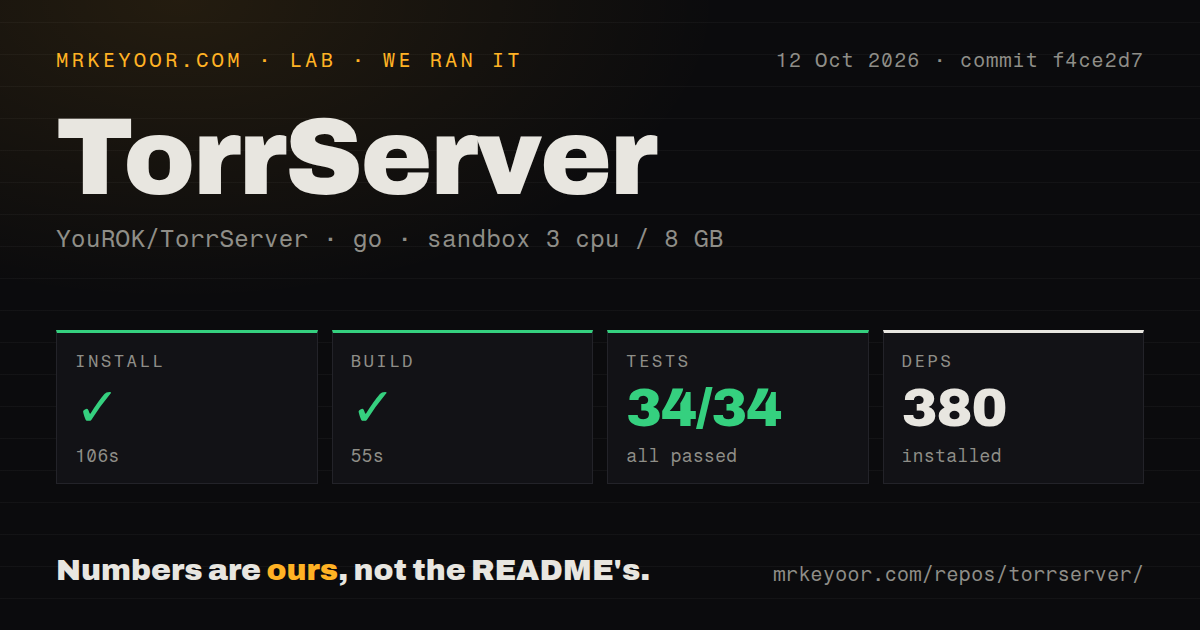
Our sandbox installed commit f4ce2d7 in 106 seconds, adding 380 packages, and built it in 55 seconds. We ran the Go project under ./server/ on October 12, 2026, using golang:1.24-bookworm in an unprivileged Debian container with 3 CPUs and 8 GB of RAM. Installation and compilation both succeeded, so the measured source path cleared those basic requirements in a fresh environment.
The test step succeeded in 31 seconds: all 34 reported tests passed, with 0 failures. Our scan also found 4 CI workflow files, no Dockerfile, and no tests directory. Go checks can exist without a directory named tests, and the successful command is the relevant evidence here. These results don't measure startup buffering, seeking, codec compatibility, or sustained streaming. The lab supplied no playback benchmark, and we can't turn a green suite into one.
Transcoding requires the gst variant and its runtime
The README distinguishes standard binaries from the optional gst variant. A normal executable cannot gain GStreamer routes through a settings toggle. If your player needs HLS output or conversion of unsupported media, choose the matching variant and provide its runtime. Linux and macOS require installed GStreamer libraries and plugins; some Windows distributions carry an embedded runtime.
Our 55-second build result doesn't establish that GStreamer, its codec plugins, or hardware encoding worked in the sandbox. The documentation distinguishes copying compatible media into a different container from transcoding it, which changes the encoded content. It also says bitmap subtitles aren't converted. If your viewing setup depends on those subtitles, that limitation is enough to rule out this route. Check the actual file and player before assuming the extra runtime solves compatibility.
Authentication is optional, and the default bind reaches every interface
The server-argument documentation says an empty bind address listens on all interfaces. Authentication must be enabled, and accs.db supplies the Basic credentials. The Docker Compose example explicitly disables authentication. Those are convenient choices for a controlled home setup, but they require deliberate changes for a shared or remote host. Pick the listening address, enable credentials, and decide which devices may reach the port before handing out stream links.
All 34 tests passing in our run says nothing about the access policy you configure. The README explains that many TVs reject self-signed certificates and provides separate HTTPS and HTTP-media modes. Keeping media on HTTP also sends its URLs and Basic credentials without encryption. That tradeoff is documented, so choose it only for the network you intend to trust.
MCP controls the existing library, including permanent removal
TorrServer exposes /mcp on the web server's port, and its MCP documentation describes tools for adding torrents, returning play links, and selecting the next unwatched episode. It uses the REST API's Basic credentials when authentication is enabled. The remove tool can permanently delete a torrent from memory, the database, and disk cache. Read-only database mode restricts mutating tools, a useful setting when an agent only needs library access.
Our 8 GB sandbox doesn't establish a safe cache allowance for your host, especially if several clients stream together. The MCP episode helper also has a narrower job than a media catalog: it parses filenames and skips files recorded as viewed. It has no series database. If filenames don't encode episodes consistently or watch marks aren't updated, the next-episode request lacks the information you'd expect from a catalog-backed television application.
October maintenance addresses real playback and upgrade behavior
The last push was October 11, 2026. GitHub lists 3,121 stars and 25 open issues and PRs, and MatriX.146.1 shipped on October 12. Its release notes include corrections for concurrent stream-state access and browsers retaining an old web interface after an upgrade. The dates and specific merged work show current maintenance.
The stream-state correction needs careful wording. Pull request 909 fixes races on the request path discussed in issue 845, but explicitly says the author couldn't reproduce that reporter's failure and doesn't claim to fix it. Our 31-second test run can't resolve that playback report either. Anyone depending on reliable seeking should repeat rapid range requests and actual player seeks against the chosen release, including concurrent clients if that's the intended use.
Choose WebTorrent for application code and Transmission for downloads
WebTorrent is the alternative to investigate when streaming belongs inside your own JavaScript application. Transmission fits a conventional download-and-seed workflow. TorrServer earns its place when an existing player needs HTTP delivery and you're willing to configure the server around that device, including formats, access, and cache limits.
The 34 passing tests make TorrServer worth a controlled trial for that job. Use a torrent you have permission to distribute and a player you'll actually keep using. Open it, seek near the end, then repeat with another client connected. If that workflow requires transcoding or HTTPS, repeat it with those features enabled. The decision should rest on the playback path you need, with the measured Go suite as supporting evidence.