Short answer
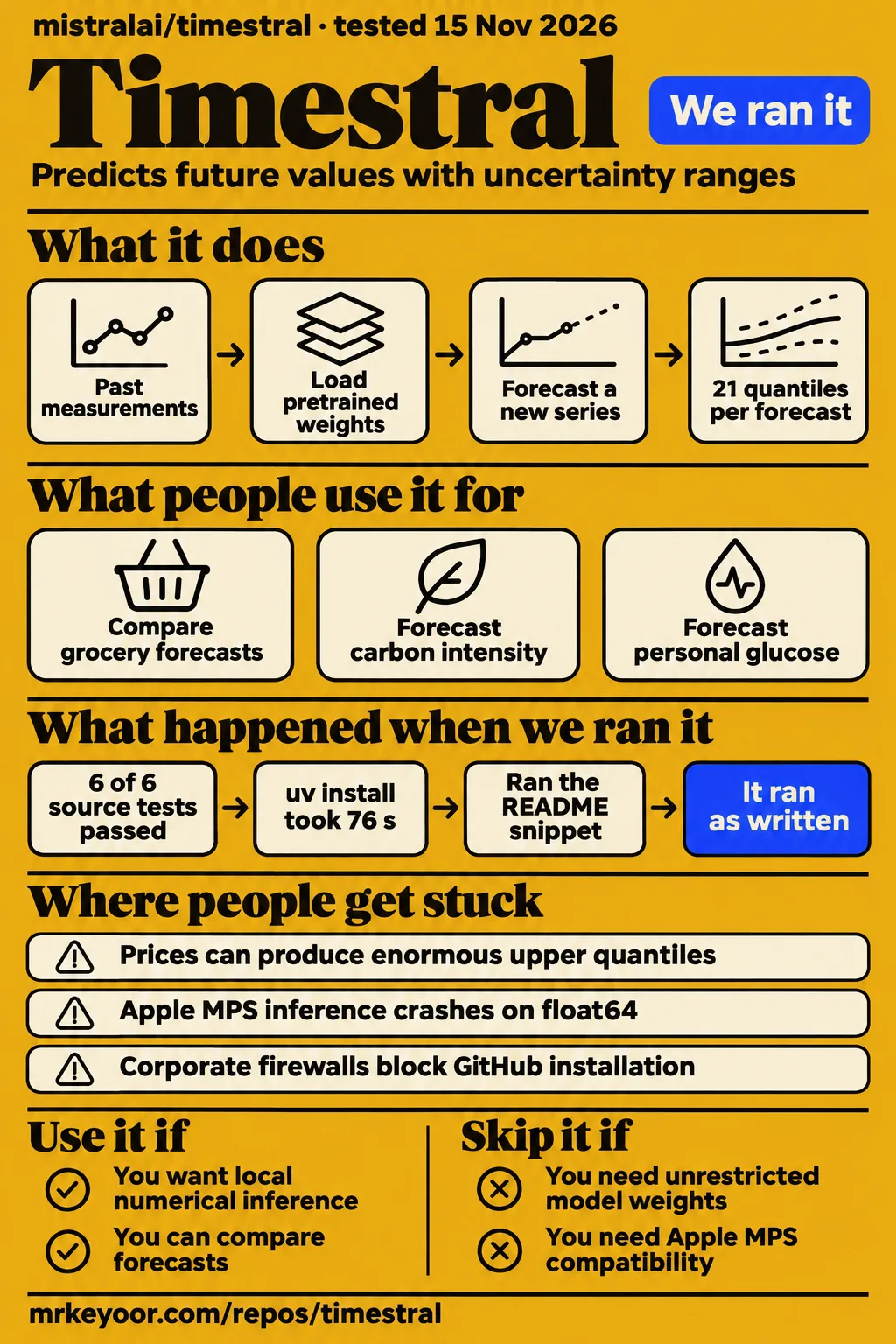
Our Timestral sandbox install succeeded in 55 seconds and all six tests passed, but the installed environment occupied 5,370 MB. Use it if you can compare forecasts against your own baseline and want numerical predictions without training a model from scratch. Skip it if you need unrestricted model weights or intend to turn price-driven upper quantiles straight into purchase orders. The licence and reported covariate failures deserve attention before either decision.
The most useful starting point is Timestral-28M. Superlinear's grocery comparison found only 0.4% more error than 209M at about one fifth of its runtime. That is a reason to start small on a similar workload, rather than assume the largest download earns its keep. Our recommendation is to make the larger model justify itself on the metric your application actually uses. Superlinear's grocery evaluation
What people use timestral for
Timestral already has public experiments in retail, energy and personal glucose forecasting, with outcomes that depend on the dataset and scoring rule. These are attributed reports, not customers whose production systems we inspected.
| Who used it | What they did | What they reported |
|---|---|---|
| alejandroerickson | Built an Apple Silicon explorer with held-out observations and a seasonal-naive comparison | Airline-passenger MAE of 34 versus 71 for seasonal naive at one origin; seasonal naive wins at some other origins. Explorer |
| Superlinear, reported by CEO Davio Larnout | Compared grocery forecasts on Walmart M5 and FreshRetailNet | Timestral-28M made 5.9% less error than ETS on Walmart and 5.5% less on fresh food. Promotion inputs gave Timestral no clear gain. Grocery study |
| Authors of the preregistered Khepri comparison | Forecast carbon intensity across nine Nordic bidding zones | Foundation models beat the baselines on retrospective zone-averaged MAPE; the small post-release holdout could not determine a MAPE advantage. Nordic study |
| Reddit user 0xdeadf1sh | Tested and fine-tuned all four sizes on personal glucose data and Metabonet | XGBoost and a small custom transformer forecast the user's personal data better, while fine-tuned 123M and 209M did best at detecting hypoglycemia. User's account |
The glucose result is particularly useful because it separates predicting a value from detecting a consequential event. A model that loses on overall error can win on detecting lows. The author also reports stronger fine-tuned results on Metabonet than on their own data. Choose the objective before choosing the winner. This is an experiment reported by one user, not evidence for using these forecasts to make treatment decisions. Glucose discussion
Other builders are changing where the model runs. Altertable-ai's DuckDB extension runs forecasts through CPU ONNX Runtime and returns 21 quantiles inside SQL. On X, mudler_it reported a LocalAI team's GGML port and a forecast API at POST /v1/forecast. Those are separate integrations, so their interfaces and supported inputs need their own evaluation. DuckDB extension, LocalAI port announcement
What happened when we ran it
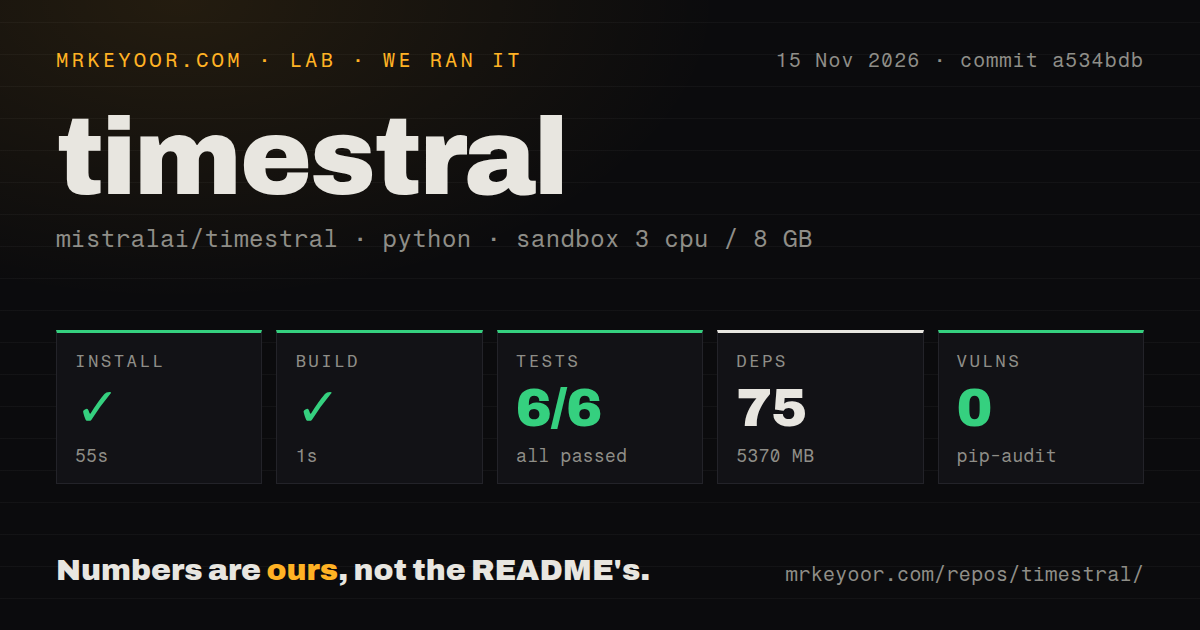
Our November 15, 2026 run at commit a534bdb installed successfully in 55 seconds, built in 1 second and passed six of six pytest tests in 50 seconds. The sandbox configuration recorded 3 CPUs, 8 GB RAM and image label ghcr.io/astral-sh/uv:python3.12-bookworm.
| Recorded check | Result | What it helps you decide |
|---|---|---|
| Installation | Succeeded in 55 seconds; 75 dependencies recorded | The evaluated checkout cleared the setup step. |
| Installed footprint | 5,370 MB on disk | Budget disk space for the environment, beyond the small source checkout. |
| Build | Succeeded in 1 second | The recorded build step completed. |
| Tests | Succeeded in 50 seconds; 6 passed, 0 failed of 6 | The supplied suite passed in this sandbox. |
| Dependency audit | pip-audit: 0 known vulnerabilities | The scan returned no known advisories. |
| Repository scan | 17 files, about 1,824 source lines, 0.5 MB checkout | Reviewing the source is a smaller job than the dependency footprint suggests. |
| Automation signals | 0 CI workflow files; no Dockerfile; tests directory present | The scan found tests but no bundled container recipe or CI workflow. |
A 0.5 MB checkout and a 5,370 MB environment are very different deployment facts. The supplied summary does not identify which packages account for that space. Treat the footprint as a result of this installation route, rather than a minimum for every possible CPU deployment. The recorded container label describes the configured image; actual runtime and operating-system versions require the raw toolchain logs.
A separate quickstart record from the same date used commit a534bdbd244d in a 2-CPU, 4 GB container and ran the README's 12-line Forecast example unedited. It records exit 0 after 84.5 seconds, with two files being fetched and a warning about unauthenticated Hugging Face Hub requests. The example generated predictions from synthetic random-walk inputs. The 84.5 seconds covers the recorded example execution, including the visible fetch activity, rather than warm inference alone. That is a completed example, not a forecast-accuracy result.
The warning matters when reproducing the first call: it asks for HF_TOKEN to raise request limits and speed downloads. The recorded call still exited successfully. Teardown is recorded as successful too. The separate quickstart has different resource limits and conflicting installation metadata, so the setup table above uses the designated build-and-test lab summary throughout.
Where people get stuck: prices, indicators and MPS
Issue #7 reports enormous upper quantiles for low-volume demand when known-future price inputs are supplied, even while the median looks sensible. That failure matters if your application orders stock from an upper percentile: a plausible central line can conceal an unusable tail. The reporter identifies two triggers, so a single switch is an incomplete response. Price-covariate report #7
| Report | What the author says happens | Recorded response and status |
|---|---|---|
| #7, price covariates | Symmetric averaging with a sign-fixed price can produce huge upper quantiles; a price flat throughout context that first changes in the horizon can do so too. | Reporter says masking flat-in-context price rows as NaN removes almost all blow-ups. Disabling symmetric averaging alone leaves the second trigger. Open report, preprocessing workaround. |
| #9, binary indicators | Negated 0/1 covariates become 0/-1 and are normalized as continuous inputs in the mirrored pass. | Reporter proposes recognizing indicators before negation or accepting 0/-1. The record shows a proposed fix, with the issue open. |
| #6, Apple MPS | The scaler converts tensors to float64, which MPS rejects. | CPU execution avoids that backend. A user reports success with paschembri's MPS fork routing statistics through CPU; the upstream issue is open. |
| #5, corporate mirrors | GitHub installation is blocked behind some corporate firewalls and package mirrors. | The sktime integrator reports using a pinned Git URL in CI. An official PyPI package is requested; the issue is open. |
For prices, preserve a regression example where the context is completely flat and the first price change occurs only in the forecast horizon. That is the case the reporter says survives turning symmetric averaging off. Compare the upper quantiles as well as the median before accepting preprocessing as sufficient for your own data. Masking the row also removes information from the forecast, so keep the original input alongside the transformed version for inspection. Two triggers in #7
For Apple hardware, buying a faster GPU does not address a float64 exception. Issue #6 supplies the actual error and a user-tested community route. That distinction matters: a community fork with reported numerical agreement is useful evidence, but it is a different dependency choice from the official repository. MPS report and follow-up
CPU cost rises with the covariates you supply
A user in issue #6 reported CPU runtime increasing from 7 seconds without covariates to 340 seconds with 22 covariates on the same 635-series workload. The context was 822 steps on an M3 Max using 10 CPU threads. This is a community measurement, separate from our sandbox checks and Mistral's small latency example. Workload in #6
| Covariates | Reported CPU runtime | Reported MPS-fork runtime |
|---|---|---|
| None | 7.0 seconds | 3.2 seconds |
| 7 | 118 seconds | 47 seconds |
| 22 | 340 seconds | 146 seconds |
The same user says the fork's predictions match CPU predictions within float32 noise. That makes the fork worth considering for this kind of Mac workload, while the 146-second result also shows that acceleration does not make a covariate-heavy batch instantaneous. Use the series count, history length and driver count together when sizing a job. Parameter count alone leaves out too much. User's parity and timing report
Mistral's official CPU example uses eight threads, three weeks of 15-minute history and a one-day horizon. It reports 17 ms for 5M and 113 ms for 209M, with 28M 3.6 times faster than 209M. Those figures describe that example. They should not become a promised response time for the multi-series, covariate-heavy job above. Official latency context
The code licence does not cover the model weights
Timestral's code is Apache-2.0, while its separately distributed weights use Modified MIT with a monthly-revenue restriction. The weights licence denies its rights when your company's or employer's global consolidated revenue exceeded $20 million in the preceding month. It also applies that restriction to derivatives, modifications and combined works. Repository licence explanation, Weights licence
The employer clause is easy to miss if you are experimenting personally. Issue #3 contains exactly that objection from a user employed by a large company. The licence text offers a route to request a commercial licence from Mistral, at Mistral's discretion. An ONNX conversion or a wrapper with a permissive licence does not remove the model restriction. Resolve eligibility before investing in an integration. User's objection, DuckDB's licence warning
The README documents local model directories, cached weights and offline loading. That is useful for keeping an inference job independent of a hosted forecasting API once the assets are present. Keep code and model revisions with the experiment, and separate the download stage from the job that reads sensitive series. The zero-advisory audit result belongs to the scanned environment; application access controls and data handling still belong to whoever builds the surrounding service. Loading options
Timestral vs TimesFM-3, Chronos-2 and simple baselines
Independent grocery results favor Timestral over ETS on the tested datasets, while the personal glucose report favors other models for overall forecast error. That is enough evidence to compare candidates, not enough to crown one universal forecaster. Keep a seasonal-naive forecast in the comparison even when every other candidate is a foundation model. Grocery comparison, Glucose comparison
| Alternative | Evidence in these records | When we would choose it for comparison |
|---|---|---|
| Seasonal naive | The explorer reports origins where it beats Timestral. Explorer | Always include it as a baseline before accepting model complexity. |
| ETS | Superlinear reports lower error from Timestral-28M on both grocery datasets, using standard classic implementations. Superlinear | Keep it when the current forecasting process uses a fitted statistical model, and measure the actual improvement. |
| TimesFM-3 | Superlinear found no winner everywhere from history alone; planned promotions helped TimesFM-3 more in its fresh-food comparison. Superlinear | Compare it when known promotions are central, with model-licence eligibility settled separately. |
| Chronos-2 | Mistral reports that Timestral-28M beats it on GIFT-Eval and TIME. Mistral | Include it as another foundation-model candidate instead of treating Mistral's benchmark as a result on your data. |
| XGBoost or a small custom transformer | The glucose author reports better personal-data forecasting from these alternatives, with a different winner for detecting lows. Reddit experiment | Favor the model that wins your chosen objective within the device's resource budget. |
Superlinear's comparison uses Walmart food sales and Chinese fresh-food store data, rather than every retailer's planning workload. Its authors explicitly distinguish standard statistical implementations from commercial planning systems. The useful decision is whether a model improves your existing forecast and downstream decision, such as stock availability or waste. Replacing a forecast engine and replacing a planning system are different purchases. Scope of the grocery comparison
What the other reviews get wrong
The Timestral technical report is available, so reviews that still describe it as unpublished are stale on that point. Eden AI and Heshamsaad's supplied pages contain that launch-era statement. The report itself describes the architecture, training approach and benchmark results. Read it alongside the open questions about training provenance, rather than treating either a missing-paper claim or an aggregate leaderboard as the entire evidence base. Technical report, Eden AI's supplied review, Heshamsaad's supplied review
StackScout dates the announcement to October 19, 2026. Mistral's announcement is dated October 15, 2026. Heshamsaad's latency figures also differ from the supplied official example: use the official 17 ms, 113 ms and 3.6-times relationship, together with its hardware and workload, rather than the review's 10 ms, 140 ms and five-times figures. These are corrections to reported benchmarks, not additional measurements by us. StackScout, Heshamsaad, Official announcement
Smaller parameter counts do not establish a deployment-cost advantage over Chronos-2. The covariate-heavy workload in #6 is a concrete reason to demand a matched workload before making that claim. And the Reddit reply calling Timestral a forecast text model is wrong: its documented output is numerical quantile arrays. The timestral.org pages in the supplied search records contain Frickbears game material and provide no support for forecasting claims. Runtime report, Numerical interface, Unrelated domain content
Questions people ask
The Timestral model family forecasts numerical time series in four sizes: 5M, 28M, 123M and 209M parameters. Its documented interface returns 21 quantiles per forecast step and accepts past-only and known-future covariates. Official repository
How does Timestral differ from linear regression or ARIMA?
Timestral uses pretrained weights to forecast a new series from its supplied history, while Mistral describes classical ARIMA and linear regression as usually fitted to each series. Zero-shot forecasting removes that per-dataset training step. You still need history, a sensible forecast horizon and an evaluation against observations. No target-specific training is different from having no input data. Mistral's explanation
How does Timestral compare with TimesFM-3 and Chronos-2?
Superlinear found no model won everywhere against TimesFM-3 on grocery history alone, and promotions helped TimesFM-3 more in that test. Mistral reports Timestral-28M ahead of Chronos-2 on GIFT-Eval and TIME. Those statements have different authors and evaluation settings, so neither supplies the missing result on your own series. Use the comparison table to choose candidates. Superlinear, Mistral
How do I install and run Timestral locally?
The README documents pip install git+https://github.com/mistralai/timestral.git, requiring Python 3.10 or newer and PyTorch 2.4 or newer. Load a Hub checkpoint with TimestralForecaster.from_pretrained, then call forecast(context, prediction_length=...). Context can be a NumPy array or torch tensor. Use revision to pin model weights as well as pinning the code you evaluate. README instructions
Machine Learning and AI Tutorials' setup video shows a noisy sinusoidal signal and a forecast extending 96 steps from point 1000, with the result displayed as an orange line. It is a useful visual explanation of the task. That controlled demonstration has a different purpose from the retail and carbon-intensity comparisons above. Local setup video
Do I need a GPU to run Timestral?
No. The official repository supports CPU inference, and the official announcement includes CPU latency measurements. Apple GPU acceleration through MPS has its own compatibility report, covered in the fix map. For a real deployment, measure the intended batch with its covariates rather than buying hardware from a model-size label. Official repository, MPS report
Which Timestral model size should I start with?
Start with 28M for a grocery-like evaluation: Superlinear reports only 0.4% more error than 209M at about one fifth of the runtime. Include 5M if resources dominate the decision and compare larger sizes if they improve your chosen metric. That recommendation follows one workload comparison, rather than a rule that 28M wins on every dataset. Model-size comparison
Can I use Timestral commercially, including when my employer exceeds the revenue threshold?
The weights licence permits use subject to its conditions, but denies rights when your company or employer exceeded $20 million in global consolidated monthly revenue in the preceding month. The text directs affected users to request a commercial licence from Mistral. A personal project does not erase the employer clause. Exact weights licence
What exactly is modified in the Timestral weights licence?
The revenue restriction is added to the weights' permission terms and extends to derivatives, modifications and combined works. The licence also requires retaining the attribution and permission notice. The repository's Apache-2.0 code licence is separate. Read the weights text itself before deciding whether a converted checkpoint or an integration can be used under your organisation's circumstances. Weights terms, Code distinction
What real datasets and training cutoff dates were used?
Mistral describes synthetic pretraining followed by post-training on a mix of real and synthetic data. Issue #3 asks for the real datasets and per-dataset end dates, with no substantive answer in the supplied thread. The technical report's existence corrects stale reviews, but a release announcement is not a substitute for the specific provenance needed for a historical evaluation. Technical report, Provenance request
Were NYC emergency-call series or benchmark test windows included in training?
The supplied issue #3 leaves those specific questions unanswered. Its author wants to score NYC emergency-dispatch forecasts only after training ends and asks whether GIFT-Eval, fev-bench and TIME test windows were excluded. This is a request for disclosure, not evidence that those series were included. Keep that distinction when describing historical zero-shot results. Questions in #3
Can the listed Papers with Code scores and benchmark protocols be verified?
Issue #2 records Niels from Hugging Face asking the team to check the listed scores, model names, benchmark protocol and openness metadata. The supplied discussion contains the listing and request, rather than a completed confirmation from the Timestral team. Treat the leaderboard listing as a reported result and the underlying reproducible evaluation as a separate piece of evidence. Leaderboard request #2
When will Timestral be available on PyPI for corporate mirrors and library integrations?
The supplied issue #5 gives no release date. Its author describes corporate mirror restrictions, and the sktime integrator says CI currently relies on a pinned Git URL because the package is not on PyPI. If your environment forbids that route, settle the approved packaging path before choosing Timestral for the project. PyPI request and integration discussion
How can I run Timestral on Apple Silicon MPS without the float64 crash?
CPU inference is the documented fallback; issue #6 also reports success with paschembri's community MPS-support fork, which moves float64 statistics through CPU. The reporter supplies prediction-parity and workload timings, while the official issue remains open. Choosing the fork means evaluating that fork's code and revision alongside the upstream model. MPS follow-up
What we have not tested yet
Our six passing tests and completed synthetic quickstart do not measure forecast accuracy, interval calibration, sustained throughput or production reliability. We have not reproduced the grocery, Nordic or glucose comparisons, the price and indicator failures, or the community MPS fork. We did not test GPU inference, the browser ports, DuckDB or LocalAI integration, offline operation or sensitive-data handling.
Interval coverage is an immediate follow-up. The explorer reports that its 10-90% interval often covers less than 80% on short horizons; Superlinear says fresh-food ranges are too narrow for setting safety stock directly. A commenter on the glucose experiment asks about coverage without receiving an answer in the supplied record. Score the intervals at rolling origins before assigning an operational meaning to q90 or q99. Explorer's coverage note, Grocery coverage, Glucose coverage question
The Nordic paper's retrospective advantage comes with unresolved contamination concerns, and its 14 post-release origins were insufficient to determine the MAPE advantage. The X post claiming up to 93% accuracy for hotel-price prediction omits a metric definition and evaluation protocol. Neither supplies a broad deployment guarantee. Nordic holdout, Hotel-price claim
The quickstart's installation metadata conflicts with the designated harness summary and even labels the installed package as git. We retain its example exit status and warning, while using only the designated lab block for installation, build, tests, dependencies and audit results. Raw toolchain logs are needed for actual runtime versions, and a zero-advisory scan does not cover application security. The next useful experiment is a rolling backtest of your own series against seasonal naive and the existing forecasting method, with upper-tail errors visible beside the median.