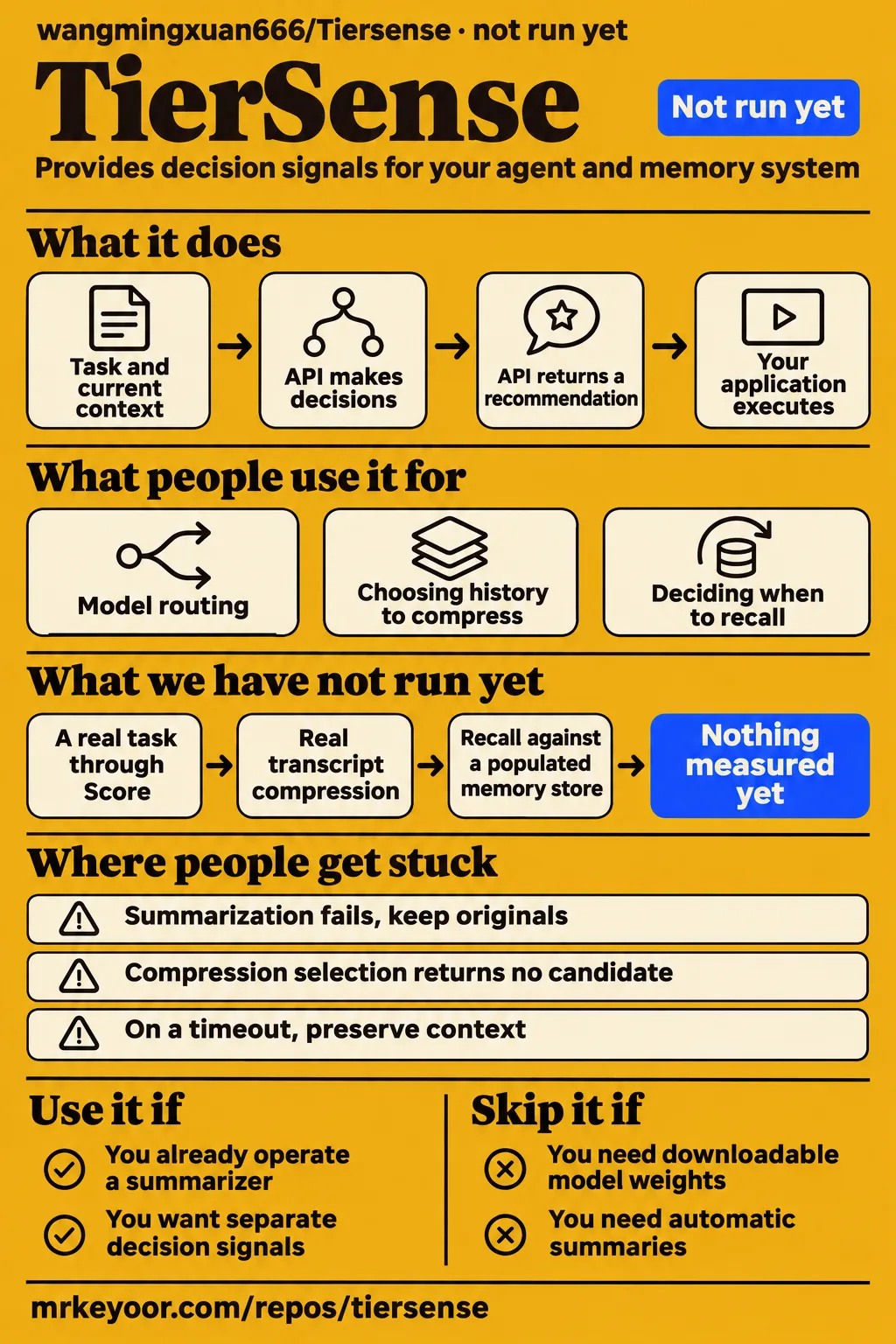
TierSense leaves summarization and retrieval to your application. Use it if you already own an agent loop and want to evaluate separate signals for difficulty, compression selection, or memory timing. Skip it if you need downloadable model weights or a complete self-hosted memory service. The README explicitly excludes model weights, production configuration, and self-hosted inference server code.
Our sandbox attempt produced no running TierSense service. That makes this a review of the documented integration contract and its practical consequences, with a stopped lab attempt reported below. The useful distinction is how much work remains yours after the API returns a recommendation.
What people use TierSense for
The authors describe independent modules for difficulty scoring, choosing history to compress, and deciding when to compress or recall. These are documented application uses, attributed to the project README, rather than customer deployments.
| Documented use | What the authors say TierSense returns | What your application does |
|---|---|---|
| Difficulty display or model routing | Five feature scores and an overall score | Displays the result or maps scores to models |
| History compression selection | Per-step recommendations and span selection | Generates a summary and replaces selected history |
| Memory timing | Compression and recall decisions with confidence values | Checks available history and memories, then executes the chosen operation |
Score is the most contained starting point if your immediate question is whether to expose a difficulty signal. The README tells you to define your own score-to-model mapping. A score therefore gives your routing policy another input; it does not choose or switch the model for you. For an existing agent, that distinction keeps the first experiment small: record the signal alongside the routing decisions you already make before giving it control.
Compress addresses a different problem: selecting portions of a growing conversation for summarization. The application still supplies the summarizer. Memory-Decide sits earlier in the decision, asking whether compression or recall makes sense now. Its answer does not identify individual historical steps. Pick the module for the missing decision in your system instead of treating the product names as a required sequence.
The integration guide explicitly says the modules are not a mandatory pipeline. That is useful advice for anyone trying to avoid adding a remote call merely because an endpoint exists. A team with a memory store but no timing policy has a different need from a team that already knows when to summarize and only needs candidate selection.
What happened when we ran it
We did not run TierSense: our November 13, 2026 sandbox record at commit 3a7f36b says no supported ecosystem was detected, language was null, and there was no Dockerfile. The recorded configuration allocated 3 CPUs and 8 GB of RAM, with image listed as n/a. Those are sandbox settings, not TierSense hardware requirements.
| Recorded check | Result | What a reader can conclude |
|---|---|---|
| Repository execution | NOT RUN: no supported ecosystem; language null; no Dockerfile | The harness did not execute the project |
| Compose safety step | FAILED: none of compose.yaml, compose.yml, docker-compose.yaml, docker-compose.yml exists | This runner required a Compose file before startup |
| Teardown | ok | The cleanup record reports success |
The safety-step record labels the repository “unsafe” because a Compose file is required by that runner. That label describes its admission rule. It is not a security finding about TierSense, and adding an arbitrary Compose file would not supply the inference server that the README excludes.
There is a conflict inside the lab paperwork. The generic run description says “deployed with its own docker compose”, while the step log says the required Compose file was absent. The supplied NOT RUN measurement and the specific failed step take precedence over that generic description. The teardown record says “ok”; cleanup does not turn the stopped attempt into a deployment.
The concrete result is a mismatch between a local execution harness and a repository whose README directs users to hosted APIs. A failed admission check gives us no reason to call the API broken. It also gives us no working installation to recommend. The documented route starts with platform access, rather than a service brought up from this checkout.
Where people get stuck: a recommendation still needs an executor
The integration guide assigns the main agent, summarizer, and memory store to your application. That is the central adoption cost: you are connecting a decision service to machinery you already operate. The guide's responsibility list is more useful for estimating this work than the short request examples.
| Integration situation documented upstream | Required handling | Why it matters |
|---|---|---|
| Tool results are still arriving | Wait for all results and preserve call/result pairing | The decision should use a complete context snapshot |
| Compression is recommended, but selection returns no candidate | Preserve history | A timing signal does not guarantee an executable selection |
| Summarization fails | Keep originals and commit replacement only after success | A recommendation alone cannot justify deleting history |
| Compression and recall are both positive | Choose ordering and deduplicate recalled content | Your application coordinates both operations |
These are upstream instructions, not problems reported by users in issue threads. They nevertheless describe real implementation branches. If your agent handles parallel tool calls, the integration point needs to come after their results arrive and before the next main-model request. Taking a snapshot in the middle would violate the documented pairing requirement.
The Memory-Decide guide also distinguishes a failed request from a negative decision. On a timeout or server error, it tells the application to preserve context and record the failure. Returning a fabricated false would hide the difference between “the model advised against recall” and “the service never answered”. Keep that difference visible in your own logs and behavior.
Compression indices belong to the history you submitted
Compress returns zero-based message positions alongside one-based historical step numbers. The compression guide defines them separately, which matters when application code replaces a selected span with a summary. A step number is not a message-array index.
An assistant message and its associated tool results form one step under this contract. User, system, and developer messages do not count as steps. Consequently, selecting a historical step can cover several messages, and replacing only the assistant's text would leave a different history from the one the service assessed. Use the returned message positions against the submitted snapshot and keep the tool call and result together.
The guide distinguishes per-step recommendations from executable spans as well. Omitting options requests recommendations; supplying an empty options object enables the default execution policy. When execution spans are returned, the guide says to process the spans whose trigger flag is true. That distinction deserves an explicit branch in the integration, rather than a single condition that treats every positive recommendation as permission to rewrite context.
After replacement, subsequent requests use the updated visible history. The guide's before-and-after example states that old covered-step values are provenance, not indices for later replacements. For someone maintaining an agent transcript, that is an especially useful detail: keep the record of what a summary covers separate from the positions used to edit the next request.
Confidence supports a decision, not a guaranteed outcome
Memory-Decide's confidence value supports its accompanying predicted decision. Its response documentation explicitly says confidence is not a calibrated correctness probability. Read the boolean and confidence together.
For example, the documentation explains that a false prediction with high confidence supports leaving the operation undone. Treating confidence alone as an instruction to compress would reverse that meaning. It is also a mistake to read a positive recall recommendation as evidence that useful content has already been found: retrieval happens in your application, after the service's decision.
This changes how I would assess the product. The first useful comparison is whether its decisions improve your agent's handling of representative tasks while preserving facts and tool history. Logging attractive confidence values is insufficient. The integration guide itself disclaims guaranteed quality or cost improvement, so any claim of savings needs a workload comparison rather than an interpretation of the response fields.
Hosted context calls need a deliberate data boundary
The documented Memory-Decide request includes the original task and the agent's current context, sent to a tierflow.cn endpoint with a bearer key. The server-side example tells developers to keep that key out of browser code.
For a team handling private repositories or customer conversations, that request shape is a deployment decision. Decide which task text and completed tool outputs are allowed to leave the application before wiring a context hook into every turn. The README's exclusion of self-hosted inference code makes a local checkout an unsuitable answer to that concern.
The guide's failure policy offers a sensible integration baseline: keep the existing context when execution fails, record the error, and preserve paired tool messages. Follow that policy in the caller. It is application behavior you can inspect, whereas the service's recommendation only becomes useful once the caller acts on it correctly.
English documentation covers the integration path
The repository provides an English README and English module and integration guides, alongside Simplified Chinese links. English readers can follow the module responsibilities, request fields, response interpretation, and failure handling in the documentation linked from the README.
The names Score, Compress, and Memory-Decide are close enough to invite assumptions about shared behavior. Read each module's contract in English before combining them. The integration guide specifically warns against transferring confidence semantics or execution options between endpoints. Shared branding does not make their request fields or outputs interchangeable.
TierSense vs Mem0 and Letta Code
Mem0 supplies a memory layer, while Letta Code supplies a stateful agent harness; TierSense documents decision signals for an application that keeps those responsibilities. Choose according to which component you need to own, using the projects' own descriptions rather than a supposed performance ranking.
| Project | Documented role | Choose it when |
|---|---|---|
| TierSense | Difficulty, compression-selection, and memory-timing signals | You want to keep your agent, summarizer, and memory store and evaluate an additional decision service |
| Mem0 | A memory layer for AI assistants and agents | You need memory storage and search behavior in the application rather than timing advice alone |
| Letta Code | A stateful agent harness | You want to evaluate an agent runtime with memory rather than integrate a standalone signal into your existing runtime |
Mem0's README includes a usage example that searches memories before generating a reply and adds conversation messages afterward. That is a different level of responsibility from TierSense returning a recall decision. Letta Code describes agents that rewrite their own memory and context. Moving to that harness is a broader architectural choice than inserting a request before your current model call.
These are comparisons of documented scope. There is no basis here for declaring one faster or cheaper. They also need not be mutually exclusive choices: TierSense's integration guide says the memory store belongs to the application. Whether another memory component is a suitable partner depends on the interface you build around it.
What the other reviews get wrong
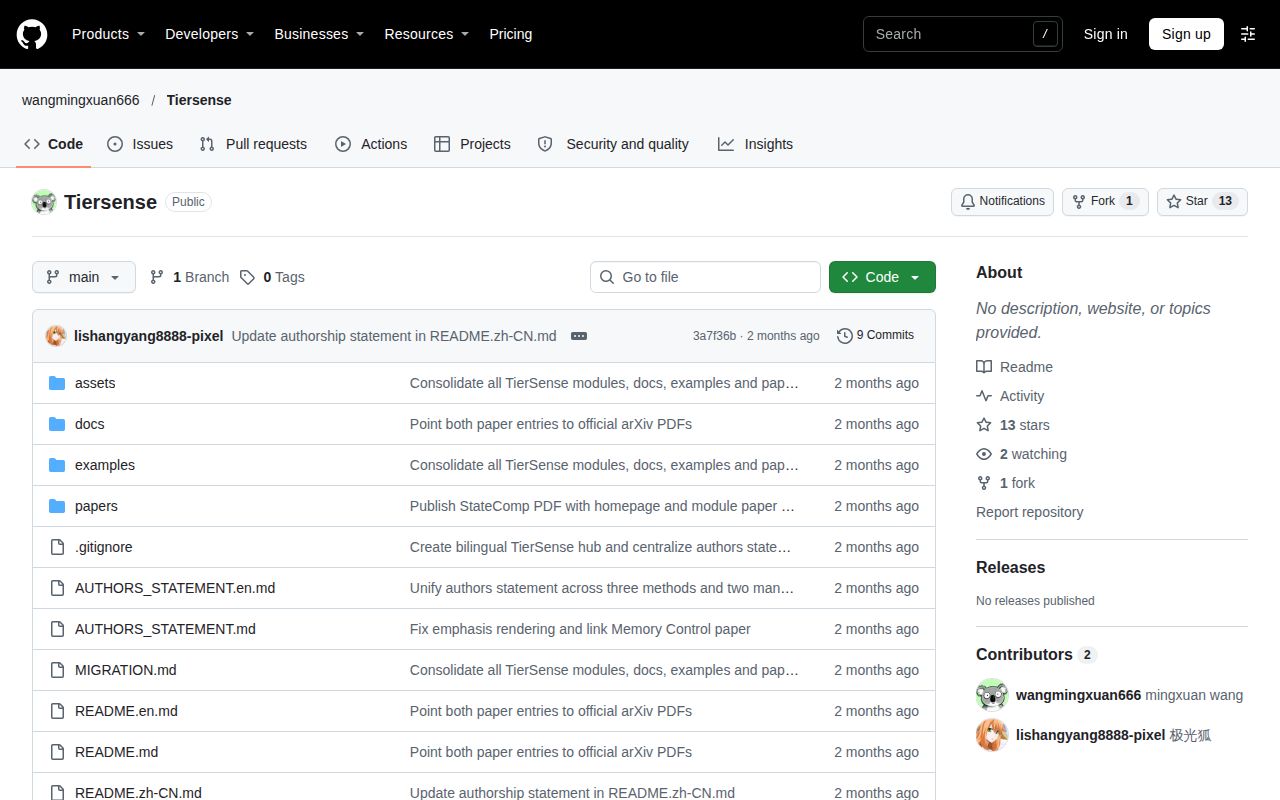
The repository catalog omits a project description, but the live README explains TierSense's agent APIs. The catalog listing therefore gives an incomplete account of what you can evaluate. Its blank description should not become a claim that the project has no documentation.
The name also leads to unrelated products. tiersense.com describes economic and logistics shock modeling. The Modrinth TierSense listing describes server-side PvP rating for Paper. Their descriptions do not supply features or installation instructions for wangmingxuan666/Tiersense. The repository's own entry point directs readers to tierflow.cn for its API.
The catalog's star count measures attention to a GitHub repository, not how well a memory decision works. For an adoption decision, prefer the explicit responsibility split in the README over the surrounding search results. A name match cannot substitute for checking the owner and the linked service.
Questions people ask
TierSense requires a platform API key for the hosted endpoints documented in its README. The practical starting point is choosing one module and implementing its request contract, rather than installing a complete memory server from this repository.
How do I get started with TierSense?
Get a key from the TierSense platform and choose Score, Compress, or Memory-Decide. The README lists their separate POST endpoints and links minimal examples. Use the module matching your requirement; the integration guide says all three calls are optional rather than mandatory on every round.
Can I self-host TierSense from this repository?
The README says model weights, production configuration, and self-hosted inference server code are not included. Treat this checkout as the documented integration entry point. A requirement to operate the inference service yourself is a reason to choose a different route.
Does TierSense generate summaries or retrieve memories?
Your application does both. The Memory-Decide guide says the API makes decisions without generating summaries, retrieving content, or modifying context. Compress supplies history-selection recommendations; your summarizer and replacement logic still have to execute them.
What we have not tested yet
The stopped sandbox attempt leaves API availability, recommendation quality, latency, billing, and operating reliability untested. We have not sent a real task through Score, compressed a real transcript, or exercised recall against a populated memory store. There are no response-quality results or workload timings to report from this attempt.
The research pack contains no attributable deployment account for this repository: its YouTube records have empty extracts, its X search returns no posts, and its Bilibili results concern other subjects. None can support a story about someone successfully using these APIs. Nor do the supplied records establish a license grant, support responsiveness, or production adoption. Our score cards leave those assessment gaps visible instead of assigning low numbers for missing evidence.
Before using the service with sensitive context, obtain and assess its applicable data-handling terms. This review has not inspected retention behavior or network traffic. We have also made no maintenance-health judgment from a catalog's relative age or a missing release tag, and performed no side-by-side evaluation of Mem0 or Letta Code.
The next useful result would come from an authorized API evaluation using representative agent histories, comparing retained facts and completed tasks with your current policy. Until then, the README gives a clear architectural answer: you supply the working agent and memory system, and TierSense supplies recommendations.