Four packages extend go test without replacing it
Testify adds assert, require, mock, and suite to Go's standard testing model. Test functions still receive *testing.T, the normal toolchain still discovers them, and go test remains the command developers run. That matters because adopting one useful helper does not force a codebase into a new runner or file layout. A team can begin with equality and error checks, then ignore the rest of the project.
The repository itself is modest. Our checked-out commit contained 91 files and about 29,854 lines of source in 0.9 MB. There was no top-level tests directory, because tests live beside the Go packages in the usual style. The 2 CI workflow files show automation is present, while the absence of a Dockerfile makes sense for a library consumed through Go modules.
assert continues after failure, while require stops the test
The distinction between the two assertion packages affects test behavior. assert.Equal records a failure and returns a boolean, which is useful when several independent properties should be checked in one run. require.NoError calls the equivalent of FailNow, so setup or parsing failures stop the current test before later checks produce noise. The names are similar, but swapping one for the other can change how much code runs after a failure.
Our 32-second test run passed all 8 reported tests, with 0 failures. That result covers the checked-out commit in the stated sandbox, not every downstream assertion combination. The README helps with the most important misuse: require must be called from the goroutine running the test or benchmark. Worker goroutines should return their result to that goroutine instead of making a fatal requirement themselves.
What happened when we ran it
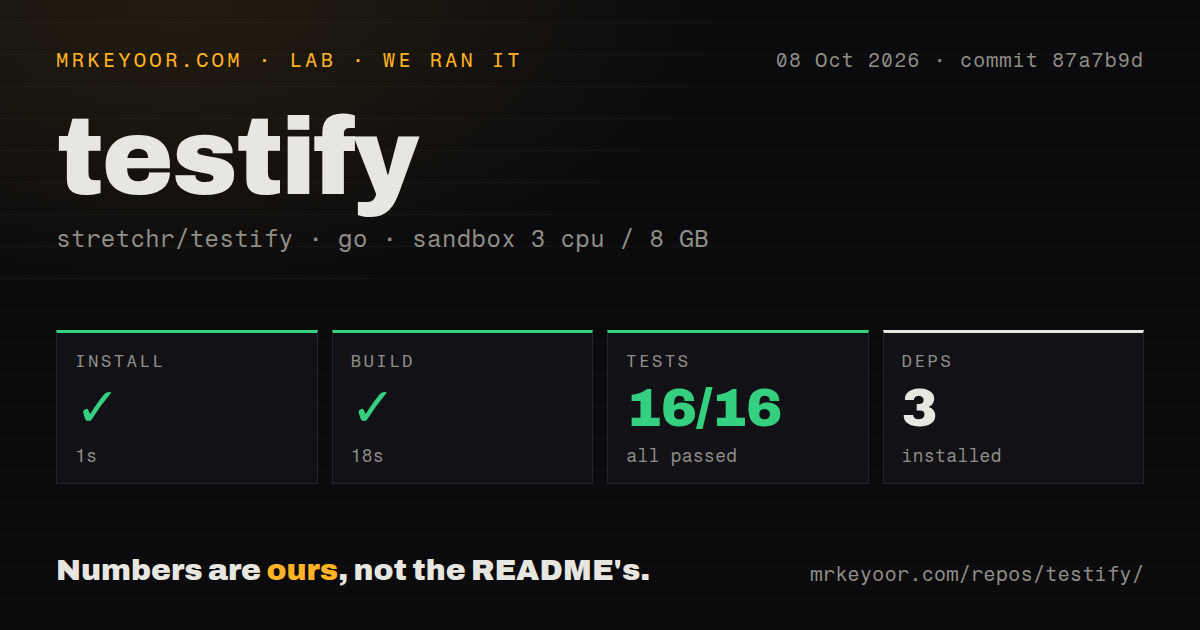
Our sandbox installed 3 packages in 6 seconds, then built Testify successfully in 21 seconds. The test step succeeded in 32 seconds, reporting 8 passed and 0 failed out of 8. Nothing in those three steps required credentials, a database, or an external service. For a Go library that stays inside the standard runner, the measured setup matched the README's simple go get pitch.
The run used commit c627960 inside an unprivileged Debian container with 3 CPUs and 8 GB of RAM. The checkout had 91 files, roughly 29,854 source lines, and no Dockerfile or separate tests directory. Those facts describe repository mechanics, not the speed of applications tested with Testify. We did not run a benchmark, and the lab result gives no basis for a performance claim.
Mocking works best at narrow interfaces
The mock package records expected calls and configured return values. Its README example embeds mock.Mock, then writes an adapter method that calls m.Called and converts the returned values. This is approachable for a small dependency boundary. It also means method adapters and runtime expectation wiring remain part of the test code unless a team brings in the separate Mockery generator mentioned by the project.
With only 3 packages installed in our run, trying Testify's mock package does not bring a large setup burden. The design cost can still exceed the installation cost. A mock that specifies an exact internal call sequence may fail after a harmless refactor. Hand-written fakes are often clearer when they model reusable state, while GoMock is a stronger choice when generated interface coverage is a team requirement.
The suite package does not support parallel tests
Testify's README carries a direct warning that suite does not support parallel tests. Issue 934 describes teardown running while parallel subtests are still active, which can make shared fixtures unsafe. Developers who rely on t.Parallel() should use ordinary subtests, t.Cleanup, and explicit fixtures rather than assuming suite lifecycle hooks will wait correctly.
The limitation did not cause a failure in our 8-test, 32-second run, so it should not be presented as a lab failure. It is a documented design boundary for downstream users. Suites can still help integration tests that need shared setup and do not run cases concurrently, but their mutable struct state can hide coupling that plain table-driven tests make easier to see.
V1 is maintained and intentionally frozen
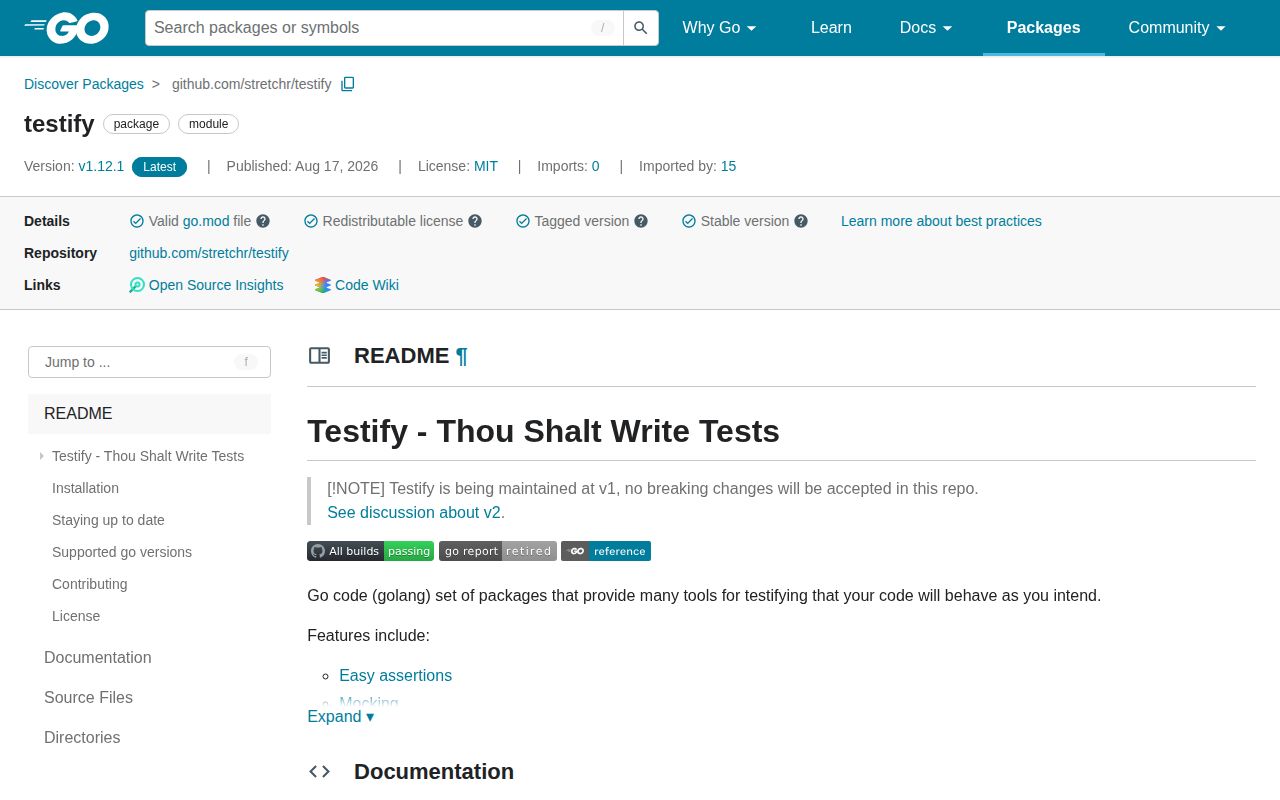
The maintainers say Testify will stay at v1 and will not accept breaking changes in this repository. That gives existing users a stable contract, though old API choices cannot be cleaned up through an ordinary minor release. The README points interested users to a separate v2 discussion rather than promising that work inside the current module. Buyers should choose the API that exists now.
GitHub showed a push on August 24, 2026, five days after release v1.12.1. It also listed 26,183 stars and 365 open issues and pull requests. Recent activity included a bug report about mock.Anything and pull requests touching assertions, mocking, and CI. The combined open count is not a defect count; paired with the recent push and release, it shows a busy mature project rather than an abandoned one.
Adopt assertions first and justify the rest
The measured path was uneventful: 6 seconds to install, 21 seconds to build, and 32 seconds for all 8 tests to pass. That makes assert and require low-risk additions when clearer failures will help reviewers and maintainers. Enable testifylint, which the README recommends, so common argument-order and assertion mistakes are caught consistently.
Treat the other packages as separate decisions. Use a mock when the interaction itself is the contract, and prefer a fake when stateful behavior matters more than call recording. Choose a suite only when its fixture hooks solve a specific problem and parallel execution is unnecessary. Testify is at its best as a small layer over idiomatic Go tests, not as a reason to rebuild every test around a framework.