A Taskfile gives every platform the same command front door
Task replaces loose setup notes and shell scripts with named commands in Taskfile.yml. Each task can have variables, dependencies, commands, working directories, and platform conditions. Contributors run task build or task test instead of finding the right script for their shell. Task parses sh-like syntax with a Go library, so the same file can work on Windows and Unix systems. External programs still have to exist on PATH.
Our commit 871da16 checkout occupied 2.5 MB and contained 981 files, with about 31,169 lines of source. There was no Dockerfile, which is reasonable for a single Go executable distributed through package managers and release binaries. Installation choices include Homebrew, apt, npm, WinGet, a download script, and go tool for Go modules. That breadth makes adoption easier than asking every platform to interpret the same homegrown script.
Dependencies run together unless the Taskfile spells out an order
A dependency list is concurrent by default. If build depends on lint and test, Task starts both and waits before building. Ordered work belongs in the command list as explicit task calls. You can cap concurrency, cancel sibling work after a failure, and choose prefixed or grouped output when parallel logs become unreadable. A developer who assumes YAML list order means execution order can get a surprise on the first nontrivial Taskfile.
Our 3-CPU sandbox is a fair setting for catching basic concurrency and portability problems, though it was not a performance benchmark. The repository had 7 CI workflow files, and its Go tests completed successfully in the container. A shared setup task can use run: once, while run: when_changed separates repeated calls by their variables. Cleanup commands can be deferred so a started service is stopped after a later command fails. The execution model is documented with concrete examples.
What happened when we ran it
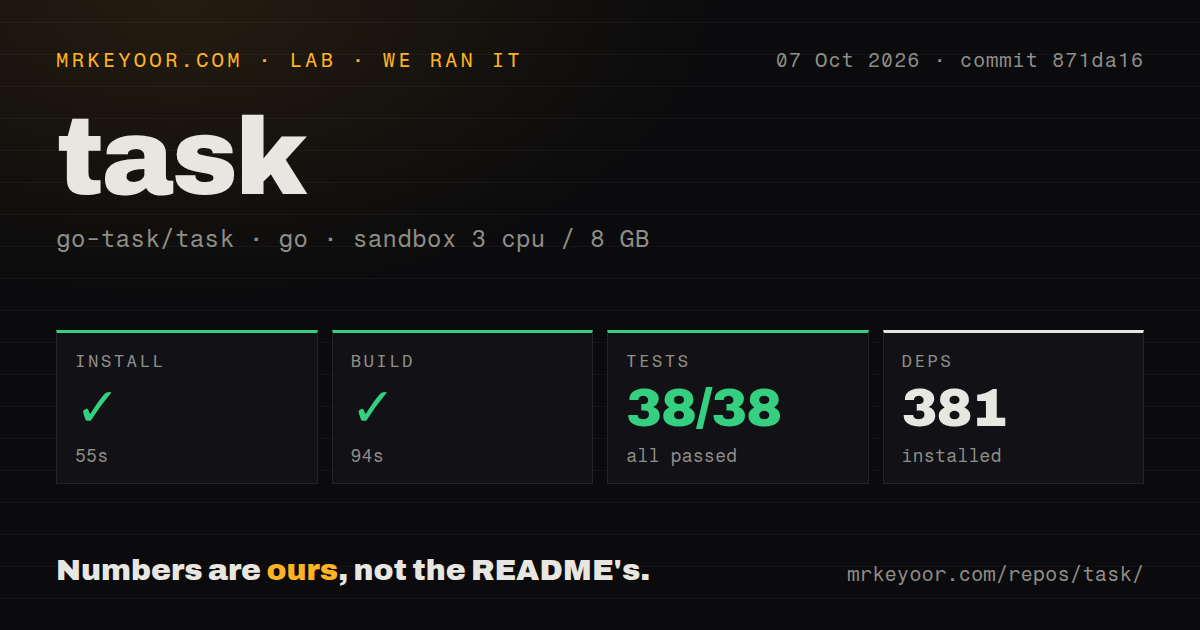
Our run installed commit 871da16 in 55 seconds and added 381 packages. Building from source succeeded in 94 seconds. The measurement setup was a fresh unprivileged Debian container with 3 CPUs, 8 GB of RAM, Go 1.24, and no secrets. Those results cover installation and compilation. We did not time individual Taskfile recipes or compare Task against another runner.
The test step finished in 40 seconds. Go reported 38 passed test groups out of 38 and 0 failures. The repository has no top-level tests directory, so that signal alone would have been easy to misread, but the command found and ran the Go package tests successfully. Nothing in the supplied run showed a missing system package, compilation error, or test failure. This is the clean outcome you want from infrastructure that sits in front of every other project command.
File fingerprints skip work only when inputs are declared correctly
Task can avoid repeating work through source fingerprints, generated-file checks, or status commands. The default checksum method notices content changes, while timestamp mode compares modification times. A task can also watch its sources and rerun when they change. This is more build-aware than a plain recipe launcher. The Taskfile author must list every source, lockfile, configuration file, and generated result that affects the output.
The 31,169-line codebase cannot protect a project from an incomplete input declaration. If a source is missing from sources, Task may call an old result current. If a status command has side effects or runs slowly, repeated checks will be painful. Fingerprints live under .task/ by default and can be moved with TASK_TEMP_DIR. Teams should review these declarations like build code, especially when a task label or variable changes the output path. A skip is only as accurate as the files and conditions behind it.
Remote Taskfiles are executable code and need a fixed reference
Task can include shared files over HTTPS or Git, including private sources reached with headers or SSH credentials. It asks for trust on first use and again when an automatically stored checksum changes. A pinned SHA-256 checksum turns a mismatch into an error. That is the safer CI pattern. The --yes and trusted-host options remove interactive prompts, but they also make the chosen source and reference part of your supply-chain policy. A branch name can change underneath you.
Release v3.54.0 shipped on October 1, 2026, and fixed remote Git Taskfile cache poisoning on shared hosts. It also added per-host HTTP headers so a credential does not have to sit in an include URL. That is a concrete reason to stay current and pin reviewed content. Our run followed six days later at commit 871da16 and still passed all 38 test groups. Remote includes are useful for a company-wide command set, but local Taskfiles are simpler when reuse does not justify another executable-code source.
Current maintenance supports adoption, while YAML sets the ceiling
GitHub showed 16,228 stars, 128 open issues, and 71 open pull requests when checked on October 8, 2026. The last push was also October 8, one week after v3.54.0. Recent work covered watch behavior, repeated dependencies, completions, documentation, and dependency updates. The combined repository counter was 199 issues and pull requests, so it should not be read as 199 defects. Both release cadence and current discussion show a maintained project.
Task fits a repository that needs a portable command index plus enough build behavior to skip unchanged work. The 55-second install, 94-second build, and 40-second green test run leave little repository risk to explain away. Complexity is the stopping point: once templates, dynamic variables, and nested includes resemble an application, move that logic into code and let Task call it. A Taskfile should remain the door to the machinery, not become the machinery.