mrkeyoor.com_
Mon 17 Aug 15:13 UTC
Self-Hostedevaluationupdated 17 Aug 2026

talos

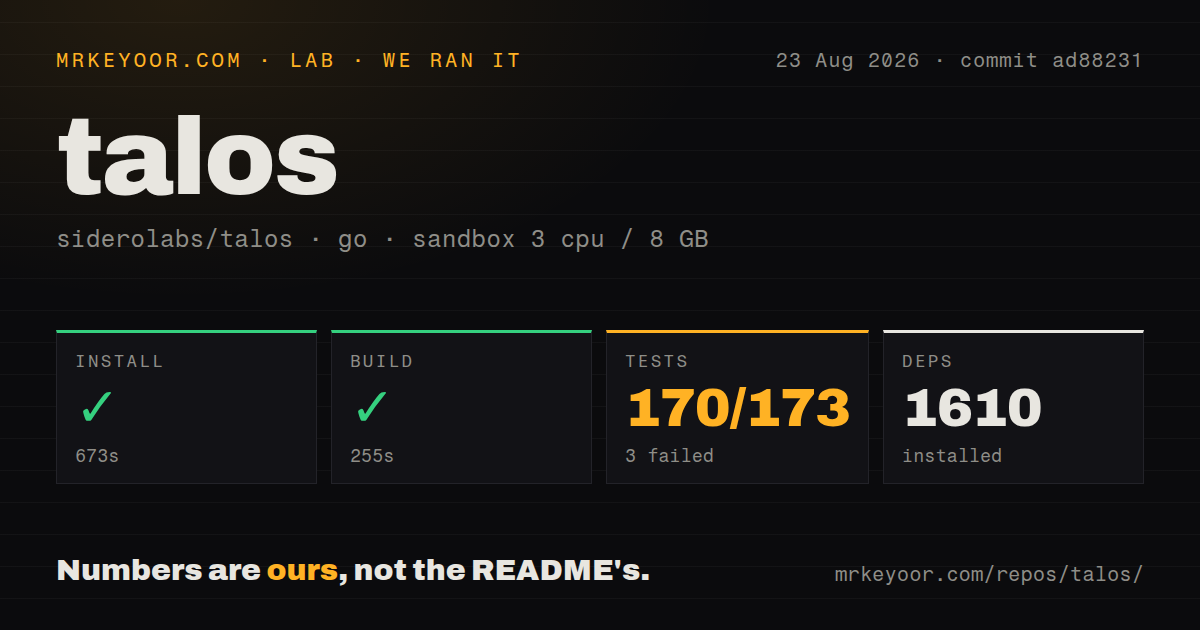
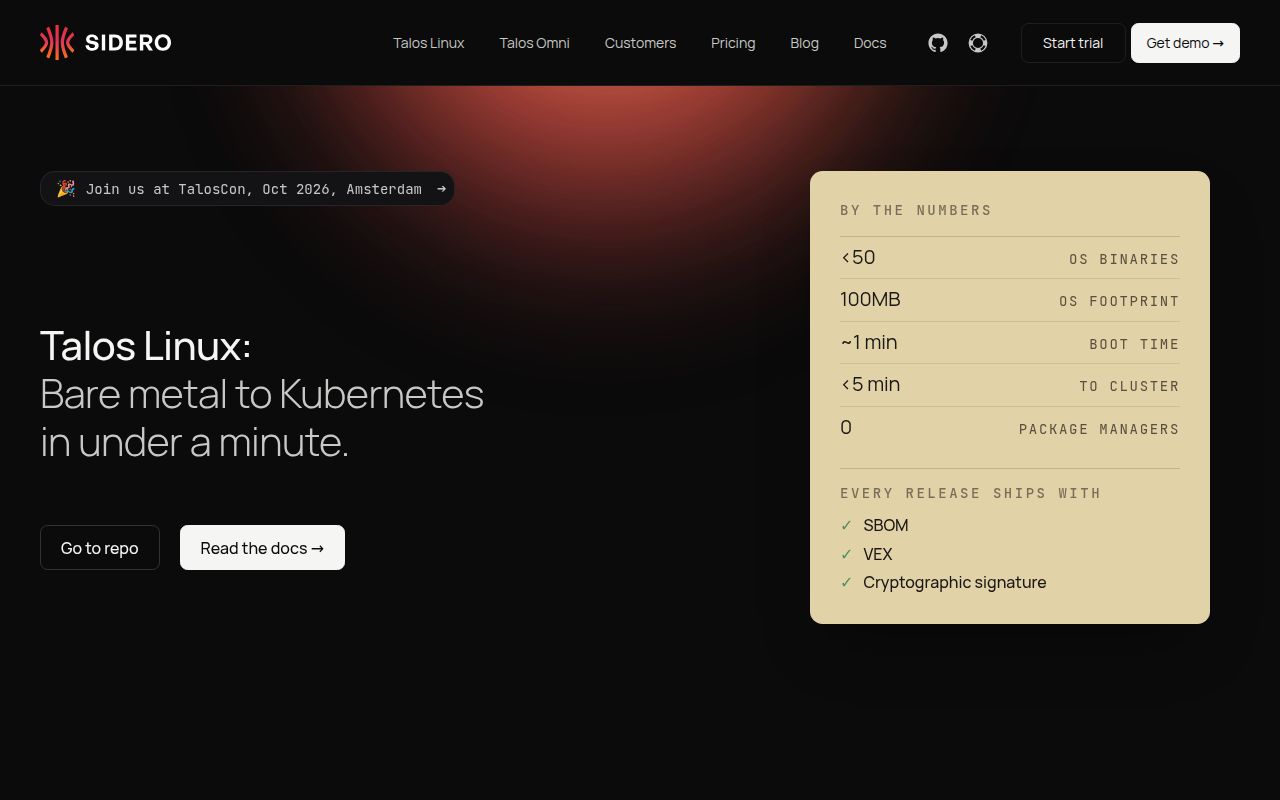
Talos Linux is a small, immutable operating system built solely to run Kubernetes nodes. Administrators manage it through a mutually authenticated API instead of SSH, package managers, or an interactive host shell, reducing configuration drift and the host surface that must be secured.

Verdict

Talos is the strongest default for teams that want the Kubernetes node itself treated as controlled infrastructure, not as a pet Linux server. Its API-only management, focused security model, excellent documentation, active releases, and broad platform support are mature enough for serious production use. Choose it only if the organization will adopt its operating model fully, because fighting the absence of SSH and host customization defeats the point.

Setup3/5Great local guides, but production networking and bootstrapping are real work
Docs5/5Excellent versioned guides, references, platform notes, and operations
Community5/5Large user base, active discussions, current fixes, and regular releases
Maturity5/5Production-focused since 2017 with tested upgrades and broad platforms

Who it’s for

Platform teams that want Kubernetes nodes to be replaceable, declarative appliances rather than general-purpose Linux servers.
Bare-metal, cloud, and virtualization operators prepared to manage machine configuration and upgrades through talosctl or automation.
Security-conscious organizations that value an immutable root filesystem, mTLS management, minimal host services, and atomic OS updates.
Homelab users who want production-style Kubernetes operations and are willing to learn Talos's API-first troubleshooting model.

Who it’s NOT for

Administrators whose recovery playbook depends on SSH, installing packages on a live node, or editing arbitrary host files: Talos deliberately provides none of those normal Linux workflows.
Teams wanting nodes to run unrelated host services beside Kubernetes: Talos is purpose-built for Kubernetes, and extra host functionality must fit its extension or container models.
Operators who routinely skip several OS minor releases: official guidance says upgrade migration is tested only between adjacent minors and recommends visiting the latest patch in each intermediate line.
L3-only bare-metal environments expecting built-in health-aware anycast for the Kubernetes endpoint: issue #14033 says Talos has a Layer 2 VIP but no equivalent solution for that topology.
Owners of unusual or older hardware who cannot test before rollout: support varies by platform tier, and issue #13231 documents a Talos 1.13 boot regression on several Intel Mac generations.
Teams without disciplined certificate and configuration-file handling: generated machine configuration contains cluster authority keys and API credentials.

Setup reality

A local QEMU or Docker trial is approachable, but a real cluster is not a one-command Kubernetes install. You install talosctl, select or build the right boot asset, boot every machine, generate sensitive machine configurations, apply them over the network, bootstrap the control plane, obtain kubeconfig, and install the networking and storage pieces your workloads require. Production adds a highly available Kubernetes endpoint, etcd backups, disk planning, certificate custody, platform-specific networking, extension selection, and separate Talos and Kubernetes upgrade procedures. The declarative API makes repeat operation cleaner, but first deployment still demands solid Kubernetes, network, and infrastructure judgment.

Kubernetes nodes as appliances

Talos Linux asks a clean question: if a machine exists only to run Kubernetes, why keep the shell, package manager, and mutable services that make a normal server familiar? Its answer is a purpose-built operating system with a read-only base, a small service set, and an API secured by mutual TLS. Administrators use talosctl to apply configuration, inspect resources and logs, upgrade the OS, and recover nodes. The host is treated more like firmware than a general-purpose workstation.

That design has concrete benefits. There are fewer packages to patch, fewer ways for an emergency edit to become permanent drift, and one declarative machine configuration that can be reviewed and regenerated. OS upgrades use images and an A/B scheme, retaining the previous image for rollback. Talos and Kubernetes upgrades are separate, giving operators control over each layer.

The trade is just as concrete. There is no SSH daemon or interactive host console. You cannot install a favorite debugging utility on the node or edit a configuration file in place. Teams must make the API, configuration documents, and replacement-oriented workflow their normal operating model.

Security by subtraction, with responsibilities left over

Talos's minimal, immutable foundation reduces host attack surface. Management uses certificates, the root filesystem is read-only, and changes flow through declared configuration or images. Version 1.13.8, released August 4, 2026, includes Linux 6.18.42 and Kubernetes 1.36.2 components plus fixes for image verification, encrypted-volume timing, service health, and mount races.

This does not secure everything above the OS. The official checklist still tells operators to protect machine configuration because it contains authority keys and credentials, enable disk encryption where required, restrict privileged workloads, apply network policies, enforce pod security, and keep releases current. Talos narrows the host problem; it does not replace Kubernetes security engineering.

Talos 1.13 also documents talosctl debug, which launches a privileged temporary container from an image or uploaded archive. It can enter host namespaces, access devices, and see the host filesystem under /host. This is a practical diagnostic escape hatch, but it requires API access and a prepared image.

Installation is clear, production design is not automatic

The basic flow is understandable: install talosctl, obtain an image, boot machines, generate configurations, apply them, bootstrap Kubernetes once, and retrieve kubeconfig. The ISO runs from memory and does not touch disk until configuration is applied. Image Factory can produce assets with official extensions, overlays, Secure Boot choices, and architecture settings.

A production cluster adds decisions no operating system can make for you. Control planes need a stable API endpoint through a load balancer, multiple DNS records, or Talos's Layer 2 virtual IP. Bare metal may need explicit addresses, gateways, DNS, MTU, and driver extensions before the API is reachable. You still select a CNI, design storage, back up etcd, protect secrets, expose observability, and arrange capacity.

Disk planning matters because the EPHEMERAL volume holds images, container data, logs, and control-plane etcd data. Official requirements recommend materially more disk than the OS image consumes. Some volume decisions apply only during initial provisioning, so a careless first layout can be expensive to correct.

Hardware coverage spans amd64, arm64, clouds, hypervisors, bare metal, and several single-board computers, but the support matrix assigns tiers. Metal, AWS, and GCP receive the highest test and fix priority; several clouds are community tested. Issue #13231 reports that Talos 1.13 fails before the kernel on multiple Intel Mac Mini generations even though 1.12.7 boots on the same machines.

The edges expose the real limitations

Talos can add firmware, drivers, and selected services through system extensions and custom images, while ordinary cluster agents belong in DaemonSets. This keeps hosts repeatable, but software expecting a writable filesystem or arbitrary systemd unit will need redesign. A recent virtiofs report on Apple's virtualization framework shows a read-write mount failing because Talos tries to change its permissions. Niche platforms demand testing.

Networking has similar boundaries. The built-in virtual IP works when control-plane nodes share Layer 2 connectivity. Issue #14033 explains that an L3-only fabric can advertise an anycast address, but Talos lacks a built-in health-aware mechanism to withdraw or proxy it when one API server is unhealthy. Those operators need their own load balancing or proxy design.

Upgrades are safe by design but not permission to fall far behind. Documentation says configuration migration is tested between adjacent minor versions and recommends visiting the newest patch of every intermediate minor. Community support for a line ends when the next minor arrives, with longer support sold separately.

A mature project with a clear buyer

Talos was created in 2017, had 10,950 stars, and was pushed on August 17, 2026. The 207 open GitHub items include both issues and pull requests. Recent work spans dependencies, SELinux, networking, storage, GPUs, platforms, and the next release. The August stable patch and daily activity indicate healthy maintenance.

Documentation is a standout: versioned install paths, configuration references, platform guides, upgrade notes, troubleshooting tools, and security checklists are present. The learning curve comes from different operational assumptions, not missing instructions.

Choose Talos when you want Kubernetes hosts to be uniform, locked down, remotely managed, and disposable. Choose a conventional distribution or K3s when local shell access, extra host workloads, or unusual manual integrations are central to how your team works. Talos is not the easiest first Kubernetes experiment, but for a team willing to make declarative nodes the rule, it is one of the most coherent ways to run the cluster beneath the cluster.

Alternatives

ProjectWhat it isPick it when
BottlerocketAn immutable, container-focused operating system developed for orchestrated workloads.pick this instead when AWS integration and a container host with an administrative container model fit your environment better.
Flatcar Container LinuxAn automatically updated Linux distribution for running containers across varied infrastructure.pick this instead when you want an immutable container host but still need a more conventional Linux operating model.
KairosAn immutable Linux meta-distribution aimed at edge and Kubernetes deployments.pick this instead when edge use, distribution customization, and building your own immutable image are central requirements.
K3sA lightweight Kubernetes distribution that runs on a conventional Linux host.pick this instead when small nodes and a familiar SSH-accessible host matter more than Talos's locked-down OS model.

What people are saying

  1. [github-trending] siderolabs/talos

Sources

  1. Talos Linux repository and README
  2. Talos 1.13 support matrix
  3. Upgrading Talos Linux
  4. Talos debug shell documentation
  5. Talos machine configuration overview
  6. Issue #14033: L3-only HA control-plane gap
  7. Issue #13231: Intel Mac boot regression
  8. Talos v1.13.8 release