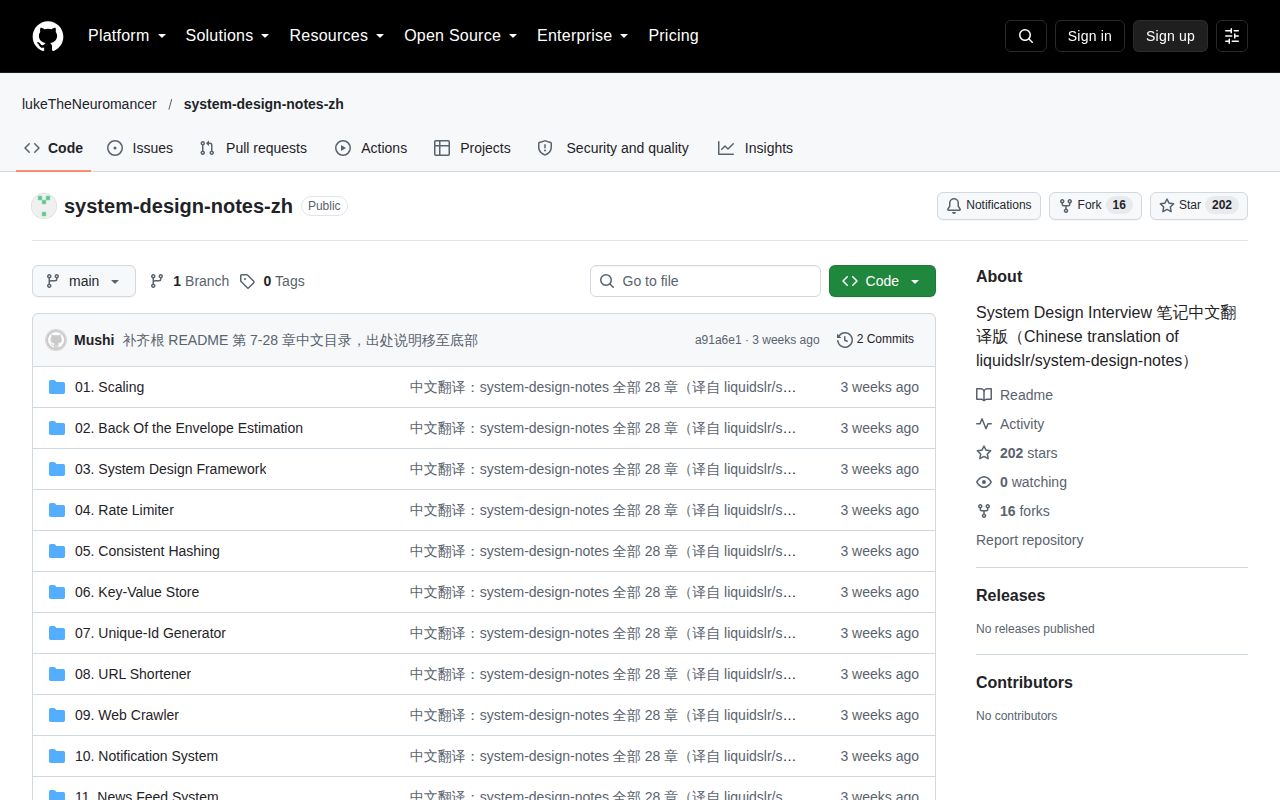
Chinese explanations follow Alex Xu's book sequence
Open the rate-limiter chapter and you get Chinese explanations of token buckets, fixed windows, and sliding-window approaches, with English names beside them. That makes System Design Notes ZH a useful revision aid for someone who reads Chinese and wants familiar technical vocabulary. It leaves an English-only reader translating the reasoning between headings. The README identifies Alex Xu's books as its basis and links to the original notes, so the collection's teaching lineage is explicit.
The contents move from scaling and rough estimation into design exercises such as chat, object storage, payments, and a stock exchange. That sequence gives a study group an easy way to choose its next topic. I would use it beside a fuller explanation rather than make it my only reference. A chapter title can tell you where to look, but deciding whether you understand a design requires more than recognizing its diagram.
What happened when we ran it
We did not run commit a91a6e1 on October 12, 2026, because the lab found no supported ecosystem and no Dockerfile. GitHub's language field was null. Those are the supplied sandbox findings, and there are no install timings, build outcomes, or test counts to add. A documentation collection can still be useful under that limitation. The review's judgments about reading and organization come from the repository text, not an execution result.
The absence of a runtime also changes what verification would mean. A successful compiler command would not establish that the payment design handles reconciliation correctly or that a storage explanation gives enough detail for an interview. Reading the argument and checking its source matter here. Keep that distinction in mind when comparing these notes with runnable reference implementations, where an exercise can fail visibly and force you to investigate why.
The interview framework starts with requirements
The framework chapter asks the candidate to clarify scope before drawing an architecture. Its news-feed example raises concrete questions about clients, friendships, media, and ordering. Those are useful prompts for a mock interview because they make the assumed workload discussable. A design drawn before that conversation can optimize for a problem the interviewer never asked you to solve.
I would turn that chapter into a practice routine: ask a partner to state the problem, write down your assumptions, and defend the first diagram aloud. The notes then give you a reference for checking what you omitted. Reading the framework silently is easier, but it leaves the communication part unpracticed. The document itself treats the interviewer as a collaborator, which gives you a better exercise than memorizing a finished architecture.
The limiter chapter names tradeoffs without providing a service
The rate-limiter notes explain that fixed windows can admit bursts around a boundary, while timestamp logs cost memory and sliding counters approximate the result. Diagrams accompany the algorithms. The chapter also points to Redis operations and Lua scripts when it discusses distributed coordination. That is enough to help you compare designs at a whiteboard. It does not provide a running limiter whose behavior you can inspect under concurrent requests.
The payment chapter is similarly useful for remembering specific design choices. It forwards a payment-order identifier for deduplication and represents amounts as strings instead of floating-point values. Those details make a discussion less vague. They remain examples inside study notes, so I would check processor documentation before applying them in a real integration. A chapter about payments is not an operating specification for your checkout service.
Local diagrams help reading, while source links need context
The repository stores chapter images alongside Markdown and refers to them through relative paths. Reading on GitHub keeps that layout together, and a local copy needs the same directory structure for the diagrams to appear. There is no need to provision a database or obtain an API key to read a chapter. The main setup cost is language fluency and the time needed to work through the argument yourself.
The README's further-reading list points to named material about Dynamo, consistent hashing, chat storage, and file synchronization. That gives you somewhere to go when a summary feels too short. The links also describe systems from particular periods, so a historical architecture example should not become an unexamined current recommendation. Use the notes to locate a question, then consult the original explanation and current component documentation when the answer affects a project.
September activity comes with an empty discussion queue
The repository was pushed on September 23, 2026. GitHub returned 202 stars and 0 open issues and PRs, and the fetched issue list was empty. The README says the notes are still being improved. Recent edits therefore support calling the collection maintained, while the empty discussion list gives little evidence of reader corrections or review. A missing release from the latest-release endpoint is unsurprising for notes and does not establish abandonment.
There is a separate reuse problem: the inspected tree contains no license file, and GitHub returned no license identifier. Public availability alone does not settle permission to republish the material. For personal revision, my deciding test is simpler. Choose a chapter such as the limiter, close it, and explain the boundary-burst problem without looking. If you can defend the tradeoff and identify what you would verify in code, the notes have done useful work. If you can only redraw the picture, keep practicing.