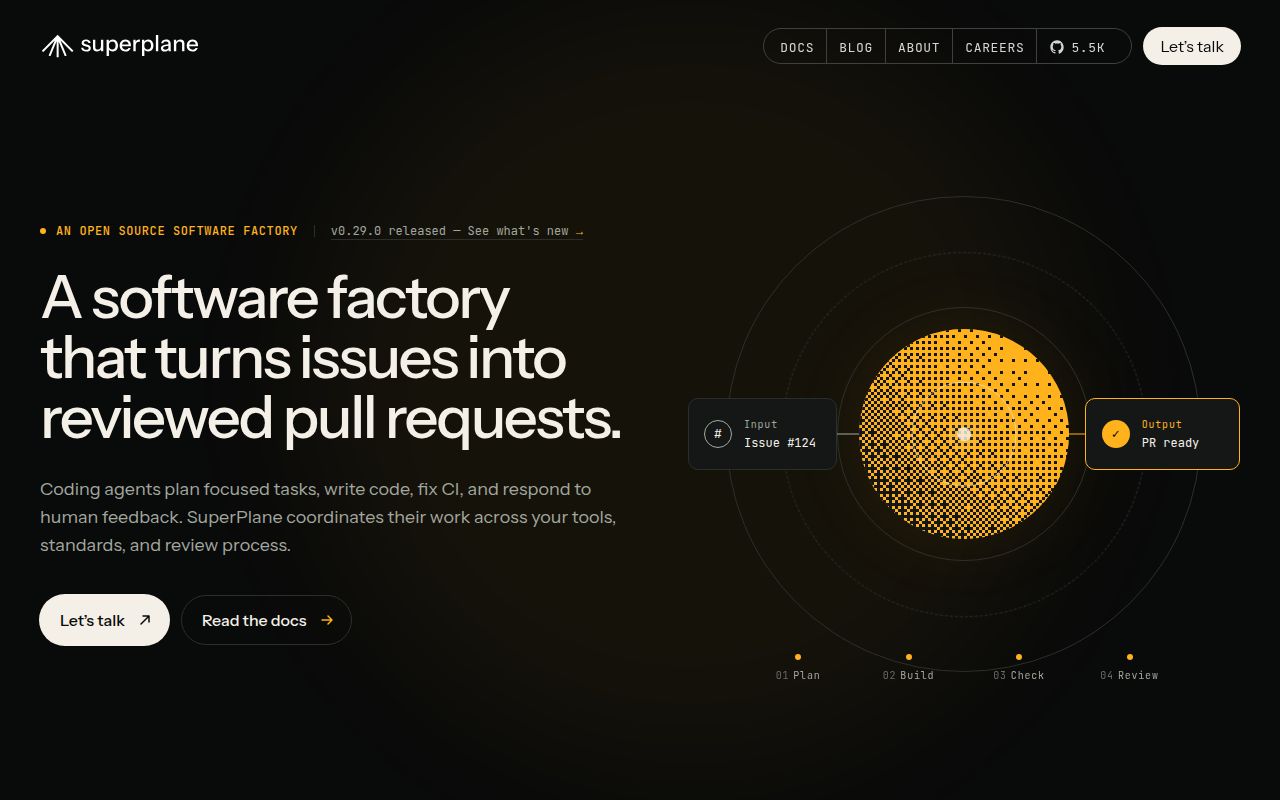
Apps combine a workflow, console, and durable state
SuperPlane handles processes that sit above individual engineering tools. A release can begin with a Git event, wait for CI, provision an environment, pause for approval, deploy in stages, inspect monitoring, and notify an incident channel when verification fails. A script can call those APIs, but it soon needs persisted state, retries, cancellation, audit history, and an interface for whoever is on duty.
An app combines a workflow graph, custom console, scoped JSON memory, and deterministic execution. Canvas and console definitions live in Git as YAML, while the web interface helps teams edit and observe them. Triggers respond to schedules, webhooks, and provider events. Run items and payloads persist across restarts, and failed steps can resume without each workflow author building a recovery database.
That fits preview environments, policy-gated deployment, staged delivery, multi-repository release trains, and incident triage. It is too much for a nightly shell script. SuperPlane earns its footprint when the process itself has become an internal product with owners, permissions, and repeated human decisions.
Agents use the same workflow paths as operators
Each app has an agent that can help design workflows and debug runs. External coding agents can enter through a CLI and published skills. Release v0.30.0 added a Run Claude Code component and structured output for agent runners, allowing an agent result to feed later deterministic steps.
The useful idea is controlled participation. The README says interface, CLI, and agent paths share RBAC. A canvas can place approvals, policy checks, waits, and human decisions around a generated command. App memory holds JSON between runs without asking the model to remember operational history. That is a better foundation than treating an agent prompt as deployment policy.
What happened when we ran it
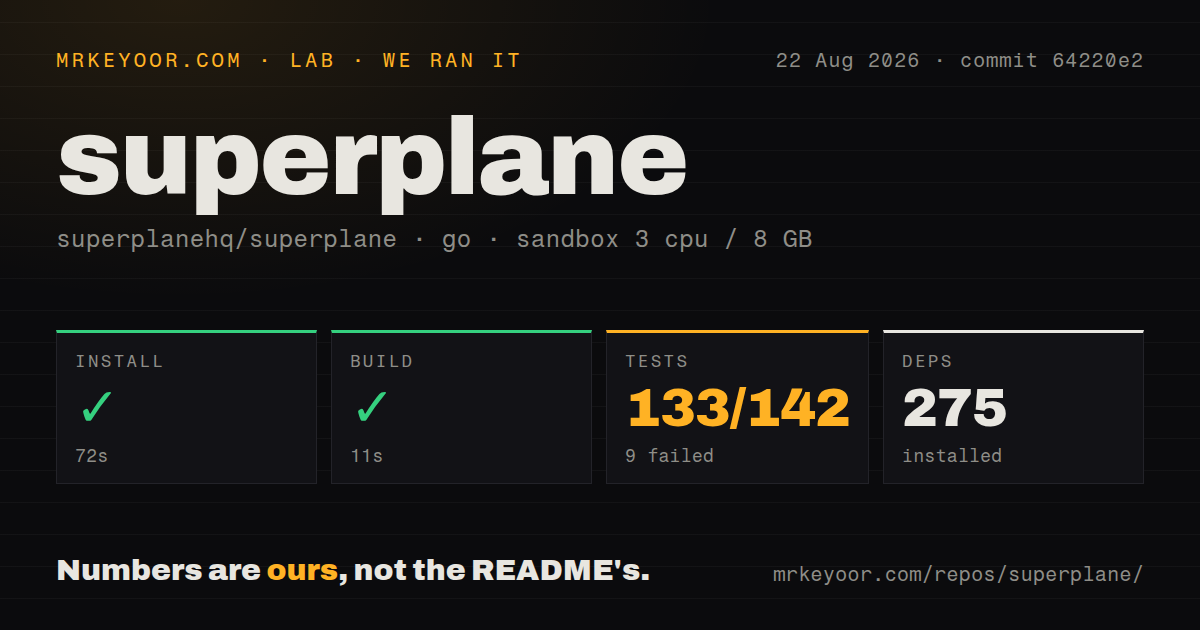
We cloned commit 64220e2 into an unprivileged Debian container with 3 CPUs and 8 GB of RAM. Installing 275 packages took 72 seconds. The build passed in 11 seconds. Tests ran for 128 seconds, with 133 passing and 9 failing out of 142, so the overall command exited 1.
The log tail does not identify the nine failed packages or test names. It lists passing utility and web packages, several packages with no test files, and then a final FAIL. We cannot tell from that excerpt whether the failures need services, depend on the environment, or expose code defects. A full-log rerun at commit 64220e2 is necessary before assigning fixes.
The checkout was unusually large: 6,901 files, roughly 1,004,333 lines of source, and 41.8 MB of checked-out data. It had a Dockerfile and a tests directory, but no GitHub CI workflow files. The README links to Semaphore for CI, so zero GitHub workflows does not mean zero continuous integration. It does mean verification lives outside the familiar .github/workflows path.
One container demonstrates a multi-service platform
The local trial is straightforward: run the published demo image with a named volume, expose port 3000, and open the UI. That is enough to inspect the canvas, integrations, and console model. SuperPlane Cloud offers a hosted path with managed runners and app installation for teams that do not want to operate the control plane.
Self-hosted production is different. The documented footprint includes PostgreSQL, RabbitMQ, and the SuperPlane application. A single-host Compose installer bundles those pieces, while Kubernetes with external PostgreSQL is the scaling route. Operators also own encryption material, backups, TLS, authentication, mail, worker capacity, inbound webhooks, outbound network access, and topology-specific upgrades.
Private-network settings need deliberate review. Administrators can allow access to tools inside a VPC or private cluster. Environment variables can override or empty the blocked-host and private-address lists. That flexibility is necessary for internal targets, but a disabled list can also let an HTTP component reach places its workflow author should never touch.
Integration logos describe categories, not complete APIs
The catalog spans source control, CI, cloud services, observability, incident response, messaging, tickets, and LLM providers. Each integration supplies particular triggers and actions. A logo does not mean every provider operation or current API revision is supported. Buyers should inventory the exact components used by a workflow and test success, failure, retry, and cancellation with non-production credentials.
Open issue #6624 is a specific warning. It says three Coolify write actions call endpoints with GET even though current Coolify requires POST, causing HTTP 405 on every execution. Issue #6107 says the SSH component cannot inject values from SuperPlane's secret store as environment variables. Those gaps matter only to certain workflows, but for those workflows they are blockers.
Keep an escape path outside the platform. A policy-gated deployment should still have a documented recovery command if an integration changes upstream or a durable run becomes stuck. SuperPlane can centralize procedure; it should not become the only place an operator knows how the underlying system works.
Beta status and 502 open items call for a pilot
The repository was pushed on August 26, 2026. GitHub listed 502 combined issues and pull requests, and the latest release was v0.30.0 from July 27. That release expanded GitLab, added Linear, improved asynchronous cancellation, changed runner behavior, and tightened several security paths. The queue and release notes both show fast engineering over a broad product.
The README is candid that SuperPlane is beta, its primitives and integrations are still maturing, and breaking changes remain possible. Documentation covers apps, canvases, memory, secrets, deployment options, integrations, and network controls well enough to plan a trial. Activity reduces abandonment risk; it does not make an unstable API stable.
Start with an internal preview environment or incident evidence workflow where a failure is recoverable. Our 9 failed tests, the open widget authorization report, and provider-specific gaps argue against making SuperPlane the sole route to production today. If the pilot survives upgrades, permission tests, runner failures, and real on-call use, then expand one workflow at a time.