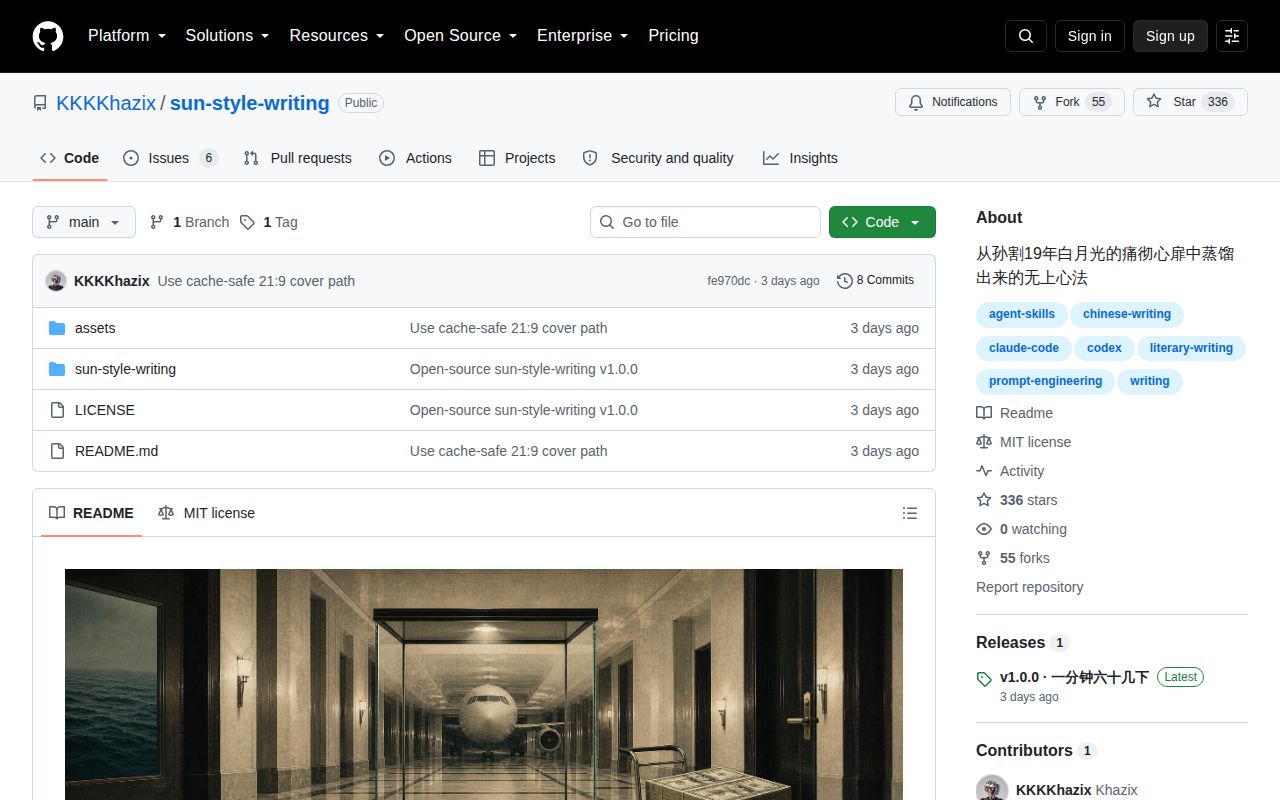
A Chinese Skill turns one literary reading into agent rules
Sun Style Writing is a folder of instructions for Chinese narrative writing. Its README says the method was extracted from the techniques in My Girlfriend Jing Tian, then recasts those techniques as directions an agent can follow: describe visible actions, use real numbers, let objects carry emotional weight, leave some questions unanswered, and return to an earlier image near the ending. The repository does not include the source article in full and states that it is independent of the people discussed.
The language boundary is immediate. The README, SKILL.md, examples, reference analysis, and revision checklist are all in Chinese, with no English guide visible. GitHub reports no primary programming language for the repository. An English-only editor could translate the files, but wording is the product here; a rough translation may change the force of rules about sentence rhythm, forms of address, and when silence should replace explanation.
The ten techniques are choices, while plain description is mandatory
The Skill names ten main techniques, including contrast, repetition, foreshadowing, objects, montage, omission, anticlimax, and circular structure. It also discusses changes in how a narrator addresses someone. The better instruction is its warning against stuffing every technique into one draft. Plain description is the base layer, while the other devices should appear only when the supplied material supports them. That restraint makes the file more useful than a checklist that rewards visible tricks.
Numbers receive unusually careful treatment. The instructions ask the model to replace loose adjectives with amounts, durations, counts, or physical measurements when the source provides them. They also state that truth matters more than the appearance of precision. The model should retain uncertainty when a writer remembers about 10 minutes, rather than sharpening the memory into a made-up exact duration. That distinction is practical for memoir, profiles, and workplace stories where a polished invention can damage the whole piece.
Scene depth gets more attention than short-sentence mimicry
Many style prompts stop at surface imitation. This one explains that short paragraphs are a sentence-level rhythm choice and should not reduce a scene to a few fragments. Its reference file asks the writer to remain inside a scene long enough to describe physical actions and ordinary objects, then move only after the moment has developed. It recommends using section breaks for major stages rather than dropping one every few paragraphs. Those are editing instructions, not decorative adjectives.
The guidance can still produce mannered copy. Repeated single-line paragraphs, carefully planted objects, exact numbers, and a circular ending become recognizable when applied on command. The Skill partly protects against that by telling users to skip techniques that do not grow from the source and to avoid importing the original article's sea, empty-room, or money imagery. A competent editor should still remove any device that calls attention to the prompt instead of the person in the story.
What happened when we ran it
We did not run commit fe970dc in our 3-CPU, 8 GB sandbox on August 30, 2026. The lab detected no supported programming-language ecosystem, and the repository has no Dockerfile. There was therefore no supported install, build, or test step to execute. Saying that plainly matters: this result gives us no evidence about model adherence, output quality, or compatibility with a particular agent host.
The practical installation is file placement. The README tells a compatible agent to install the repository, or asks the user to copy the sun-style-writing folder into a local Skills directory. Release v1.0.0 also provides a packaged .skill file. No API credential or hosted service is documented. The runtime dependency is the agent itself, which must recognize Skills, load the instruction file, and follow the linked reference when needed.
Issue 1 shows that written safeguards still need checking
The project's most useful open report is issue 1. Its author says the source material gave an approximate 10 minutes, while the model output changed that to 11 seconds. The issue directly contradicts the Skill's rule that a model must not invent precise figures. It does not prove every host or model will make the same error. It does prove that a sentence in SKILL.md is not an enforcement mechanism.
Generated work should be checked against the original notes line by line for amounts, dates, elapsed time, quotations, and what each person could know. The same review should catch invented physical details. The Skill often asks for the position of objects, light, smells, and small actions to deepen a scene, but a model cannot observe a room that the writer never described. Its instructions say not to fill those gaps; the human editor remains responsible for catching violations.
A new repository has attention but little operating history
GitHub recorded the last push on August 27, 2026, the day v1.0.0 was published. The repository had 336 stars and 6 open issues and pull requests when fetched on August 30. Several open threads are praise or unrelated prose rather than defect reports, so the combined count should not be read as six known bugs. The recent push and issue activity show current attention, while one release and a few days of history leave little evidence about long-term maintenance.
Sun Style Writing is worth reading even if you never install it. The strongest material is the distinction between observable facts and emotional explanation, plus the warning that scene depth cannot be faked with short lines. As a production writing aid, it belongs before a human edit rather than after one. Its rules can cut vague sentiment from Chinese narrative, but issue 1 is enough reason to verify every precise-looking detail before publication.