mrkeyoor.com_
Sat 03 Oct 07:16 UTC
Dataevaluationupdated 03 Oct 2026

stampede review

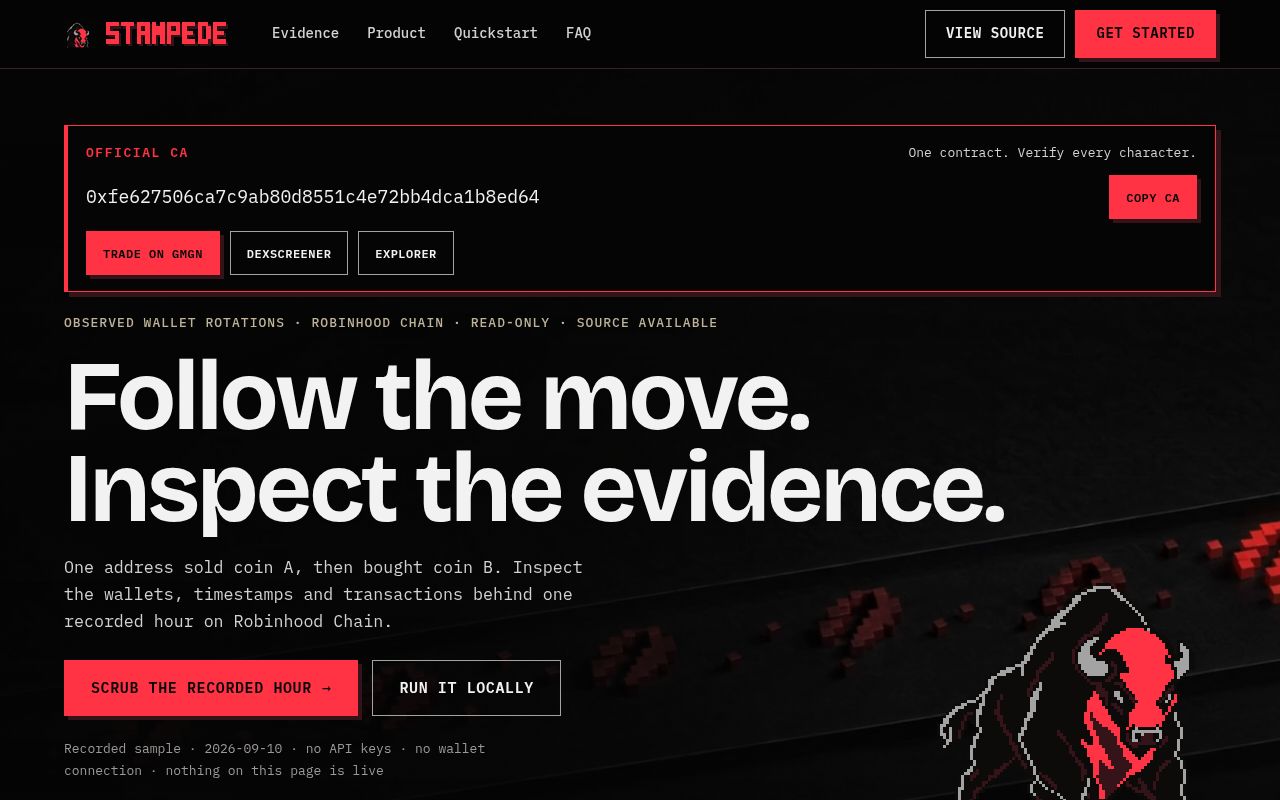
Stampede is a read-only explorer that finds cases where one blockchain address sold one coin and bought another within a chosen time window. It turns those observations into a feed, ranking, flow view, and 3D map while keeping the wallet addresses and transaction hashes attached.

Verdict

Our Stampede run built in 6 seconds and passed 97 of 105 collected tests, but 8 collection/setup errors kept the suite red. Use the recorded demo to inspect its evidence model or study this narrow Robinhood Chain dataset. Do not treat its ranking as a forecast, and do not redistribute the code until the author chooses a license or grants permission.

We ran it

Lab card: what happened when we ran stampedeScreenshot of stampede (stampede.tools)
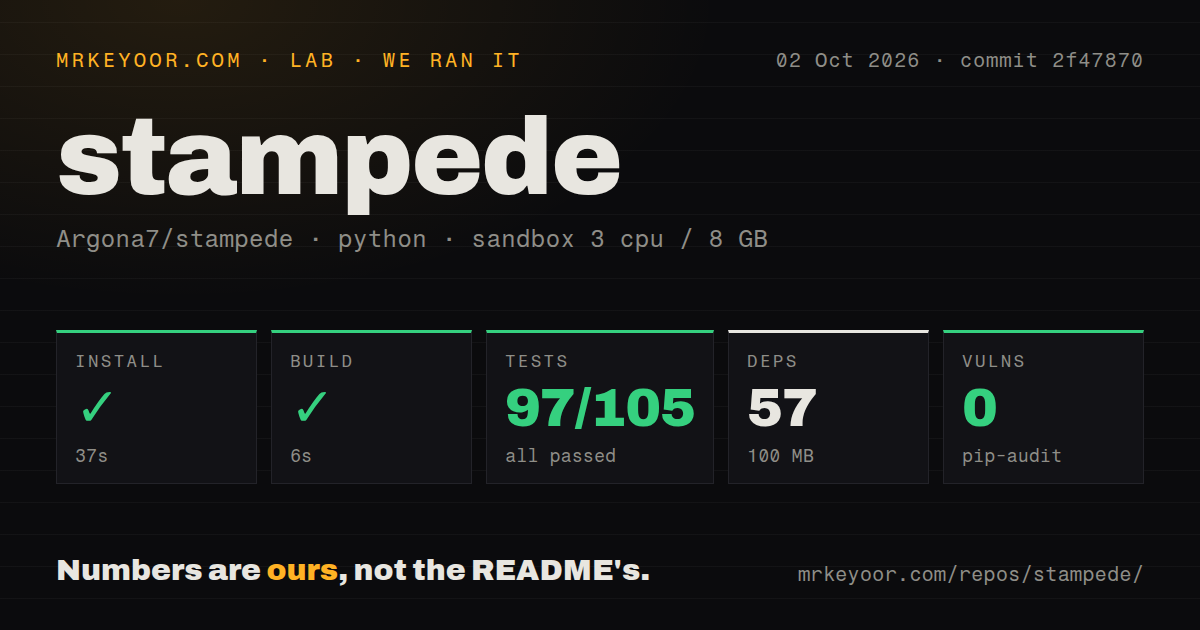
Install✓ · 37s57 packages · 100 MB
Build✓ · 6s
Tests✗ · 72s97 passed · 0 failed · 8 errors of 105 (pytest)
Known vulns0(pip-audit)
Repo654 files~32,507 lines of source · 186 MB · 0 CI workflows · tests dir

Answers from our run

Does stampede build from source?

Dependencies installed in 37 seconds (57 packages), and the build succeeded in 6 seconds. We cloned commit 2f47870 into a clean Debian container with 3 CPUs and no project-specific setup.

Do stampede's tests pass?

Yes: 97 of 105 passed when we ran the project's own test command (pytest), with 8 collection errors. Some failures need services or credentials a bare container does not have.

Does stampede have known vulnerabilities in its dependencies?

pip-audit found none in the dependency tree at the time of our run.

Who should not use stampede?

Traders seeking automated execution or buy signals: Stampede is read-only, sends nothing to the chain, and explicitly makes no return prediction.

What are the alternatives to stampede?

Blockscout, Graph Node, Rotki. Our Stampede run built in 6 seconds and passed 97 of 105 collected tests, but 8 collection/setup errors kept the suite red.

Setup3/5Clear demo guide, but our suite hit 8 setup errors
Docs5/5Exact scope, evidence, limits, commands, and failure help
Community2/5143 stars and 3 unanswered issues around scope and licensing
Maturity2/5v0.1.0, one recorded hour, no license, and a red suite

Who it’s for

Researchers studying wallet behavior on Robinhood Chain's PONS v2 and supported Uniswap v4 pools.
Analysts who want every observed rotation tied back to transactions rather than hidden behind one score.
Developers who want a recorded local demo before connecting live data providers.
Readers comfortable treating address order as an observation, not proof that one trade funded another.

Who it’s NOT for

Traders seeking automated execution or buy signals: Stampede is read-only, sends nothing to the chain, and explicitly makes no return prediction.
Analysts covering Ethereum broadly or several DEXes: the documented universe is Robinhood Chain ID 4663, PONS v2, and supported graduated Uniswap v4 pools.
Windows or Linux teams requiring a verified setup guide: the getting-started path says only macOS on Apple silicon was verified.
Anyone who needs permission to redistribute or build a product from the code: no license has been chosen, and two open issues ask about licensing or reuse.
Release gates that require a green fresh-container suite: our run ended with 8 collection/setup errors.

Setup reality

Our fresh Debian sandbox installed commit 2f47870 in 37 seconds, adding 57 packages and 100 MB. The build succeeded in 6 seconds. Tests exited 1 after 72 seconds: 97 passed, 0 failed, and 8 collection/setup errors were reported; pip-audit found 0 known vulnerabilities.

The recorded demo needs no secret, but the full web view needs Node 22 or newer and the bundled sample is downloaded separately. Live ingestion needs an Alchemy key; HyperSync and the X mentions service have optional tokens.

The project pins Python 3.13, serves locally on port 8791, and needs WebGL 2 for the 3D view. Its guide was verified on Apple silicon macOS, not Linux or Windows, and there is no Dockerfile.

Stampede observes trade order without claiming money flow

Stampede looks for a specific sequence: one address sells coin A, then buys coin B within a selected window. It labels direct sequences that happen in one transaction, clean sequences where the wallet sold only A, and ambiguous sequences where other sales also occurred. The interface keeps ambiguous rows visible but excludes them from edge weight. That distinction prevents a useful observation from turning into a story the chain data cannot support.

Its scope is Robinhood Chain ID 4663, specifically PONS v2 bonding curves and the Uniswap v4 pools that supported coins graduate into. Plain transfers and other exchanges are outside the dataset. The v0.1.0 sample records 60 minutes on September 10, 2026. It is suitable for learning the tool and inspecting its calculations, not for making general claims about wallet behavior across chains.

Four views expose the same underlying transactions

The terminal shows a live feed and a radar screen. Browser views add a ranked RADAR table, a FLOW diagram around one coin, and a 3D MAP of routes. An evidence card opens the wallets, sell and buy transactions, timestamps, gaps, and grades behind a route. The ranking shows its score parts instead of presenting one unexplained number.

The recorded sample contains 146,329 trades and 33,743 wallets according to the README. Its default 30-minute view has 12,164 observed sequences after the documented direct and clean filtering used by the demo. Stampede also warns that timestamps may be interpolated when exact block times were unavailable, and it marks those values as approximate in the interface.

What happened when we ran it

Our sandbox installed commit 2f47870 in 37 seconds, pulling 57 Python packages and using 100 MB on disk. The build passed in another 6 seconds. Pip-audit reported 0 known vulnerabilities. We used an unprivileged Debian container with 3 CPUs, 8 GB of RAM, Python 3.12, and no secrets.

The test command exited 1 after 72 seconds. Pytest reported 97 passed, 0 failed, and 8 collection/setup errors among 105 collected tests. The log tail for test_radar.py, test_shared_session.py, and test_traders.py says Starlette's test client requires the httpx2 package and gives pip install httpx2 as the remedy. The log does not explain why that package was absent, so we will not assign a cause.

The recorded demo avoids credentials, while live mode does not

The demo fetches a compressed release asset once, unpacks its database, and serves a replay on localhost. It does not read API credentials or connect a wallet. The web interface needs Node 22 or newer, while the terminal and server use Python. A user can inspect a known route, pause the clock, and open its transaction evidence without making a live data request.

Live ingestion changes the setup. The sample environment asks for an Alchemy key, with a HyperSync token available as an optional source and a separate optional token for X mentions. External market context and holder data are disabled in demo mode. The 3D scene needs WebGL 2. The guide's verified platform was Apple silicon macOS 26.5.1, so Linux and Windows users are following an unverified path even though the commands are expected to be similar.

A visible score is still only a ranking of observations

RADAR combines recent distinct-wallet inflow, acceleration, source breadth, wallet quality, age, and curve stage. Stampede shows each part and records what happened 30 and 60 minutes after an alert on indexed trades. That makes the score auditable. It does not turn the score into evidence that a coin will rise, that addresses belong to one person, or that a preceding sale financed a later purchase.

The README says thresholds were calibrated on 5 hours from one launchpad, while the public sample covers 1 hour. It also says most spikes described in the research note ended below the alert price by the end of the measured horizon. Anyone evaluating the ranking should preserve those limits beside screenshots and exports. Removing them would convert descriptive research into a claim the project rejects.

The missing license blocks ordinary reuse

The documentation is frank that no license has been chosen and that the code is available for reading and running the demo, not redistribution. Issue 1 asks for a LICENSE file. Issue 3 requests explicit permission to port the project to TypeScript. Neither issue had a response when checked, so a public repository should not be mistaken for permission to create a derivative product.

GitHub showed 143 stars, 3 open issues, and a last code push on September 18, 2026. The v0.1.0 release arrived on September 11 with the sample and demo video. This is an early, focused research tool with unusually careful claims and a currently incomplete test environment. Its best use is inspection: follow an observed sequence back to its transactions, then stop where the evidence stops.

Alternatives

ProjectWhat it isPick it when
BlockscoutA general explorer and analytics stack for EVM-compatible chains.pick this instead when broad transaction and contract inspection matters more than wallet-rotation views.
Graph NodeA blockchain indexer that exposes application-specific data through GraphQL.pick this instead when you want to define and operate your own reusable chain-data schema.
RotkiA privacy-focused portfolio, accounting, and transaction analysis application.pick this instead when the job is tracking a user's holdings and history across services.

What people are saying

  1. [velocity-scout] Argona7/stampede

Sources

  1. Stampede README
  2. Stampede getting-started guide
  3. Stampede v0.1.0 release
  4. Stampede license request issue 1
  5. Stampede reuse permission issue 3

More data reviews

Trader-Archives · seriousdb · Awesome-Astra-Embodied-AI · awesome-fly · meme-radar · awesome-production-machine-learning · the whole board →