SAGE chooses who should act, then stops before execution
SAGE sits between agent discovery and task transport. Given an incumbent agent, a task, and a set of candidates, it compares three routes: continue alone, collaborate with selected peers, or hand the work to a specialist. The decision includes role assignments, task-dependency topology, predicted success, cost, latency, risk, and a plain explanation.
The boundary is unusually clear for an agent project. The 22-file repository returns a routing decision and intentionally does not call A2A's message, streaming, polling, or cancellation methods. A platform team must connect that output to real agents. This is policy code, not a server you can point at an agent registry.
Permissions remove candidates before scores can flatter them
Eligibility comes first. An agent is excluded when it is unavailable, failed, unauthorized, over budget, too slow for the deadline, or below a required capability threshold. SAGE checks cost and the task graph's critical path again after constructing a team. A strong learned score cannot push an infeasible agent back into the result.
That is a sound ordering for systems that may spend money or cross data boundaries. The reference implementation is also small enough to inspect: our checkout was 0.1 MB with about 1,379 source lines. A reviewer can follow the constraints, scoring terms, and update rules without tracing a distributed platform.
The inputs are demanding, however. Tasks need weighted requirements and dependency edges. Agents need capability claims, cost, latency, availability, and permissions. Live rerouting also needs progress, completed work, failed agents, and an estimate of transferable context. Most agent systems do not have all of that data in a trustworthy form.
Online learning is useful only when outcome evidence is honest
SAGE keeps global and requirement-specific trust, so success at coding does not automatically make an agent credible at research. It also compares quoted confidence, cost, and latency with observed results. Outcome updates prefer per-agent or per-requirement evidence; a single team score receives less weight because it cannot identify who contributed.
The 3-second build proves that the reference package is easy to check mechanically. It says nothing about whether the learned policy will improve under a company's data. Outcome labels can be noisy, incentives can distort bids, and a team may appear successful because one member rescued another. The algorithm document admits that its credit assignment is not causal and calls for logged propensities and off-policy evaluation in production.
Beam search explores several possible collaborator groups instead of taking the first locally attractive teammate. The search is bounded, so it does not claim a global optimum. That tradeoff is sensible for a router, but teams still need load tests and limits using their actual candidate count and requirement graphs.
What happened when we ran it
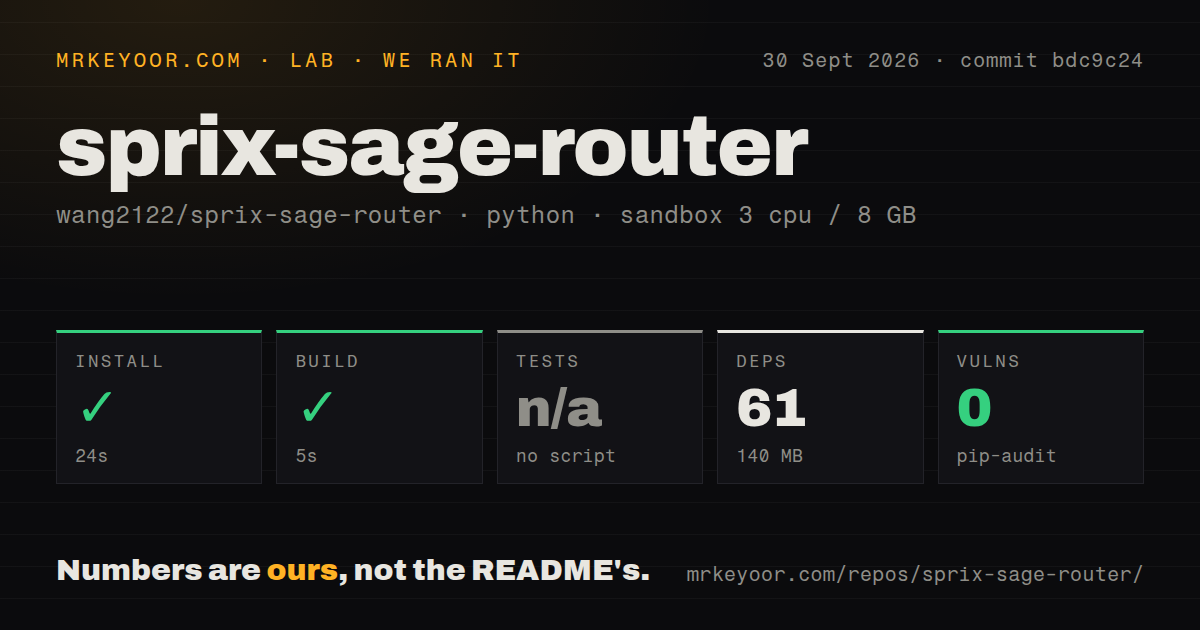
Our run installed 36 packages in 25 seconds and used 37 MB on disk. Commit aed9785 contained 22 files and roughly 1,379 source lines. The detected build finished successfully in 3 seconds in an unprivileged Python 3.12 Debian container. Pip-audit reported 0 known vulnerabilities in the installed environment.
The lab did not detect a test script or target, so it skipped tests. The README does document python -m unittest -v, and the repository map names a root test_sprix_sage.py file, but those facts do not turn our skipped step into a test pass. The project has one CI workflow file, no Dockerfile, and no tests directory in the measured checkout.
The runtime README says there are no dependencies and the demo needs only Python 3.10 or newer. Our 36 installed packages came from the lab's detected install path, not necessarily from SAGE's runtime requirements. A production integration would add far more: an agent registry, A2A client, identity checks, durable state, monitoring, and a place to record outcomes.
The benchmark is synthetic and says so plainly
The included benchmark runs simulated tasks whose hidden capabilities, pair effects, cost, and latency differ from SAGE's own prediction model. That separation is better than grading a router with its own score. Online SAGE spends more in the published table to obtain higher simulated quality, making the tradeoff visible.
Still, the README explicitly says those results are not evidence of real-world superiority. It calls for real executions, stronger learned baselines, heterogeneous agents, trace replay, calibration work, and adversarial conditions. The 25-second install makes reproducing the simulator cheap; it does not close any of those evidence gaps.
A fresh research preview should be judged as one
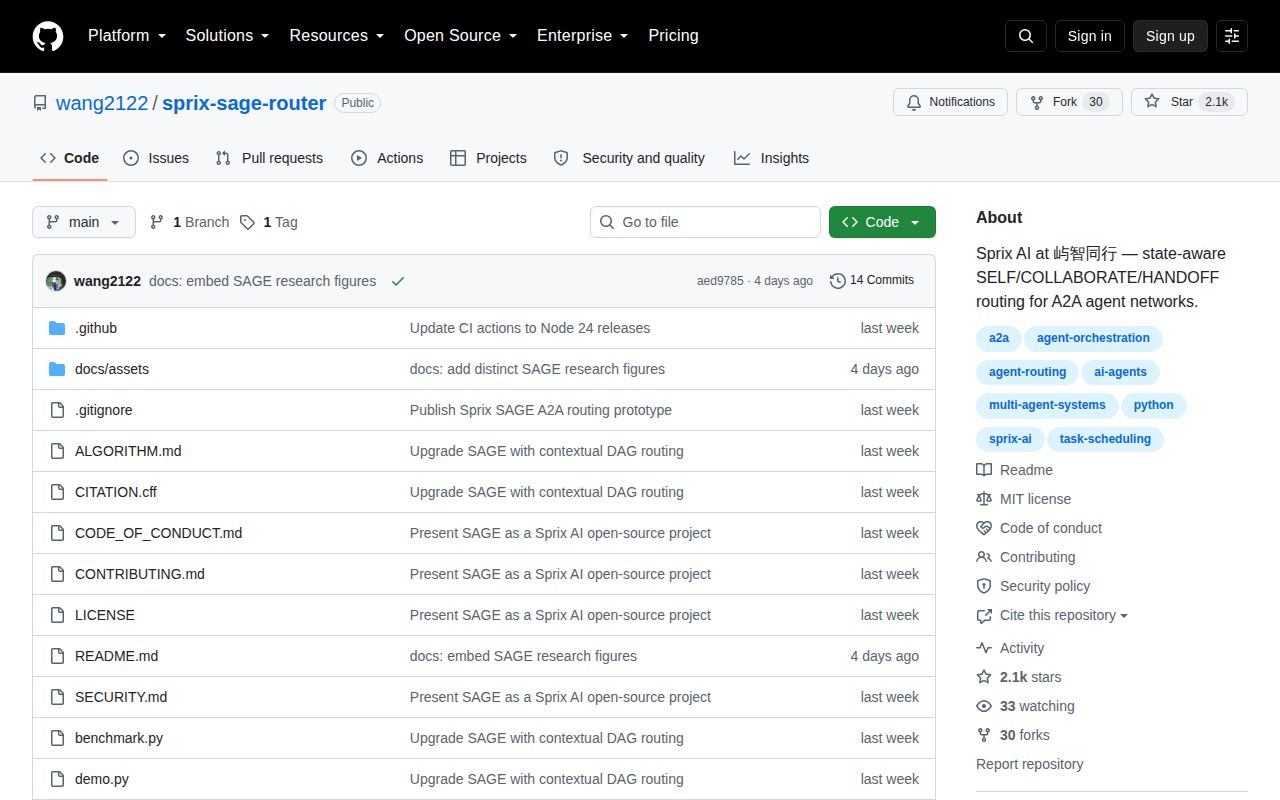
The repository was created on August 18, 2026, pushed on August 21, and had no releases. GitHub showed zero open issues and pull requests. With 2,090 stars after only a few days, attention arrived much faster than evidence of outside maintenance or deployment. The README labels version 0.2 an early-stage research preview rather than a production SLA or peer-reviewed result.
As research code, SAGE is unusually candid and useful. The algorithm document states its approximations, the simulator avoids circular scoring, and production gaps are named. Adopt the ideas when your platform already has A2A execution and structured evidence. For a runnable multi-agent system, LangGraph or AutoGen provides the larger execution layer that SAGE deliberately leaves out.