This is a hardware integration kit for a Chinese BLE recorder
Sonicloud Recorder is built around the company's recording card and its CB08-style Bluetooth protocol. The repository's primary language is Chinese, and there is no English README. It combines a Python desktop client, a browser console, a Flutter example, and binary SDKs for Android, iOS, and HarmonyOS. The desktop code can scan, connect, inspect device state, control recording, download files, and hand audio to an optional local transcription stack.
The checkout at commit fa63976 contained 144 files, about 5,801 lines of source, and 39.2 MB. That small source count hides a wide integration surface: native mobile libraries, a Flutter app, firmware samples, a video, vendor-page snapshots, and the Python demo all live together. GitHub now redirects the requested sonicloudco/recorder path to SonicloudTech/sonicloud_opensdk, which is the current repository identity.
The Python demo exposes the protocol details that matter
The desktop project uses Bleak for transport and provides both a command-line REPL and a FastAPI web interface. Its parser handles partial frames, multiple frames in one notification, noise recovery, CRC-16/XMODEM, and separate caches for data and button notifications. File downloads carry a 4-byte little-endian offset, can resume, and check WAV metadata before saving. These are the unglamorous details that decide whether a BLE transfer survives real firmware behavior.
Audio arrives as raw Opus at 16 kHz mono, with documented 40-byte frames representing 20 ms. The application remains responsible for decoding, storage, playback, and speech recognition. OTA has another boundary: BLE controls the mode and connection state, while Wi-Fi/TCP carries the firmware. That split makes this repository useful to an integrator who owns the whole device flow. It offers little to someone who only wants to record a laptop microphone.
What happened when we ran it
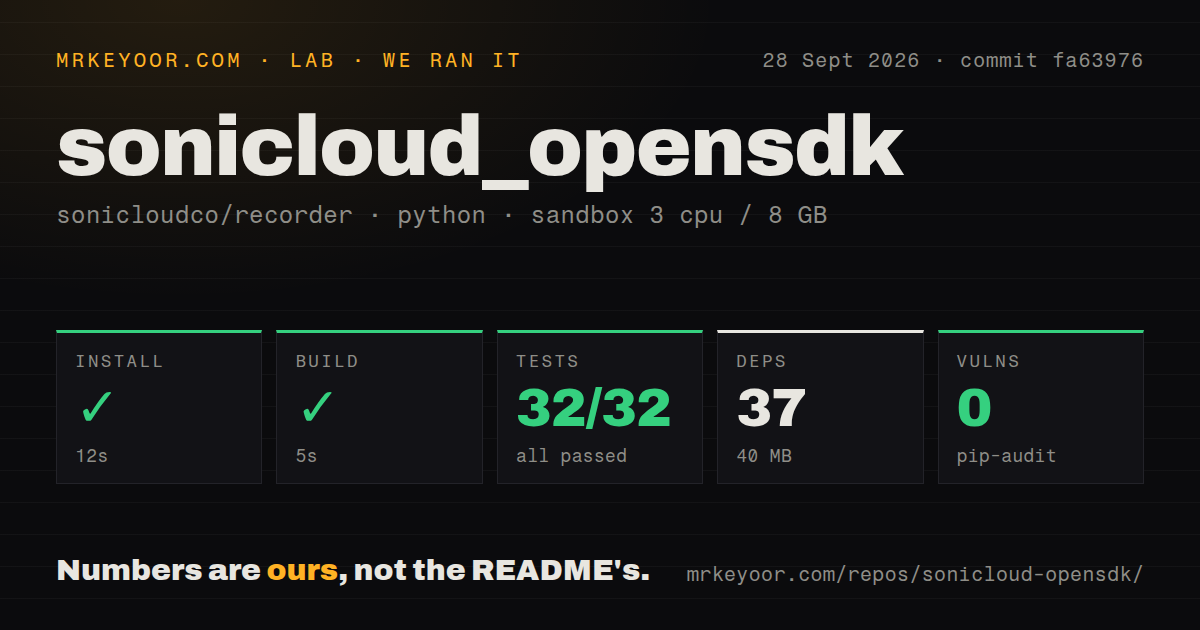
Our sandbox installed the Python project under pnote-web-win&Mac-demo in 12 seconds. It added 37 packages and occupied 40 MB, then completed the build in 5 seconds. Pytest ran for 11 seconds and reported 32 passed, 0 failed, and 8 skipped of 32. Pip-audit found 0 known vulnerabilities in the environment we installed.
Those tests exercise protocol and device behavior without a recorder. The nested README describes fake transport coverage for request matching, multi-frame lists, downloads, resume behavior, deletion, ASR fallbacks, web validation, and directory-traversal protection. Our sandbox result does not establish Bluetooth compatibility with every chipset or firmware. The repository has a tests directory, yet GitHub shows 0 CI workflow files and no Dockerfile, so maintainers must run those checks through some other process or by hand.
The 40 MB core becomes much larger with offline speech
Basic command-line use needs Python 3.10 or newer, Bleak, an operating-system BLE adapter, and a recorder that advertises the expected service. The browser console adds FastAPI and Uvicorn. Offline transcription adds FunASR, ModelScope, Torch, and Torchaudio. Its guide says the first transcription downloads roughly 900 MB for SenseVoiceSmall and warns that Torch and Torchaudio major versions must match, with a Windows import error as the documented failure when they do not.
Real-device setup is therefore more involved than the 12-second sandbox install. You must grant Bluetooth permissions, avoid another app holding the recorder connection, identify the correct scan result, and verify at least one file download. Debug logging can include transmitted and received hexadecimal frames. The root guide tells users to remove serial numbers, addresses, authorization codes, and recording content before sharing logs, which is sound advice for field support.
MIT covers the examples, while shipped binaries may have other terms
The root LICENSE is MIT, but the README draws a narrower boundary around what that grants. Android AAR, iOS static library, HarmonyOS HAR, firmware, private protocol details, and some documents may contain proprietary material. Redistribution and commercial use can depend on the package notes or a business agreement. Teams should inventory each binary rather than treating the repository badge as one license for all 39.2 MB.
Documentation also has a current paper cut. Pull request 1 reports that the root README names an Android AAR removed in commit fa63976 and links a document that is no longer published. The repository tree contains the newer AAR, while the Flutter demo keeps an older copy. GitHub recorded the last push on September 18, 2026, 2,710 stars, and 1 open combined issue or pull request. There is no tagged release, so file names and commit pins carry more weight than a version number.
Generic BLE libraries are better when the hardware contract is yours
Bleak is the natural lower-level choice for a Python desktop tool because this demo already depends on it. SimpleBLE covers more platforms from one Bluetooth library, while Flutter Reactive BLE fits a Flutter-led app. Whisper.cpp addresses local transcription without prescribing any recorder. Each alternative leaves the CB08 framing, download commands, firmware behavior, and vendor adaptation to you.
Sonicloud's repository saves work only when those device-specific pieces match the hardware on your desk. The 32 passing tests support a serious evaluation, and the simulated transport makes protocol changes safer. Buy or borrow a unit before committing an application architecture, confirm the license for every supplied SDK, and treat successful file download and resume as the acceptance test.