mrkeyoor.com_
Tue 10 Nov 00:34 UTC
Dev Toolsevaluationupdated 09 Nov 2026

OpenSandbox review

OpenSandbox provides an API for running AI-agent workloads on infrastructure you operate. Its documented environments support command execution, file operations and code execution, with Docker for local execution and Kubernetes for cluster deployment.

trackingstars / 7d
Verdict

The OpenSandbox CLI installation completed in 30 seconds and its test step succeeded in 81 seconds. A live sandbox deployment remains unverified. Evaluate the project if your team can operate its server and runtime, then reproduce the documented create-to-cleanup workflow on your chosen backend. If signatures or provenance are required, verify the exact artifacts before adoption.

We ran it

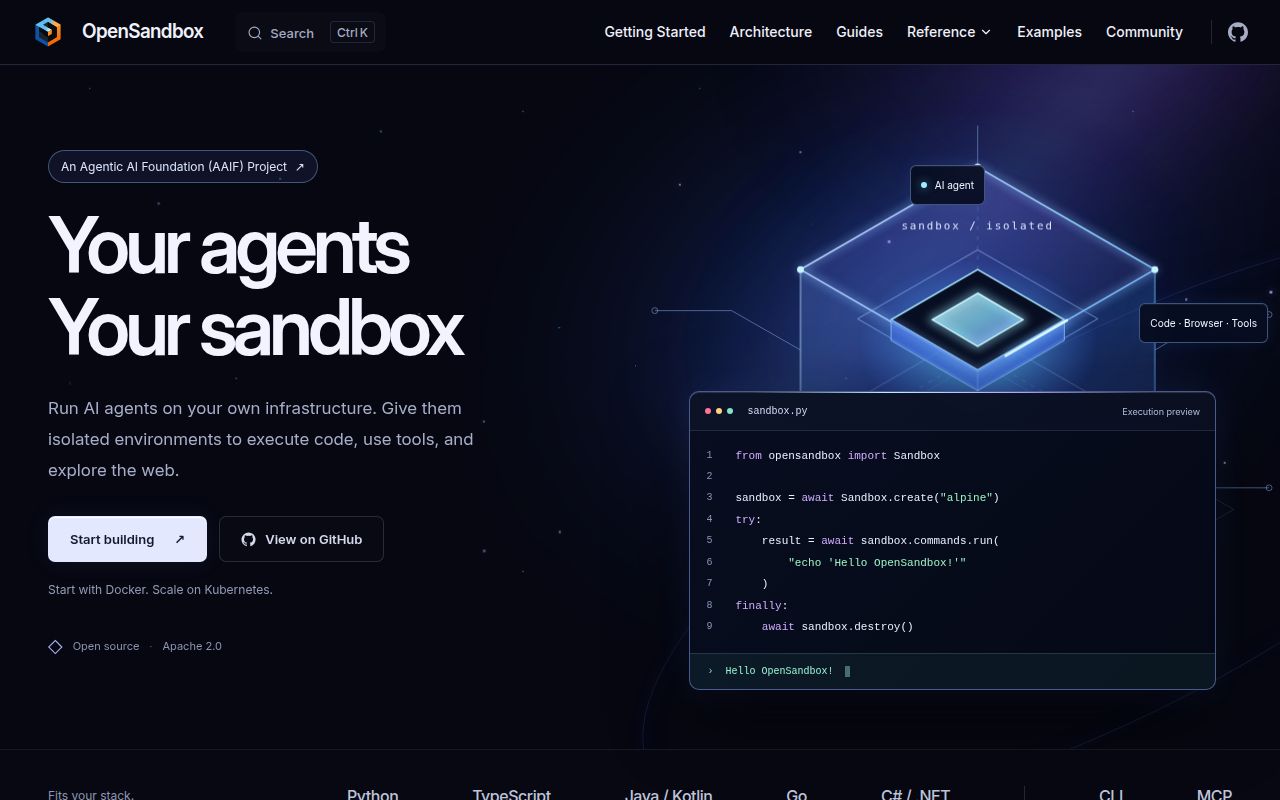
Lab card: what happened when we ran OpenSandboxScreenshot of OpenSandbox (open-sandbox.ai)
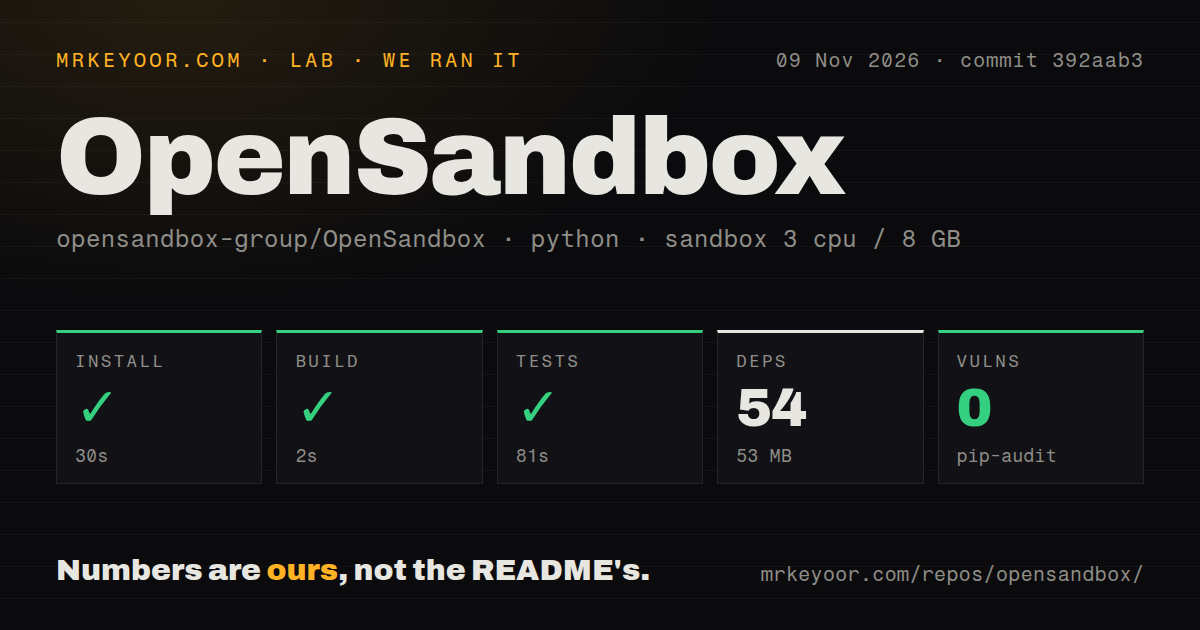
Install✓ · 30s54 packages · 53 MB
Build✓ · 2s
Tests✓ · 81sran, no count parsed
Known vulns0(pip-audit)
Repo3223 files~669,961 lines of source · 99.2 MB · 22 CI workflows · tests dir

Answers from our run

Does OpenSandbox build from source?

Dependencies installed in 30 seconds (54 packages), and the build succeeded in 2 seconds. We cloned commit 392aab3 into a clean Debian container with 3 CPUs and no project-specific setup.

Do OpenSandbox's tests pass?

Yes. The project's own test command exited successfully in 81 seconds, although its output did not expose an individual test count.

Does OpenSandbox have known vulnerabilities in its dependencies?

pip-audit found none in the dependency tree at the time of our run.

Who should not use OpenSandbox?

Teams expecting the CLI installation to supply a working sandbox service without a reachable server.

What are the alternatives to OpenSandbox?

E2B, gVisor. The OpenSandbox CLI installation completed in 30 seconds and its test step succeeded in 81 seconds.

SetupN/AThe CLI installation, build and test steps succeeded, but the record does not reproduce server setup or a live sandbox workflow. Those missing checks prevent an honest service setup score.
Docs3/5On the visible five-point rubric, 3 means actionable instructions with material verification gaps. The supplied CLI guide explains connection setup, lifecycle checks, cleanup and backend restrictions, while the release guide explains signing limits. Neither deployment route was independently exercised, so this review does not award the higher scores reserved for reproduced coverage.
CommunityN/AThe supplied material does not establish maintainer capacity or support responsiveness. Repository activity alone would not justify a numerical support score.
MaturityN/ASuccessful CLI checks do not establish isolation strength, live lifecycle reliability or Kubernetes operating behavior. Operational maturity remains unassessed.

Who it’s for

Platform teams prepared to operate a sandbox server and its runtime.
Developers evaluating a terminal workflow for sandbox creation, commands and file operations.
Kubernetes operators who can validate templates and lifecycle transitions on their chosen backend.

Who it’s NOT for

Teams expecting the CLI installation to supply a working sandbox service without a reachable server.
Docker-only deployments that require the documented template-management workflow, which needs a Kubernetes backend.
Organizations requiring verified signatures or provenance before adoption, unless their exact artifacts satisfy that policy.
Automation that treats acceptance of a pause request as confirmation that the sandbox is paused.

Setup reality

Our November 9, 2026 sandbox run at commit 392aab3 installed the Python project in ./cli/ in 30 seconds, built it in 2 seconds and completed the test step successfully in 81 seconds. We recorded 54 dependencies and 53 MB on disk. Pip-audit reported zero known vulnerabilities among 52 scanned packages; two reported packages were skipped. No passing-test count was supplied. The audit result does not certify other components, workload images or the isolation boundary.

The CLI requires a reachable OpenSandbox server. Its guide configures a connection domain, protocol and API key. The local server quick start requires Docker and Python 3.10 or newer. Workload images and cluster components add requirements outside our CLI measurement.

Template management requires a Kubernetes-backed runtime. Our configured sandbox had 3 CPUs, 8 GB RAM and image label ghcr.io/astral-sh/uv:python3.12-bookworm. That label does not establish actual runtime or operating-system versions. This run did not verify a live sandbox lifecycle or either deployment backend. The documented acceptance workflow below remains unexecuted in this lab record.

OpenSandbox's CLI passed our installation, build and test steps. Running an agent workload still requires a reachable server and a runtime. For a platform team, the next decision is whether to operate those components and verify their behavior on the intended backend.

What happened when we ran it

Our sandbox installed the Python project in ./cli/ in 30 seconds, built it in 2 seconds and completed the test step successfully in 81 seconds. The run used commit 392aab3 on November 9, 2026. The record supplies no passing-test count.

We recorded 54 dependencies and 53 MB on disk for this installation. The whole checkout contained 3,223 files, approximately 669,961 source lines and 99.2 MB. These measurements do not include the requirements of workload images or a deployed Kubernetes service.

Pip-audit reported zero known vulnerabilities among 52 scanned packages; two reported packages were skipped. That result does not certify other components, workload images or the isolation boundary.

The configured environment had 3 CPUs and 8 GB RAM, with image label ghcr.io/astral-sh/uv:python3.12-bookworm. The label does not establish actual runtime or operating-system versions. The scan recorded 22 CI workflow files and a tests directory, with no Dockerfile detected. That scan result does not contradict the project's documented distribution of published container images.

The run establishes CLI installation, build and test outcomes. It does not establish sandbox creation, browser operation, isolation strength, cluster reliability or startup latency.

The server is a separate setup task

The project README describes Docker for local execution and Kubernetes deployment through a unified sandbox API. Its local quick start requires Docker and Python 3.10 or newer, initializes server configuration and starts the server.

The CLI guide then requires a reachable server and shows configuration for the connection domain, protocol and API key. Installing the command-line package alone does not reproduce that service setup.

There is also a checkout-specific detail: the guide says development commands run from cli/ resolve against the checked-out Python SDK through a local uv source override. Our result therefore does not establish compatibility across separately published client and server versions.

Reproduce the documented workflow on your backend

The CLI guide supplies an acceptance sequence: create a sandbox, inspect it, check its health, run a command, write and read a file, then kill the sandbox. These are documentation-derived steps that this lab record did not execute. Reproduce them against your server and retain the diagnostics before relying on the service.

Two documented behaviors matter for automation. First, template management requires a Kubernetes-backed runtime. A Docker-only trial cannot validate that workflow. Second, pause is asynchronous. Poll the sandbox until the transition finishes rather than treating request acceptance as the completed state.

The guide also distinguishes shell commands from literal arguments. By default, the payload after -- is joined into a shell command string. The --argv option sends a literal argument list when the sandbox image's execution daemon supports argv requests. Check that support before depending on literal handling of spaces, quotes or shell syntax. This review has not executed either command mode.

Check signing evidence for the exact artifact

The supplied release metadata identifies release-1.2.0, published October 27, 2026. Our measured checkout is commit 392aab3; the CLI run is not a test of an installed release-1.2.0 artifact.

The release verification guide specifically names release-1.2.0 among the examined releases with reported missing signatures and provenance. It says the current umbrella release process lacks the signing coverage of the older per-component workflows.

For umbrella images, the guide directs users to the versioned release BOM for a digest. Matching that digest checks artifact identity, not who built it. If your deployment policy requires a signature or provenance, verify the exact artifact and resolve any missing evidence before adoption. We did not independently verify release signatures.

E2B and gVisor serve different requirements

E2B's README documents cloud sandboxes controlled through JavaScript or Python SDKs. Its quick start asks for an E2B API key, and it also includes a self-hosting route. Consider the documented cloud workflow when that operating model suits your application. This review does not compare costs, deployment effort or behavior under load.

gVisor's README describes an application kernel and the runsc runtime, which integrates with Docker and Kubernetes. Consider it when an existing container platform needs an isolation layer. Assess the surrounding lifecycle and agent interface separately. Neither alternative is a measured winner in this review.

How the ratings work

The documentation rubric assigns 1/5 when usable task instructions are absent, 2/5 when essential steps are missing, 3/5 when instructions are actionable but material verification gaps remain, 4/5 when the principal workflow has been reproduced, and 5/5 when the relevant deployment routes have been independently checked.

Documentation receives 3/5. The supplied guides explain connection setup, health checks, cleanup, template restrictions and artifact-verification limits. Our record does not reproduce their live workflow. Setup ease, community support and operational maturity remain unassessed because the CLI checks do not establish those outcomes.

The next useful result is a recorded create, health, command, file and cleanup sequence on your chosen backend, with diagnostics for any failure.

Alternatives

ProjectWhat it isPick it when
E2BInfrastructure with a documented cloud sandbox workflow controlled through JavaScript or Python SDKs.Evaluate its cloud quick start when an E2B account and API key suit your operating model. Its README also documents a self-hosting route; this review does not compare deployment effort or cost.
gVisor gh↗An application kernel with the runsc container runtime, which integrates with Docker and Kubernetes.Evaluate it when your existing container platform needs an isolation layer. Assess lifecycle orchestration and the agent-facing interface separately; this review does not establish a complete agent platform built from gVisor.

What people are saying

  1. [github-trending] opensandbox-group/OpenSandbox

Sources

  1. OpenSandbox README
  2. OpenSandbox CLI guide and consequential behavior documentation
  3. Release verification, including explicit release-1.2.0 signing evidence
  4. E2B README
  5. gVisor README

More dev tools reviews

You-Dont-Know-JS · evilginx2 · google-colab-cli · mujoco · SteamTools · git-cliff · the whole board →