Choose the source workspace only if you need to contribute or investigate
Modern Web Guidance separates its source workspace from the repository used to distribute compiled skills. Use the source repository to inspect or improve guidance, CLI tooling and evaluation harnesses. If your immediate goal is to put the skills into a coding agent, start with the distribution path.
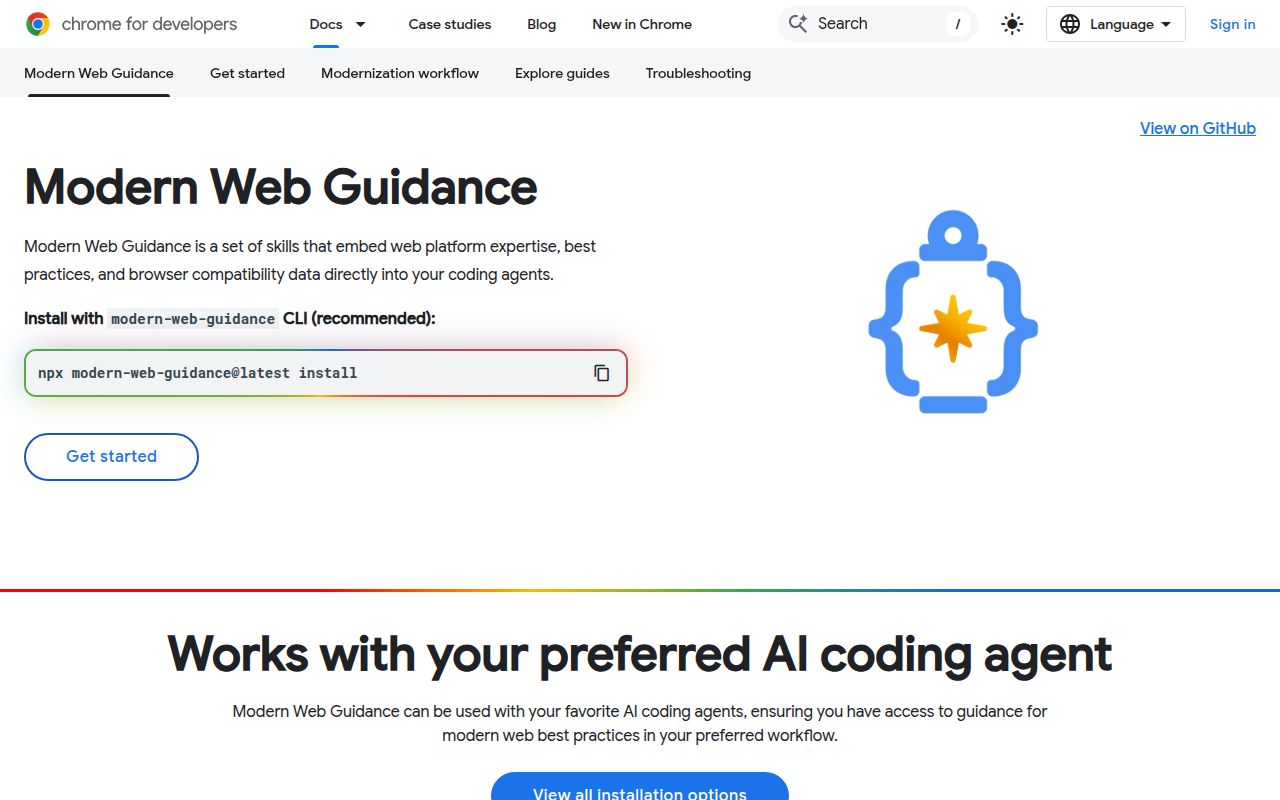
The contribution guide identifies the installation repository as a read-only distribution of compiled skills and plugin configurations. The README also documents an interactive installer:
npx modern-web-guidance@latest install
This is the README's installer command, not a command executed in our recorded source-workspace run. It requests the latest package rather than pinning the measured source commit. The source installation footprint below should not be treated as the cost of installing the distributed skills.
The README also gives examples of searching for dialog animation guidance, retrieving a guide by ID and scanning a codebase for legacy patterns. Those are documented entry points. Our record does not show a coding agent applying a retrieved guide or demonstrate the quality of its resulting code.
What happened when we ran it
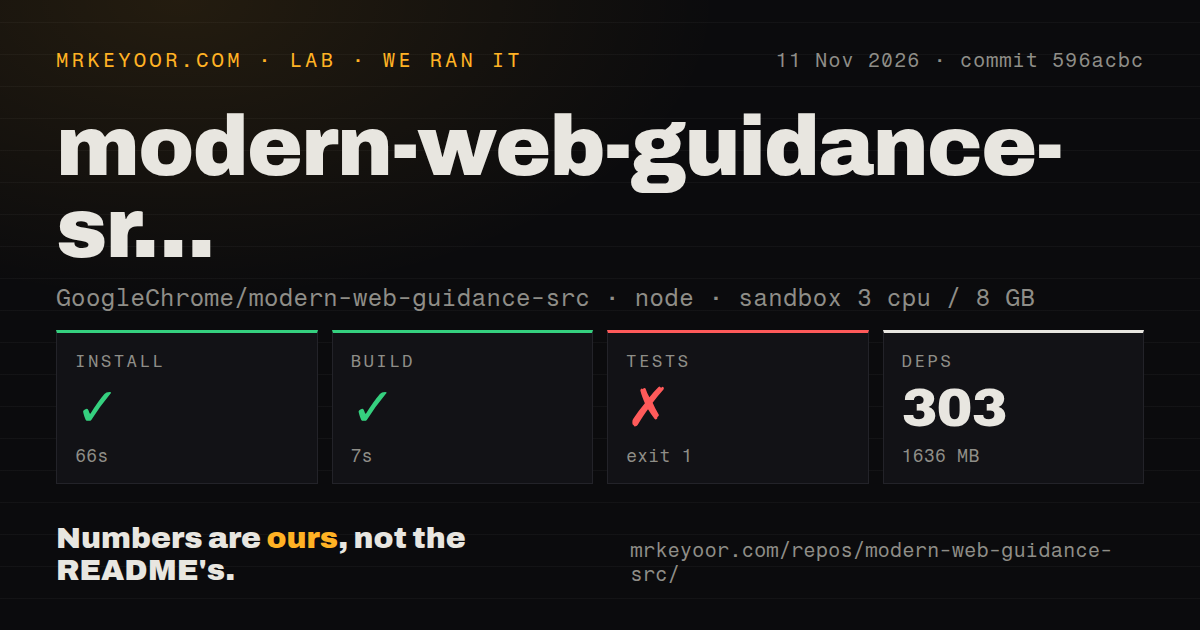
Our source installation succeeded in 66 seconds and its build in 7 seconds, but tests failed with exit 1 after 155 seconds. The run used commit 596acbc on 2026-11-11. It recorded 303 dependencies and 1,636 MB on disk. A successful build therefore left contributor validation incomplete.
The supplied test tail contains expected: undefined and operator: 'fail', followed by lifecycle failure messages. Its summary fragments report failed subtests, but do not identify the assertions or provide enough context to diagnose them. Adding those fragments together would not establish a unique failing-test count. The record does not support a package, environment or browser explanation for the failure.
The sandbox configuration specified 3 CPUs, 8 GB RAM and image lab-node:22. Actual runtime and operating-system versions require toolchain logs beyond that label. The checkout scan recorded 2,350 files, about 177,327 source lines and 100.3 MB. It found six CI workflow files, no Dockerfile and no separate tests directory. The test command nevertheless ran and failed.
These checks do not establish that the distributed skills are broken or that their advice improves agent output. The useful next step for a contributor is to obtain the complete failure output and identify the failing assertions before calling the checkout validated.
Contribution rules affect where to start
New guidance is reserved for onboarded Peers unless a Content ATL or Owner permits it. Anyone can propose use cases through issues or submit pull requests to improve existing guides. A small correction to an existing guide is therefore a different contribution path from writing a new guide from scratch.
All submissions require a signed Google contributor agreement before merging, including documentation-only changes. For new guide topics, significant refactors and new architectural features, the contribution guide asks for an issue first to agree on scope and design. It permits direct pull requests for typo fixes, minor documentation clarifications and small bug fixes.
The guide separates guidance-content work from tooling, infrastructure and evaluations. Choose the relevant track before preparing a submission. The source setup uses pnpm and requires Node.js >=22.18.0. Its documented full preflight command builds distributions, typechecks, lints and runs unit tests:
pnpm preflight
This command is quoted from the contribution guide; the lab record does not identify its test command as this complete preflight. The recorded successful build cannot establish that all contributor checks passed. The supplied documentation extracts also do not establish that every documented instruction matches measured commit 596acbc.
Decide how to handle query telemetry
The README says Google collects anonymous usage information, including installation counts, the calling agent name, guide retrieval IDs and agent-generated CLI search queries. It says raw user prompts are not collected. These are the project's descriptions of its collection policy; our run did not inspect network traffic.
The README documents DISABLE_TELEMETRY=1 as the opt-out. Teams evaluating the skills on work-related queries should review that policy and choose their configuration before the trial. The supplied excerpts do not establish local-search network behavior or experimental-feature retrieval controls, so this review makes no claims about those behaviors.
Choose a reference or data catalog for narrower needs
MDN Web Docs documents CSS, HTML, JavaScript and Web APIs. Its content repository describes reference documentation and learning resources. Choose MDN when the immediate task is to read web-platform documentation directly rather than work on an agent-guidance repository.
web-features publishes feature identifiers with Baseline statuses. Its README describes a shared feature catalog and browser-availability data. Choose it when your tooling needs those identifiers and support data rather than authored implementation guidance.
Neither alternative was measured alongside Modern Web Guidance. This comparison distinguishes their documented purposes and makes no speed or quality claim.
For a contributor trial, start with the relevant contribution track and a small existing-guide change. Resolve the recorded test failure with complete logs before expanding the work. For skill adoption, use the documented distribution path and evaluate its behavior in your intended coding agent; the source build alone cannot answer that question.