
Game Boy-only support is the reason to choose Slot
Slot turns a supported Anbernic handheld into a Game Boy-focused interface with shelves of cartridges and a choice of emulator core. The README limits the game library to GB, GBC, and GBA. That makes the project unusually easy to judge: if those are the games you reach for, its narrow interface has a purpose. If you want the same device to browse many console libraries, you will run into its boundary immediately.
Our source checkout contained 395 files, about 59,603 lines of source, and occupied 19.1 MB. It is a Rust frontend, with separate crates for graphics and other parts of the application. The README's cartridge-carousel and core-picker demonstrations explain the intended interaction. They do not establish how well your own games will run. I'd choose Slot for that particular cartridge experience, rather than as a general replacement for every feature in stock firmware.
What happened when we ran it
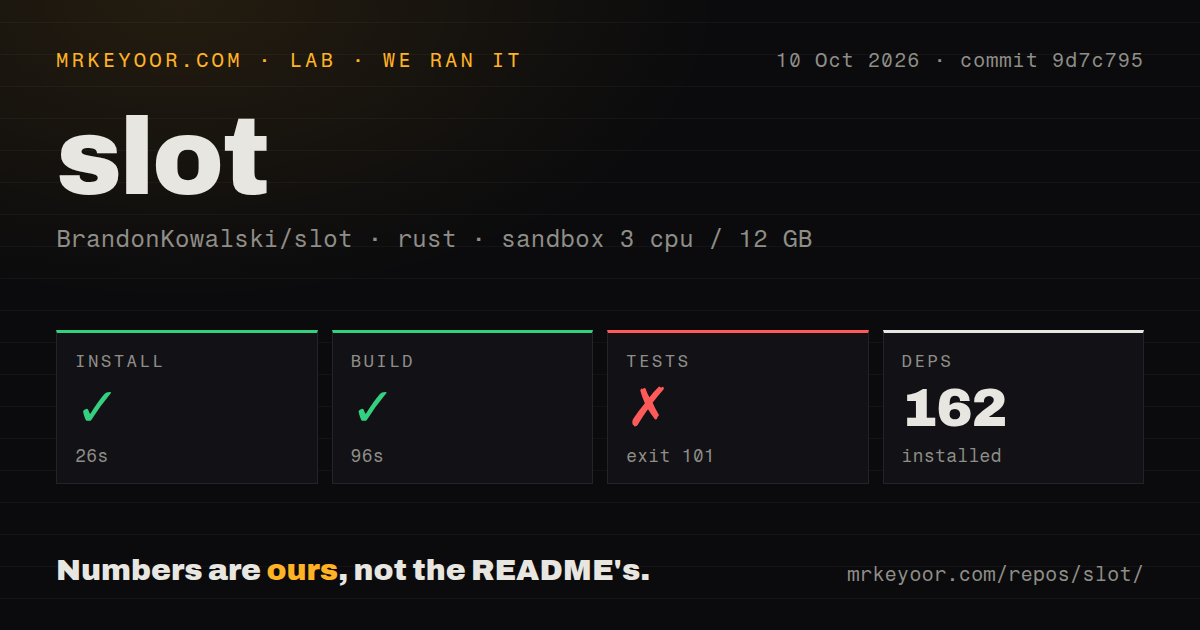
Our run installed Slot commit 9d7c795 in 26 seconds, adding 162 packages, and completed the build in 96 seconds. We cloned it on October 10, 2026, in a fresh Debian sandbox with 3 CPUs, 12 GB of RAM, and the lab-rust:1 image. The container was unprivileged and held no secrets. These results establish that the source build completed in this environment, without measuring gameplay on an Anbernic device.
Tests failed with exit 101 after 34 seconds. The log says Cargo could not compile the record example because of an unresolved import, then identifies HeadlessSurface as configured out under a macOS condition. This is a concrete platform problem on the path our test command took. The log tail does not report how many assertions passed, so there is no defensible test count or claim that every part of the suite failed.
The supplied scan found 2 CI workflow files, no Dockerfile, and no tests directory. That last signal is limited: the source tree also contains tests nested inside crates. It should not be read as proof that the project has no tests. The useful finding remains the failed command and its compile error. A working build followed by a blocked test step gives contributors less confidence than a green run of both commands would.
The recording example imports a macOS-only graphics surface
The graphics module at the measured commit exports HeadlessSurface only under cfg(target_os = "macos"). The record example imports that name. This source detail agrees with the log's platform restriction. It gives a contributor somewhere specific to investigate, without turning the example's compilation failure into a claim that the device frontend cannot run.
The 96-second build and 34-second failed test step concern different targets reached by the sandbox commands. Neither number predicts game frame rate, device boot time, or battery use. A Linux contributor who needs the recording example should treat its macOS-only import as an obstacle before planning around it. Handheld users following the release-image route have a different question: whether the packaged frontend behaves correctly on their supported device and chosen games.
Device installation starts with BaseOS and an SD card
The Slot user guide asks you to flash BaseOS, then copy the extracted Slot release onto the card. Games belong in platform folders and must be unzipped. This is local software, without a hosted API credential in the documented installation path. It needs a supported handheld and prepared storage. The sandbox's package installation does not perform the card preparation or establish that a release boots on physical hardware.
The 162 packages installed in our sandbox describe source development, not the files you must compile yourself to use a release. Device details still matter. The README marks RG34XXSP support as lacking stick support and gives RG28XX owners a rotation setting if the picture is upside down. Issue 50 clarifies that this export must precede the launch script's exec, a useful detail for someone editing that script.
Achievements and Bluetooth headphones are outside the intended feature set
The guide explicitly declines RetroAchievements, cheats, and Bluetooth headphone pairing. Those are reasons to choose another frontend if they are part of your routine. The maintainer also asks contributors to discuss proposed work first and says the project should remain light on features. Treat that as a scope decision. There is no basis for presenting the missing features as an upcoming roadmap or promising that enough requests will change it.
Our 19.1 MB checkout and successful build offer no evidence about power management. Issue 49 asks for a longer lid-close delay or deeper standby because reopening after shutdown requires a cold start. The guide documents saving on lid close and eventual power-off. If quick pickup after a pause matters more than the cartridge presentation, investigate that behavior before replacing the setup you already use.
October 10 activity shows fixes alongside unresolved gameplay reports
The last push was October 10, 2026, and v1.6.0 shipped that day. GitHub returned 98 stars and 14 open issues and PRs. The release notes add RG28XX support, a warning for failed save writes, and crash-log retention. These are practical changes for handheld owners. Their presence supports a finding of current maintenance, even though the project has a small visible audience.
Issue 48 reports intermittent GBA frame drops, and an open pull request proposes an audio-pacing change as a suspected fix. That is ongoing investigation, without proof of resolution. I'd compare MustardOS for its wider device-management interface or KNULLI for multiple emulators and game engines. Choose Slot only after checking your own save, resume, and audio behavior on the handheld: the 96-second build cannot settle those decisions for you.