The model writes an HTML film that Chromium renders
Shipvideo, presented as LaunchVideo in its README, turns a URL or prompt into a launch clip by having a language model write an HTML scene. Chromium draws that scene frame by frame, and ffmpeg encodes an MP4. This approach suits animated text and explanatory diagrams. You can inspect the renderer and agent instructions rather than treating the whole video as an unexplained output from a video-generation model.
The 0.4 MB checkout we measured contains an OpenComputer director agent and a separate Next.js frontend. The form starts a session, sends the brief, and polls for a downloadable file. The model decides the shots and words, while browser code supplies the motion. That's useful for a developer exploring automated launch graphics, although anyone needing exact approved wording should still inspect what the agent produced.
What happened when we ran it
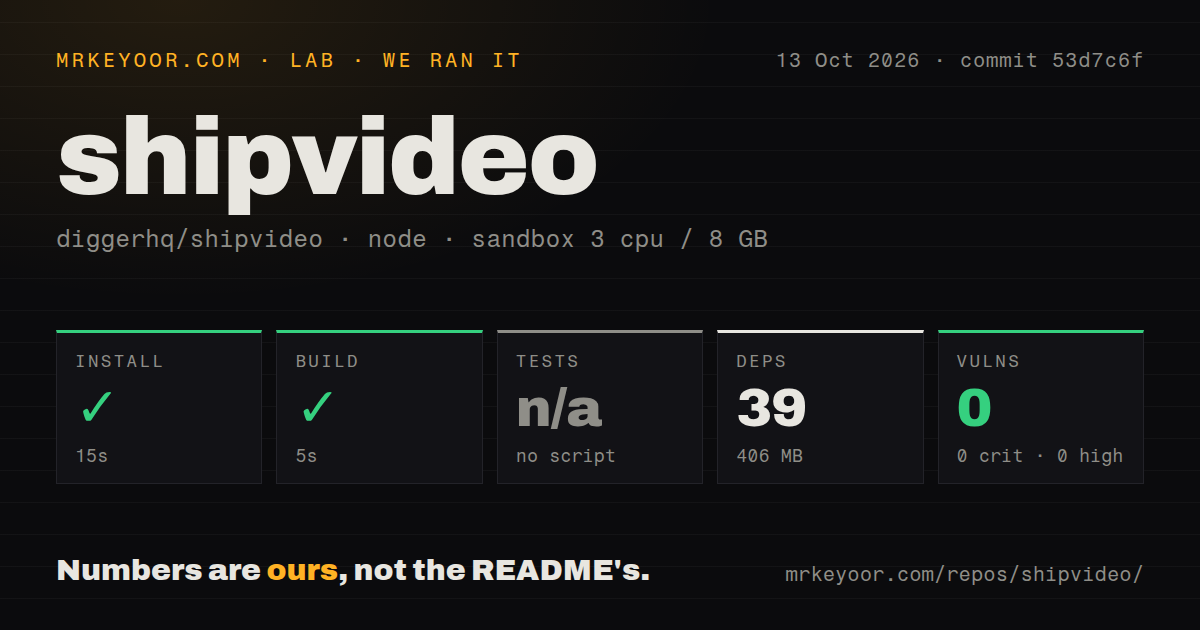
Our sandbox installed commit 53d7c6f in 15 seconds, adding 39 npm packages and occupying 406 MB on disk. The build succeeded in 5 seconds. We ran the October 13, 2026 check in an unprivileged Debian container with 3 CPUs, 8 GB of RAM, Node 22, and no secrets. The checkout contained 41 files and roughly 1,418 source lines.
Tests were skipped because there was no test script or target. The scan found no tests directory, no Dockerfile, and 0 CI workflow files. Npm audit reported 0 known vulnerabilities across critical, high, moderate, and low severity categories. These results establish a successful repository setup and build. They do not establish a completed video job, visual quality, rendering speed, or reliable downloading from the managed service.
The passing build does not validate the video service
The root package's build command is tsc --noEmit, a TypeScript check. The web/ package separately defines its Next.js build. This distinction matters when reading the lab result: a working agent package cannot tell you whether the frontend, session provisioning, Chromium startup, and signed download path all work together. Each of those belongs to the product's actual execution path and needs verification on the intended deployment.
Our 5-second build is therefore an encouraging starting result with a narrow scope. The README's complete workflow requires an OpenComputer account and deployed agent. The frontend needs OPENCOMPUTER_API_KEY and an agent identifier. Its run instructions also use Vercel tooling. A developer can work through these steps, but the small form hides an external service dependency that a repository compiler check cannot exercise.
Session storage removes a separate upload service
The completed MP4 goes into /workspace/videos/<job>.mp4, and the frontend requests a signed workspace download. That design avoids configuring another object-storage bucket just to retrieve the result. The agent can also run through the playground or CLI without the web form. For someone trying the project privately, direct session-file retrieval provides a useful way to separate rendering problems from frontend problems.
The 406 MB installed footprint excludes any unmeasured rendering-runtime setup. Source code bootstraps Playwright, ffmpeg, browser libraries, and fonts inside the session environment. The documented target is an Amazon Linux arm64 microVM, so moving this mechanism to an ordinary local container requires checking its package and browser assumptions. Our Debian run supplies no timing or success result for that bootstrap. Budget the deployment work separately from the npm setup.
Audio, footage, and external images are outside the scene design
The scene tool rejects HTML containing audio, video, or iframe elements. Agent instructions also forbid external images and CSS transitions, directing the model toward inline SVG, canvas, and keyframe animation. These are concrete creative boundaries. A text-led explanation of a software feature fits. A product spot built around camera footage, music, or a recorded presenter requires another production path rather than a more elaborate prompt.
Our 39-package setup says nothing about whether your chosen language renders legibly. Issue 3 reports garbled Chinese text, attributed by its author to a possible missing font. It was closed on October 10 without comments describing a fix. That is a user report, not a failure from our sandbox. If your launch needs Chinese text, verify actual frames before treating the issue's closed status as evidence that the output is correct.
Scene checks catch browser errors, not inaccurate product claims
check_scene loads the HTML under a virtual clock and reports browser errors plus visible text at selected timestamps. The agent is instructed to repair problems before rendering. That's a useful inspection loop for lingering text and empty beats. It still relies on the model to interpret the report, and it cannot establish that the claims on screen match your product's capabilities or approved messaging.
With no test target in our snapshot, I would keep the first deployment private and inspect representative jobs. The public-form limiters store counters in process memory, and their source calls them soft ceilings per function instance. It identifies a Vercel Firewall rule as the harder control. If you expose your own form, confirm the actual request controls before assuming those counters provide an account-wide spending limit.
October maintenance leaves the license question unanswered
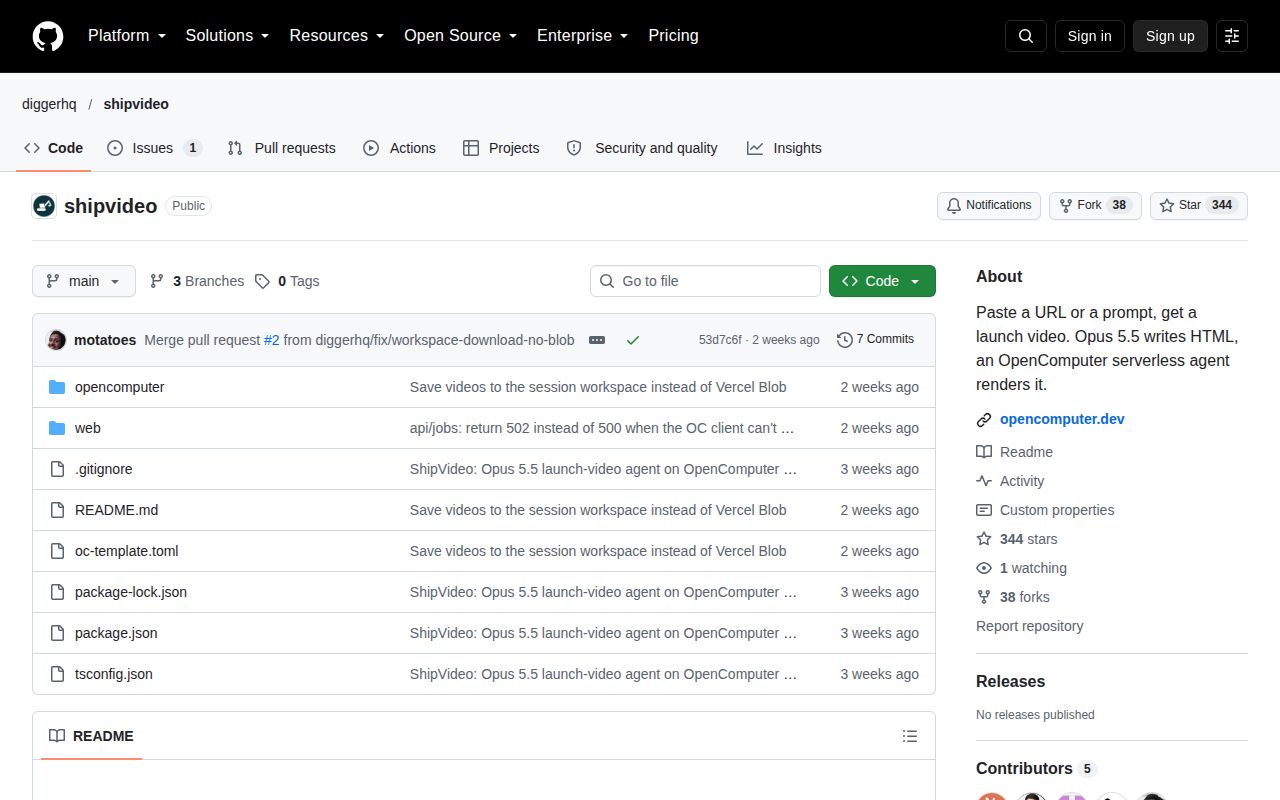
GitHub reported a last push of October 1, 2026, 344 stars, and 1 open issue or PR. Recent activity includes the merged workspace-storage change and the closed Chinese-text report. The latest-release endpoint returned no release. Those dates show maintenance and user feedback close to the lab run, but the available history is too thin to infer a dependable release process for an unattended production service.
The October 13 snapshot also had 0 CI workflows. More immediately, GitHub identified no license, the file tree contains none, and open issue 1 asks whether a license is missing. That unresolved question prevents me from recommending routine commercial reuse. Remotion is a better candidate for an authored React video system, subject to its own license terms. Motion Canvas fits code-controlled explanatory animation with preview and voice-over synchronization. Choose Shipvideo for investigating this particular managed-agent workflow, then verify a complete render and download before adopting it.