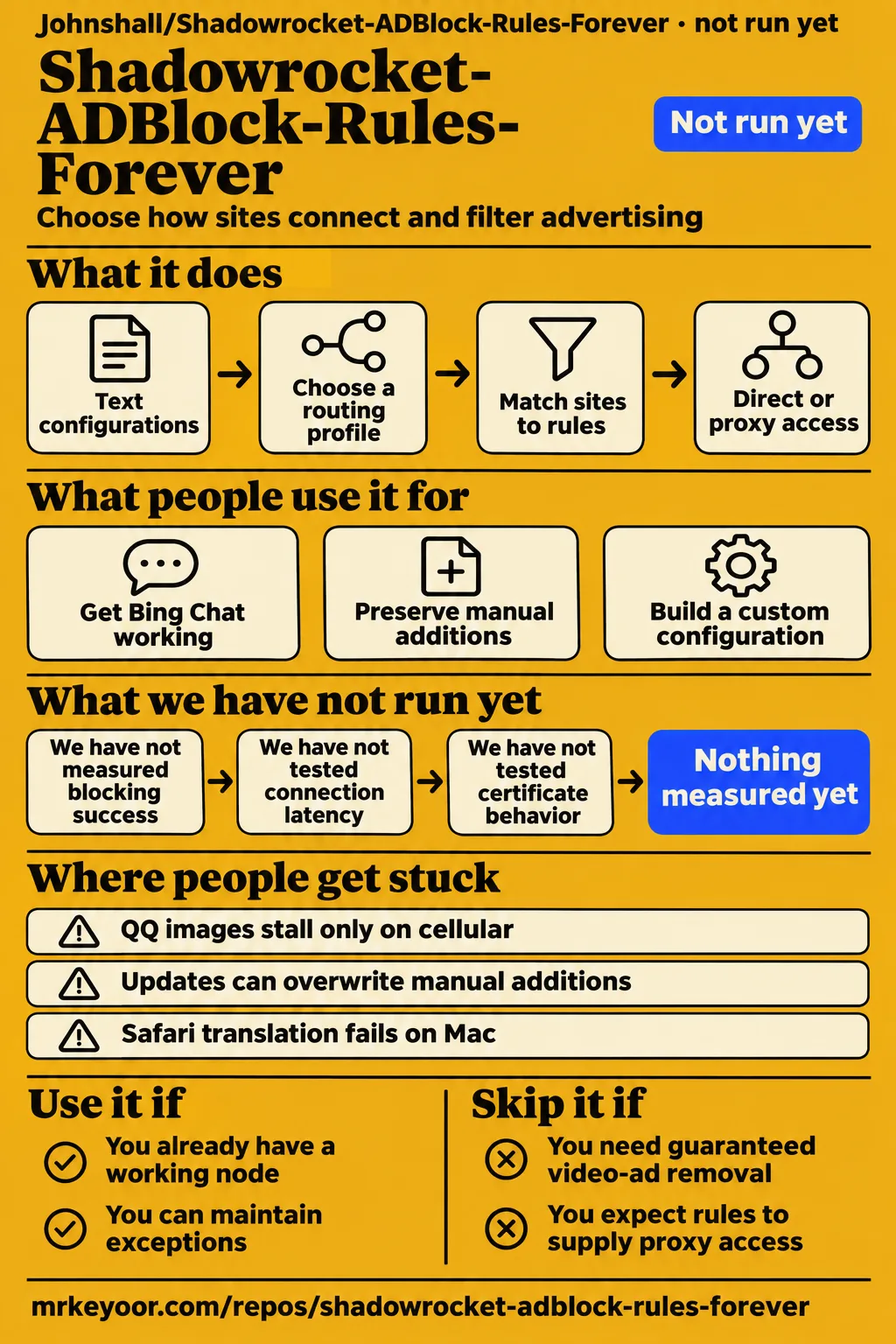
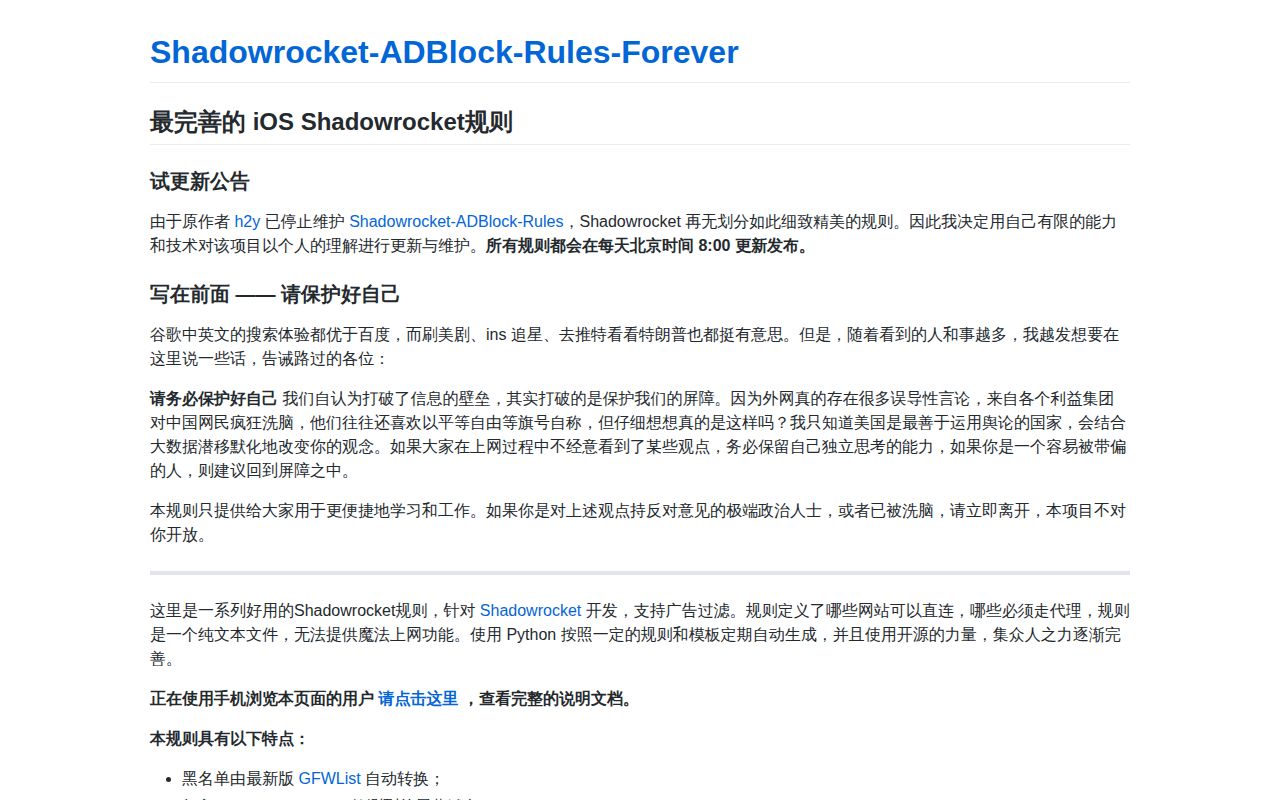
Use Shadowrocket-ADBlock-Rules-Forever if you already have Shadowrocket and want to choose how unfamiliar sites are routed. Skip it if you expect the download to supply a proxy connection or reliably remove every video ad: the README explicitly rules out both expectations. Our sandbox stopped before execution. This is a review of the configuration choices and reported failure paths, with no claim of measured blocking performance.
The decision starts with the fallback: where does a request go when no specific rule matches? A blacklist defaults to direct access; a whitelist defaults to the proxy. That distinction is more useful than the word “Forever” in the name or a promise of daily updates. Johnshall documents both defaults, and they make different omissions costly for different readers.
What people use Shadowrocket-ADBlock-Rules-Forever for
Really-well used a Bing proxy override to get Bing Chat working under domestic/international routing, while other users reported messaging and browser problems under particular profiles. These are individual reports, with different outcomes:
| Person and task | What happened | What you can take from it |
|---|---|---|
| Really-well, Bing Chat | Adding a leading Bing proxy rule restored Chat in issue #125. | A website loading does not mean every service on that site gets the route it needs. |
| AzuMiWanHua, QQ images over cellular | The domestic/international profile stalled images; the blacklist worked, and reinstalling the app resolved the reported case in issue #31. | Record the network and profile before deciding the list is at fault. |
| momochina, Safari translation on macOS 13 | Translation failed with the proxy enabled but worked on iOS; the reporter suspected client behavior in issue #62. | A working phone configuration is insufficient proof of identical Mac behavior. |
| fwilyair, preserving manual additions | The user described a Python workflow that fetched fresh rules and merged a separately maintained custom list in issue #125. | Local customization can become an ongoing maintenance job. |
| h31105, composing a custom configuration | A published Gist combines Johnshall's blacklist reference with DivineEngine advertising and China lists in Shadowrocket-Default.conf. | The project can be a component inside a personally maintained configuration. The Gist documents composition, not a successful device test. |
The Bing case explains the appeal. Really-well could reach Bing directly but could not use Chat. Johnshall suggested placing DOMAIN-SUFFIX,bing.com,PROXY first, and Really-well reported success. Later, Johnshall linked a commit and mario-huang replied that it worked. The same discussion immediately exposed the next problem: a manual change could disappear on refresh. That sequence is documented in #125, so the useful outcome includes both the routing correction and the need to preserve it.
What happened when we ran it
Our measurement setup on November 23, 2026 allocated 3 CPUs and 8 GB RAM, but the sandbox recorded NOT RUN at commit f4341bf: no supported ecosystem was detected, the language was null, and there was no Dockerfile. The image was marked n/a. These settings describe the sandbox allocation, not device requirements or actual runtime versions.
| Check | Recorded outcome | Meaning for this review |
|---|---|---|
| November 23 repository sandbox | NOT RUN: no supported ecosystem; language null; no Dockerfile | No installation, build or test result was produced. |
| November 25 Compose prerequisite | Safety step failed because no supported Compose filename existed | The container workflow stopped before a deployment. |
| November 25 cleanup | Teardown reported ok | Cleanup success says nothing about rule behavior. |
The later attempt hit this exact prerequisite error: unsafe repo: none of compose.yaml, compose.yml, docker-compose.yaml, docker-compose.yml exists (rule: a compose file is required). The accompanying generic run summary says “deployed with its own docker compose”, but that conflicts with the actual failed step. It cannot support a successful-deployment claim.
This is a limitation of the execution path. The project distributes text configurations for Shadowrocket; the failed Compose check is not evidence that those configurations fail on an iPhone. Importing a file into the intended client is the relevant next evaluation, rather than treating the absence of a container stack as a product defect.
Choose the default route before adding ad filtering
Blacklist profiles default unknown sites to direct access, while whitelist profiles default them to a proxy, according to the project's profile-selection FAQ. Choose that behavior before deciding whether you want the advertising lists attached.
For mostly direct browsing, the blacklist makes you dependent on the restricted-domain list catching the sites that need a proxy. For proxy-first browsing, the whitelist makes you dependent on the direct list catching services you want to keep local. These are consequences of the documented defaults, not speed rankings. “Domestic” in the profile names means China; it does not automatically mean your home country.
The domestic/international variants route Chinese sites directly and foreign sites through a proxy. The return-to-China variants reverse that arrangement. The README also offers direct-with-filtering, proxy-with-filtering and an ad-only file without routing rules. Its selection table separates these purposes. You do not have to adopt a split-routing policy just to examine the filtering component.
Avoid choosing sr_adb.conf because its filename looks like the obvious starting point. Its own comment identifies it as an old blacklist retained for backup and backward compatibility, generally unnecessary for new selection. That warning is inside the file. Start from the named profile in the current selection guide instead.
Where people get stuck: similar symptoms have different causes
YouTube playback failures and missing messaging images led to different workarounds in the tracker, so start with the matched domain, selected policy and network rather than applying one global fix.
| Symptom | What the named report says | Reported outcome |
|---|---|---|
| YouTube opens but playback stalls | In #25, alex14563's log included kCFStreamErrorDomainSSL and -9829; Johnshall suspected HTTPS decryption. |
The user reported restored operation. Johnshall suggested a client update or reporting client and iOS versions to the developer. |
| Proxied apps fail with decryption enabled | In #122, kumuweifengchun-sudo and dannychen0109 connected failures to HTTPS decryption. | Johnshall could not reproduce it. A bot closed the issue for inactivity, not a demonstrated rule fix. |
| WeChat Moments media keeps loading | In #40, c740030066 saw media traffic use the proxy; Johnshall attributed it to DNS resolving overseas. | Johnshall suggested a whitelist temporarily. The user's direct overrides offered intermittent relief. |
| QQ images stall only on cellular | In #31, AzuMiWanHua said Wi-Fi worked and disabling IPv6 did not help. | Reinstalling the app resolved that user's case; Johnshall had not reproduced it. |
| Safari translation fails on Mac | In #62, momochina compared macOS 13 with a working iOS setup. | A commenter suggested an Apple-domain bypass. The thread ended without a confirmed resolution. |
For WeChat or QQ, compare Wi-Fi and cellular without changing the profile first. Then compare the affected profile with the alternative that worked in the relevant report. Save the domain and the policy shown in the proxy log. This sequence combines the diagnostic questions Johnshall asked in #31 and #40. It avoids repeating the IPv6 suggestion as an established cure when the user explicitly said it failed.
DNS means the lookup that turns a service's hostname into an address. In the WeChat discussion, where that lookup placed the destination was Johnshall's explanation for an unexpected route. A blanket direct rule for every .cn address changes more than the single failing media host, so retain the narrow domain evidence when asking for help.
Updates can replace the custom rule that fixed your problem
Updating a remote configuration can overwrite manual additions, and Johnshall recommends extension configurations for those additions in issue #11. That is the maintenance cost to consider before editing the downloaded file.
The thread begins with a smaller confusion: where to enter the URL in the shortcut. Johnshall explains the initial import prompt and the second text field in the shortcut editor. It then becomes a discussion about preserving changes. After the maintainer recommends writing them in an extension configuration and closes the discussion, tianzhich still asks how that arrangement works. Closure is not a substitute for a clear walkthrough.
The ermao.net guide distinguishes the configuration file, remote rule sets and server-node subscription. A node is the proxy endpoint you connect to. Updating its subscription does not mean the routing configuration was refreshed. The guide also distinguishes replacing a configuration from compiling it to refresh referenced rule sets.
The README describes daily publication at 08:00 Beijing time and schedules its shortcut after that build window. That is a publishing schedule. In #48, Klaus-Kin reported that the shortcut worked unlocked but failed while locked; moving its schedule was suggested, with no demonstrated reliable locked-screen solution. Keep a copy of your working configuration and inspect the device's actual update result after changing the automation.
Security and transport settings deserve a separate decision
The lazy configuration changes UDP and QUIC handling as well as routing lists: it sets udp-policy-not-supported-behaviour = REJECT and block-quic = all-proxy in the reviewed lazy.conf.
Its comments explain that unsupported UDP forwarding is rejected rather than sent directly. UDP is a transport used by some applications, and QUIC is a protocol that runs over it. The QUIC setting blocks it for proxied connections while leaving direct connections outside that block. These are concrete policy choices hidden behind an easy-import label. A routing diagnosis should include them when the failing application uses the affected transport.
HTTPS decryption is another choice. It lets the client inspect encrypted requests using a certificate trusted by the device. The configuration instructions describe generating or installing that certificate and enabling trust. Do not treat that as an incidental checkbox required by every routing profile. In #40, Johnshall says decryption can be disabled when Safari's Google redirect works and the YouTube script is unnecessary.
The old YouTube script is a poor reason to enable it indiscriminately. In #25, Johnshall says the script is ineffective on newer YouTube versions and can stall at the ad-loading screen, explaining why it was disabled by default.
English readers need to translate the main project guidance
The project's README and linked import instructions are Chinese, while ermao.net publishes an English setup guide. The sampled support threads are predominantly Chinese too.
That affects troubleshooting more than importing. You can copy a configuration URL without understanding the surrounding discussion, but the distinction between a temporary workaround, a maintainer suggestion and a confirmed user retest often lives in the replies. The QQ thread is a useful example: an initial IPv6 explanation gives way to a failed retest and then a successful reinstall. Reading only the first answer produces the wrong recommendation.
The geographic assumptions also need translation. Chinese direct-routing lists and a return-to-China configuration solve specific connectivity needs. An English-speaking reader outside China should choose them for those needs, rather than assuming “domestic/international” describes a location-aware default for every country.
Shadowrocket-ADBlock-Rules-Forever vs Clash rules and browser filtering
Your client and desired default route decide this comparison before list size does: the README targets Shadowrocket, while Johnshall points a Stash user toward existing Clash resources in #61.
| Choice | What the documented comparison supports | Pick it when |
|---|---|---|
| This project's blacklist vs whitelist | Unknown sites default to direct vs proxy in the README. | You can name the fallback you want and accept maintaining exceptions. |
| Lazy policy groups vs explicit filtering variants | The October source review found no enabled advertising-blocking rejection rules in the checked lazy profile. | You want service routing and policy groups, or deliberately choose a separate filtering variant. |
| Loyalsoldier/clash-rules | Johnshall suggested it to a Stash user in #61; its own README describes Clash rule sets. | Your chosen client consumes that format. The suggestion is not a completed Stash conversion test. |
| Browser filtering plus routing-only rules | Johnshall suggests omitting the larger advertising rules when browser filtering is sufficient in the README. | You do not need filtering inside other apps. |
| Original h2y project | Johnshall says the original stopped being maintained and describes continuing its work in the README. | You are tracing the project's lineage, rather than looking for a measured competing winner. |
A second project to consider is blackmatrix7/ios_rule_script. Its README describes routing rules, rewrites and automation scripts across platforms. It is a candidate when you want individual components to assemble yourself, rather than Johnshall's profile menu. Johnshall already lists it among the sources used for the lazy configurations, so these projects are related building blocks rather than wholly independent competing products.
What the other reviews get wrong
The jiasuqifanqiang.org and jiasuqijichangtuijian.blog guides attach advertising-blocking claims to an import of lazy_group.conf, but ermao.net's dated inspection found none enabled in the profile it checked.
Both jiasuqifanqiang.org's guide and jiasuqijichangtuijian.blog's guide describe the imported configuration as blocking advertising and tracking domains. The author of ermao.net's October 9, 2026 review inspected the upstream configuration and all 34 enabled remote rule sets. None contained advertising-blocking rejection rules. The correction is specific to that inspected profile and date, not a claim that Johnshall distributes no ad-blocking files.
Those two guides also send readers to Subscription settings for configuration freshness. Ermao.net distinguishes node subscriptions from configuration updates. Follow the update target, not a similarly named switch.
Couleurapp's listing says the policy-group configuration needs no further adjustment, promises full web and app advertising removal, and says daily updates guarantee freshness without manual maintenance. The README tells users where to configure proxy groups and explicitly disclaims complete filtering. Ermao.net adds the practical requirement that groups contain usable selected nodes. The locked-phone failure in #48 is a concrete counterexample to assuming an upstream schedule guarantees a device refresh.
Questions people ask
Shadowrocket-ADBlock-Rules-Forever supplies text configuration files for Shadowrocket; it does not supply the proxy connection, as the README explains.
What is Shadowrocket-ADBlock-Rules-Forever?
It is a collection of routing configurations with optional advertising filtering for Shadowrocket. The README describes generated text files that decide which sites connect directly and which use a proxy. Bring your own working node for proxy access.
Will thousands of rules slow down my connection?
The maintainer says Shadowrocket builds a search structure and caches matches instead of checking every line for every request. That is an implementation explanation attributed in the README, not our latency measurement. Rule count alone is an inadequate basis for promising either a slowdown or a speed gain.
Why are some ads still appearing, especially video ads?
The README explicitly says filtering is incomplete, especially for video ads, and that simple URL matching cannot fully remove YouTube advertising. Its FAQ also says app updates can change advertising strategies. First make sure the file you chose actually includes filtering.
Why does YouTube open but leave videos stuck on the thumbnail or loading screen?
Users in #25 and #122 connected that symptom to HTTPS decryption, and Johnshall separately warned about the old YouTube script. #25 includes a restored-operation report; #122 ended with an inactivity closure. Compare behavior with the script and decryption disabled before treating every rejected request as an ad successfully blocked.
Should I enable HTTPS decryption for domestic-direct, foreign-proxy routing with ad filtering?
Johnshall says it can stay off when Safari's Google redirect works and you do not need the YouTube script. That answer appears in #40. Routing, filtering rules and encrypted-request inspection are separate choices, with a documented certificate-trust step for inspection.
Can scripts stay enabled by default after daily configuration updates?
A commenter in #40 suggests forking and changing the enable field, while Johnshall points to the update instructions. The same discussion says the old YouTube script is disabled by default. Treat permanent enablement as your maintained customization, rather than a reason to turn on every bundled script.
Where do I enter the rule-file URL in the automatic-update shortcut?
Enter it in the prompt shown on initial import, or open the shortcut's three-dot editor and use the second text field. Johnshall gives both routes in #11. Use this project's shortcut instructions rather than assuming a different lazy-rule shortcut takes the same input.
Why does the update shortcut fail when my iPhone is locked?
Klaus-Kin's iOS 16 report says the shortcut could not open the app through the shadowrocket URL scheme while locked, although manual execution worked unlocked. #48 records the failure and the suggestion to schedule it later. That suggestion is a workaround, not proof of reliable locked-screen execution.
Why does Safari's google.cn redirect stop working after a configuration update?
The README advises toggling HTTPS decryption off and on after an update. In #34, Magi-xu reported that changing escaped slashes avoided the repeated toggle, and Johnshall linked a fix commit. This is a historical reported fix, not a reason to rewrite every redirect expression yourself.
Why do WeChat Moments photos and videos fail to load with these routing rules?
In #40, Johnshall attributed one user's unexpected media proxying to DNS resolving overseas and suggested a whitelist temporarily. The user described intermittent results from direct overrides. Capture the media domain and its matched policy rather than assuming every WeChat failure has that cause.
Why do QQ images stall on cellular data while Wi-Fi works?
AzuMiWanHua reported exactly that difference in #31, but disabling IPv6 did not solve it. The user ultimately reported success after reinstalling the app. The report supports checking network, profile and client state, not diagnosing every cellular failure as an IPv6 problem.
Why does Safari translation fail on macOS when the proxy is enabled?
momochina reported failure on macOS 13 alongside working iOS translation and suspected Shadowrocket behavior. #62 contains an Apple-domain bypass suggestion but no confirmed successful retest. The maintainer also said Apple domains were already direct in the whitelist, so the suggestion should not be presented as a proven fix.
What we have not tested yet
We have no controlled device measurements of blocking success, false positives, connection latency, memory, battery use or throughput. The recorded sandbox settings do not identify an actual operating system or runtime, and the failed Compose prerequisite produced no deployed application to measure. The November 25 summary and failed step conflict; only the latter records an execution outcome.
We have not reproduced the extension-configuration procedure, locked-screen automation, transport-policy effects, certificate behavior, or the messaging and translation workarounds on current clients. The video entries contain no transcripts, so they support no claim about what a creator demonstrated. No relevant Reddit or X account of use accompanies this review.
Profile freshness also needs a separate audit. The retrieved blacklist artifact carries a November 15 build timestamp while the whitelist artifact carries November 24; the lazy file has a different dated header. Those artifacts, the whitelist and lazy.conf do not resolve whether the difference comes from delivery, collection timing or update schedules. The README also says its top500 table was rebuilt from an old ranking after free access to the ranking stopped. A fresh generated file is not proof of fresh ranking input.
No comparison here measures competing lists on the same device, network and workload. The useful next result is a device run with the exact profile URL and file saved, matched-rule logs for your essential services, and a refresh that demonstrably preserves your custom exceptions.