It is a reference library, not a coding platform
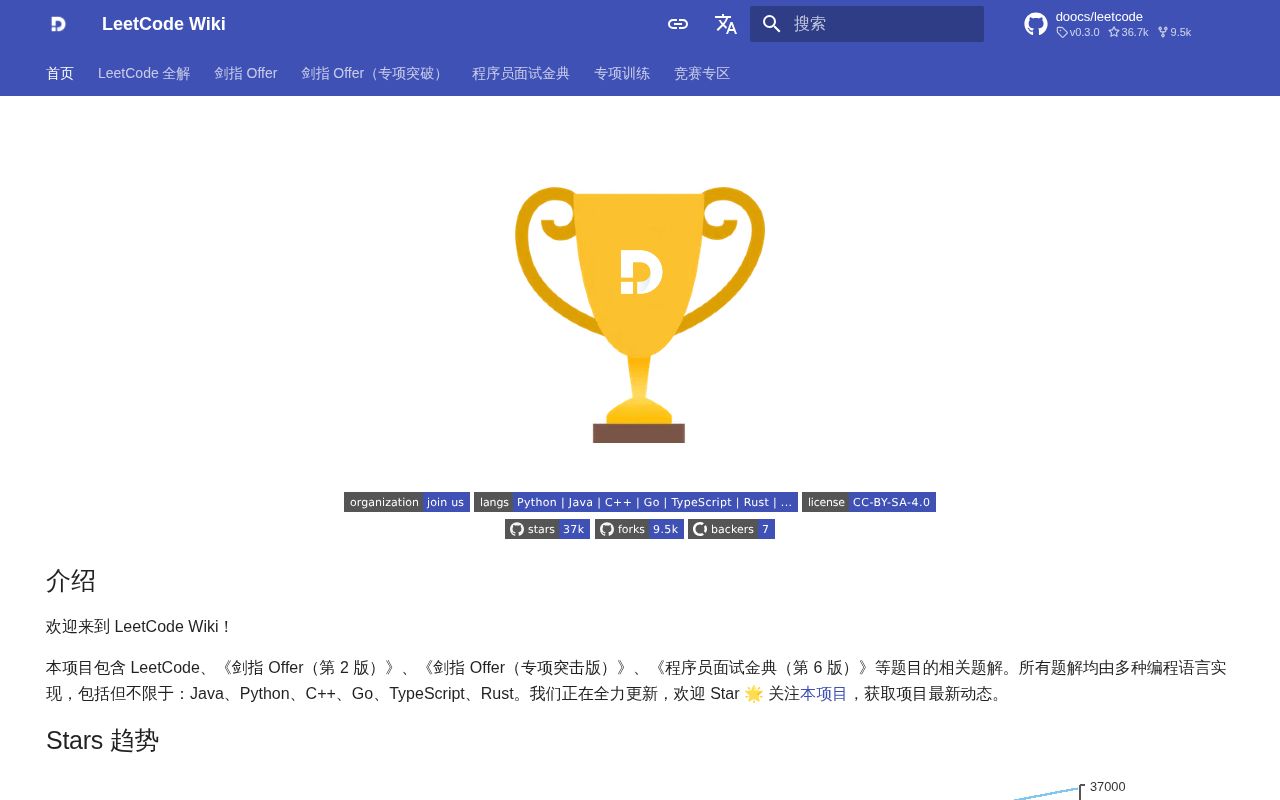
doocs/leetcode is best understood as a very large answer shelf for algorithm practice. The repository has 36,546 stars and centers on LeetCode, while also covering the second edition of Sword Offer, its focused edition, and the sixth edition of Cracking the Coding Interview. Its main documentation is Chinese, although an English README exists. That language choice is central to the experience: English readers can navigate the project, but the strongest fit is someone comfortable studying explanations and indexes in Chinese.
The project addresses a familiar interview-preparation problem: one site may give you a prompt, but you still need a clear implementation and a way to connect that problem to a reusable technique. The README does this through links grouped under basic algorithms, data structures, and search. It names at least 6 implementation languages, including Java, Python, C++, Go, TypeScript, and Rust, so it is useful when a concept makes sense in one language but you want to see how another expresses it.
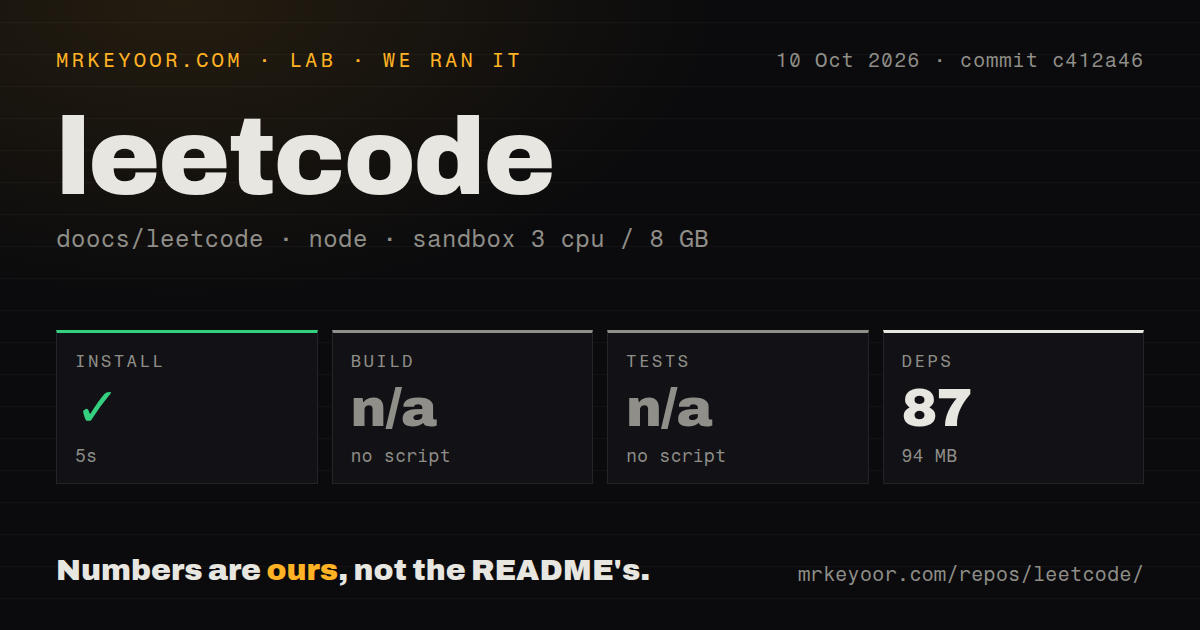
Our install worked, but there was nothing to build or test
We cloned commit 60ada74 into an unprivileged Debian sandbox with 3 CPUs and 8 GB of RAM. In our run, pnpm installation succeeded in 13 seconds, installed 86 packages, and occupied 92 MB. That is a clean result for dependency setup. The more important finding is what came next: the repository provides no build script or target and no test script or target, so both stages were skipped. A skipped test step is not a passing test suite.
The checkout itself contained 35,982 files, about 610,402 lines of source, and consumed 228.2 MB. We also found 13 CI workflow files, no Dockerfile, and no tests directory. Those facts make sense for a content-heavy repository, but they change what “running it” means. This is not a typical Java or Node application where installation leads to a server and a green test command. The hosted documentation is the product; the local tree is mainly the underlying corpus and tooling.
The strongest feature is practical indexing
The README does more than dump links by problem number. It creates routes into concepts such as binary search, prefix sums, difference arrays, two pointers, monotonic stacks, monotonic queues, hashing, breadth-first search, depth-first search, backtracking, pruning, and A*. That is genuinely helpful because interview study rarely proceeds neatly from problem 1 upward. A learner can identify a weak technique, select several examples, and compare how the pattern changes across constraints.
Specific entries show the value of that organization. The basics list connects problem 34 to binary search, problem 912 to quicksort and merge sort, and problems 303 and 304 to one-dimensional and two-dimensional prefix sums. The data-structure section groups Daily Temperatures, Sum of Subarray Minimums, and other problems under monotonic stacks. The search section distinguishes ordinary BFS, multi-source BFS, bidirectional BFS, deque-based BFS, and A*. Those labels turn a giant archive into a usable revision map.
Verification is the biggest rough edge
The absence of a test target matters. A solution repository can contain code that was accepted under a particular judge, language version, or input contract, yet still be awkward to validate as a whole. Our run found no tests directory and could not execute a repository-level suite. That does not show the answers are wrong; it means users should not confuse a large catalog with a centrally verified software package. For serious teaching or reuse, run the selected solution against the original problem cases yourself.
The repository is also heavy for someone who only needs a dozen patterns. At 228.2 MB checked out, cloning everything is less convenient than using the hosted site. There is no Dockerfile, and installation does not culminate in a documented build artifact in the measured workflow. The CC-BY-SA-4.0 license is friendly to sharing, but its attribution and share-alike terms deserve attention if you plan to republish explanations or build commercial course material from them.
Current activity outweighs the old release tag
The latest tagged release is v0.3.0 from February 20, 2025, which is old relative to this review. That alone is not a reason to call the project abandoned. The repository was pushed on September 4, 2026, the day of our review, and has 36,546 stars. For a documentation corpus, ongoing commits can be a better health signal than frequent packaged releases because new problems and translations may land without needing a formal version.
The reported open-issue count is 0. That looks tidy, but it is not enough evidence to claim flawless maintenance or unusually fast support. Zero can reflect prompt issue handling, a preference for pull requests or discussions, or simply the current snapshot. Taken together, same-day code activity and substantial adoption indicate an active project, while the February 2025 release date suggests consumers should follow the main branch or hosted site rather than wait for frequent versioned bundles.
It belongs beside your practice workflow
In a real study stack, doocs/leetcode fits after the problem statement and before your own final implementation. Read the original prompt, attempt a solution, then use this repository to compare techniques or language syntax. Keep your own notes and executable tests elsewhere. It should not be wired into production as a runtime dependency, and the 610,402-line corpus is not a substitute for measuring the complexity and correctness of the specific code you adopt.
Choose walkccc/LeetCode when you want a more English-first companion site, kamyu104/LeetCode-Solutions when terse accepted implementations are the priority, or labuladong/fucking-algorithm when pattern-oriented Chinese teaching is more valuable than exhaustive problem lookup. doocs/leetcode wins on breadth, multilingual comparison, and structured topic lists. Its tradeoff is equally clear: our 13-second install succeeded, but the repository offered no single build or test gate that could certify the collection as a whole.