Semantic Router is useful after one model becomes several
The project handles a problem that appears after an organization has multiple inference options. A request might need a cheap model, a private endpoint, a large context window, an image-capable backend, or extra safety checks. Semantic Router evaluates configured signals and decisions before choosing a provider model. It can also run multi-model algorithms that retry, compare, or fuse responses. Applications keep calling OpenAI-compatible endpoints instead of duplicating policy in every codebase.
Version v0.3 names 21 signal families in its generated configuration catalog, ranging from keywords and language to classifiers, PII, jailbreak, and user feedback. Selection algorithms include static choice, KNN, SVM, latency-aware ranking, and multi-factor scoring. Plugins cover caching, memory, RAG, tool selection, request trimming, and response checks. This breadth is the reason to consider the project, and the reason a small application should hesitate. Every enabled component creates configuration and evaluation work.
The local stack starts four layers before a model answers
The quickstart requires Python 3.10 or newer plus Docker on Linux, macOS, or WSL2. vllm-sr serve starts the Router, Envoy, Dashboard, and supporting services. The first Dashboard setup adds model endpoints, chooses a routing preset or single-model baseline, and activates generated YAML. Envoy listens on port 8899 by default; the Dashboard uses port 8700. Native Windows Python can validate configuration, but the documented local serving path requires WSL2 or another Linux environment.
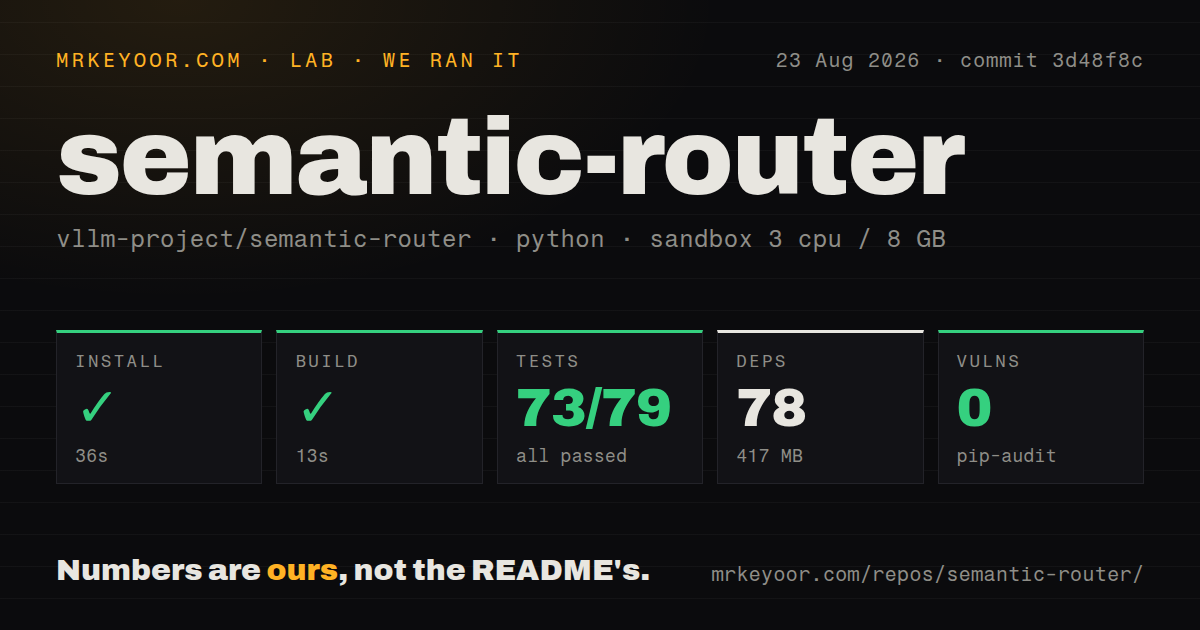
The router normally does not provision custom providers. Teams must start reachable vLLM, Ollama, hosted API, or other model endpoints and bind them in the canonical config. Secrets belong in environment substitutions such as ${MODEL_API_KEY}, with Kubernetes Secrets used in cluster deployments. The 417 MB Python environment we measured arrives before model images, weights, caches, Envoy state, or GPU runtimes, so the checkout footprint is a poor estimate of a production deployment.
What happened when we ran it
Our harness worked from the repository's ./bench/ project at commit 3d48f8c. Installation completed in 36 seconds, adding 78 packages and occupying 417 MB. The build succeeded in 13 seconds. This was a 392.7 MB checkout with 5,604 files and roughly 906,170 lines of source, which makes the project materially larger than a routing helper imported into an application. GitHub lists Go as its primary language, while our measured bench path was Python.
Tests exited with status 1 after 17 seconds. Pytest counted 73 passed, 0 failed, and 6 collection or setup errors among 79 collected outcomes. The log tail named three grounded-fusion files and three real-evaluation files, then warned that no files were found in configured testpaths. It did not print the underlying exception for those six errors, so we cannot say what dependency or service caused them. Pip-audit reported 0 known vulnerabilities in the measured Python environment.
The 73 passing tests do not cover a routed production request
Our sandbox had 3 CPUs, 8 GB of RAM, no secrets, and no model backends. It checked the bench package's install, build, and discovered tests. It did not start Envoy, download router-owned models, connect an inference endpoint, exercise a GPU, or compare routing quality. Six collection errors also mean the test command was not clean even though no executed test assertion failed. A trial should begin with one physical model and a static route before adding learned decisions.
The repository scan found 35 CI workflow files, which is substantial automation, but no Dockerfile or tests directory at the measured project root. Published v0.3.0 artifacts include separate router, extproc, dashboard, operator, shim, and ROCm images plus a Helm chart, Python package, and Rust crate. That release packaging is useful evidence of deployment intent. It also shows how many surfaces a production pin and rollback plan must cover.
Configuration is explicit enough to audit and easy to overgrow
One canonical v0.3 YAML document owns listeners, providers, routing, entrypoints, recipes, and global services. Signals detect facts, decisions define eligible routes, algorithms choose candidates, and plugins modify a matched path. Validation checks schema errors, unresolved references, invalid provider bindings, and incompatible recipe boundaries before serving. This is better than hiding routing behavior inside application code, especially when security or privacy reviewers need to see why a request reaches a backend.
The docs advise starting with the smallest configuration rather than copying the exhaustive example. Follow that advice. A 906,170-line repository with multiple gateways, storage choices, model assets, and cluster modes can make a simple two-model policy look like an infrastructure program. Direct requests to a concrete provider model bypass recipe signals, decisions, plugins, cache, learning, and session routing, so operators also need to decide whether that bypass is allowed at each public entrypoint.
Same-day activity brings support and moving parts
GitHub recorded 5,311 stars, 375 open issues and pull requests combined, and a last push on August 26, 2026. The latest stable tag was v0.3.0 from June 5, while the README points new quickstart users at a development package and tells production users to pin a stable version after checking compatibility. Current pull requests include fixes for Response API streaming through Anthropic backends and local image handling in Kind-based tests. The combined open count should not be read as 375 defects.
This is one of the few routing projects that treats model choice as an operating system problem rather than one classifier call. The design becomes worthwhile when policy, observability, gateway integration, and several inference pools already belong to the same team. Our 73 passing tests and successful build justify a controlled evaluation, while the 6 setup errors and large surface argue for a narrow first deployment. If one proxy rule can express the requirement, Semantic Router is too much software.