Twenty-six skills cover craft, medium, trade, and case studies
Plugin version 2.0.0 divides screenwriting knowledge among 26 modules in 4 layers. General dramaturgy covers premise, structure, character, dialogue, scenes, formatting, genre, and workflow. A medium layer adds television series, writers' rooms, sitcoms, and Chinese opera. Tradition and trade modules address American, Japanese, Korean, French, and mainland-Chinese practice. The last layer studies Chekhov, Ozu, Succession, and published television scripts as working corpora.
That breadth comes from 47 craft books and 23 volumes of published scripts, scores, and plays, according to the plugin manifest. The source tree contains 26 SKILL.md files and 50 files whose paths include references. Modules pair operating instructions with tables or worked analyses. This is closer to a shelf of craft manuals than one prompt that says “write a compelling scene.”
The workflow skill gives long projects a durable spine
Version 2.0.0 uses sw-workflow as the practical entry point. It routes a feature, stage work, or series through different stages and names the skill to call for each deliverable. A story-bible.md convention carries project state across sessions. That matters because an agent can give good scene advice in isolation while forgetting the premise, character web, format, or season decision that made the scene necessary.
The series path uses 8 stages, labeled S0 through S7, from engine and character web through pilot structure, story breaking, drafting, and submission. Other skills cover act outs, story engines, document packages, room practice, and comedy mechanics. A user can invoke one of the 26 modules directly, or automatic discovery can load it when the prompt fits.
Across 26 modules, the project resists a single universal formula. Where sources disagree, it keeps both positions and explains when each may help. Truby's organic structure sits beside Field and Snyder page maps instead of replacing them. Film structure does not get copied wholesale into episodic television or Chinese opera. That makes the collection more useful than a rigid beat-sheet generator, provided the agent preserves the distinctions.
What happened when we ran it
We did not run commit 357d134 in our September 29 sandbox. GitHub classifies the repository as Python, but the lab found no supported executable ecosystem target and no Dockerfile. There is therefore no measured installation time, build result, test count, dependency footprint, or vulnerability audit for this review.
Repository inspection found 91 files, including 1 Python module, 2 plugin manifest files, and 26 skill files, but those facts are not a substitute for our missing run. We did not install the Claude Code or Codex plugin, trigger the skills with sample scenes, compare revisions, or grade output against a screenplay. The author lists source coverage and conventions; our lab block proves none of the creative claims.
That distinction matters for writing tools. A skill can load and still give dull, derivative, or genre-inappropriate advice. Test it on your own material: give it a real scene, inspect which module loaded, compare the revision with the stated objective, and keep the original. Do not score it by how confidently the agent names a famous framework.
Runtime translation trades auditability for one maintained source
Version 2.0.0 has READMEs in 5 languages, while the 26 skill bodies stay Chinese. Output follows the language of the user's question, and a terminology table maps translated craft vocabulary back to terms such as logline, act out, and beat sheet. The design avoids maintaining parallel instruction trees that drift. It also means an English-only user executes instructions they cannot read directly.
Issue 3 proposed an English plugin and described that exact trust problem. An English edition was built and later removed; the current README explains that supporting one translated tree would create pressure for many more. The maintenance reasoning is coherent, and the cost remains real. Runtime translation lets you use a method. It does not let you verify whether the agent skipped, softened, or mistranslated a source rule.
The language choice is easier to accept for brainstorming than for production or contractual advice. The repository dates industry facts because union rules, rates, platforms, and Chinese policy details change. Treat those sections as notes from named editions, not live professional guidance. The pack can structure a pitch document or explain a writers' room chain; a current lawyer, guild source, or commissioning editor must settle today's rules.
MIT covers the skills, not every quotation they contain
Among the 10 recent commits, one added an MIT license on September 15, 2026 and a NOTICE that separates original structures, checklists, and workflows from quoted material. Quotations remain under the rights of book authors, scriptwriters, translators, and publishers. Even public-domain originals may have copyrighted translations. Installing the pack for study and republishing its reference corpus are different decisions.
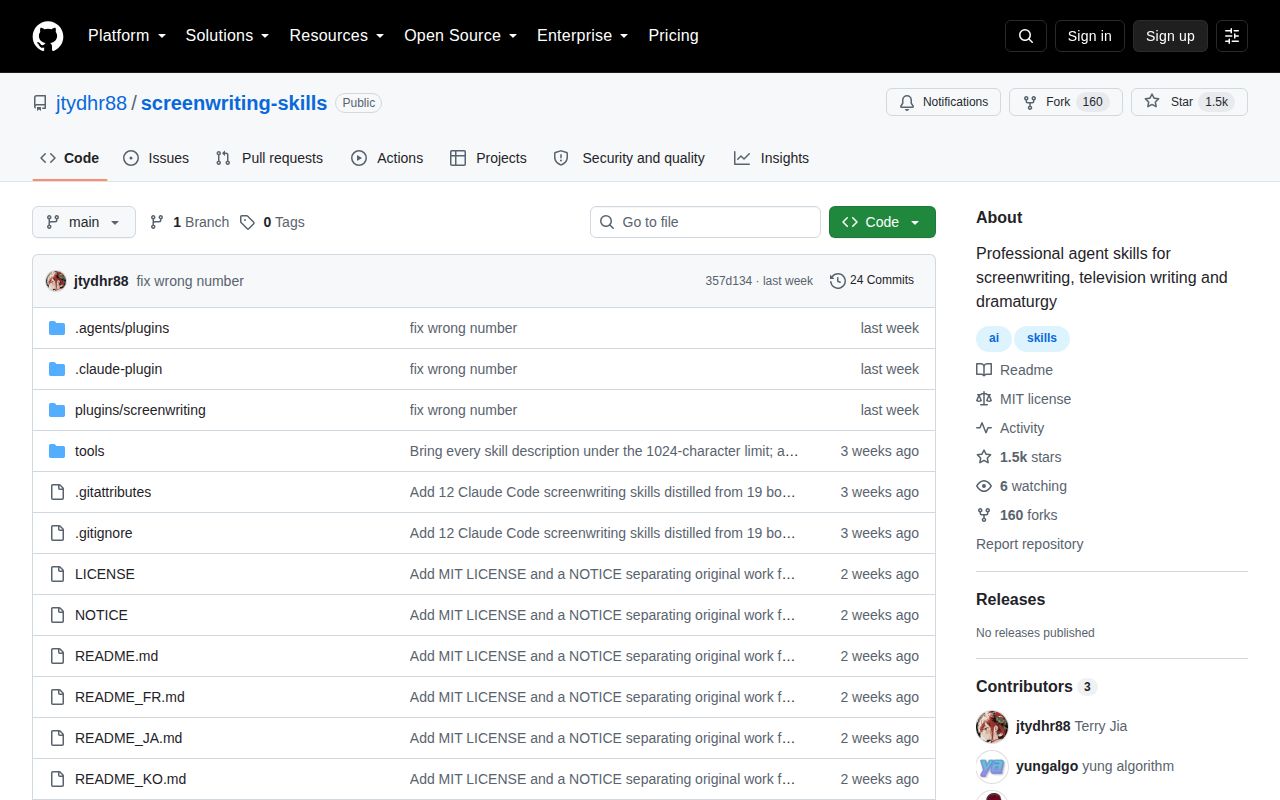
GitHub showed 1,463 stars, 0 open issues or pull requests, and no published release on September 30. The last push was September 22, and the 10 recent commits include new Truby modules, licensing work, multilingual README edits, and a corrected count. The activity is current, but an empty issue queue gives little evidence about support response or how many writers have tested full projects.
Use the library to question pages, not to surrender authorship
Across 26 modules, the strongest use is diagnostic. Ask why a second act sags, whether a series engine can generate another 20 episodes, where a scene's value turns, or which format convention applies. The modules provide vocabulary and checks, then your draft supplies the evidence. Their range is unusually wide, including opera systems that most Western screenwriting packs never address.
The weak use is asking the agent to produce a finished script while treating 26 skills as authority. The repository cannot decide what only this writer has seen, which contradiction belongs to this character, or whether a scene deserves to stay. Install it if you want more precise questions and a structured project memory. Keep judgment, source verification, rights review, and the final sentences with the human writer.