Choose a message before choosing a visual theme
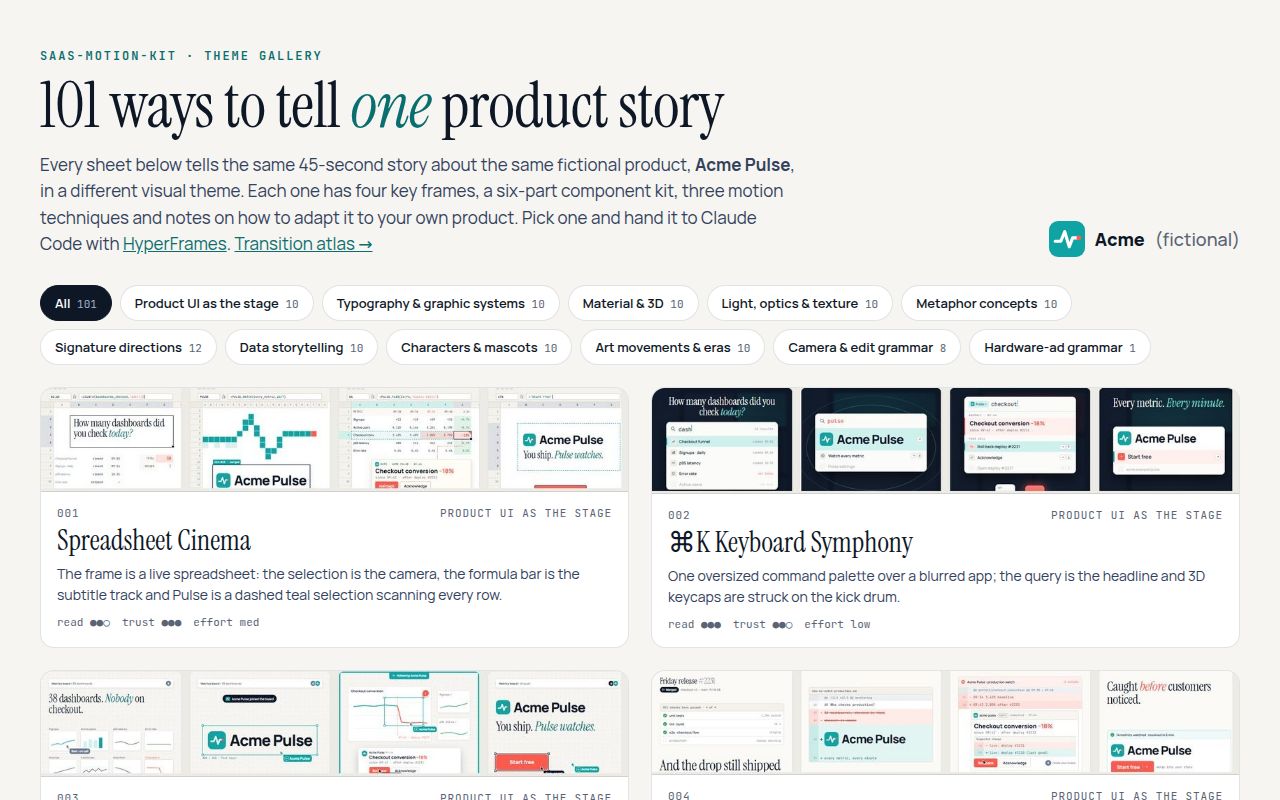
Write the product claim you can prove before opening saas-motion-kit's theme gallery. That is the useful discipline in this repository: a Claude Code skill carries a software promo through briefing, component selection, storyboarding, and delivery, with a human decision between stages. The kit supplies process documents and examples around HyperFrames, which renders the resulting HTML animation. You still decide what the film should say and whether its preview works.
The README lists 101 visual themes and a transition atlas, but those themes are creative directions with frames and motion notes. Choosing one doesn't hand you a finished advertisement for your product. The workflow asks you to redraw a proof frame in your brand and invent a component for the film. This suits a developer or designer who wants structured creative work more than a catalog of interchangeable promos.
What happened when we ran it
Our lab did not run saas-motion-kit at commit bc7a414: the harness found no supported ecosystem despite the repository's Python language classification, and no Dockerfile for a fallback path. The recorded sandbox attempt was dated October 14, 2026, with 3 CPUs, 8 GB of RAM, no secrets, and no elevated privileges. No runtime image was selected. There are no measured install, build, test, dependency, or vulnerability results to report.
That result leaves rendering reliability unverified. It also shouldn't be read as proof that the project cannot execute: the documented production route uses Node.js, HyperFrames, and ffmpeg, alongside Python helper scripts. We have source evidence for those requirements, not a completed preview or exported film. The decision here therefore rests on the kit's documented workflow and constraints, with an actual render still needed before adoption.
HyperFrames and media tools sit outside the kit
The quick start requires Node.js, ffmpeg, and Claude Code, and installs HyperFrames skills separately. HyperFrames downloads its own headless Chrome. The tools documentation also names NumPy, Pillow, and SoundFile for the Python helpers, with ffprobe on the shell tools' path. Cloning this repository supplies the creative kit rather than every executable needed for the production route.
The documented Node.js requirement is 22 or newer. Optional footage generation adds a separate service dependency: fal_shots.py needs FAL_KEY, sends a shot list through fal's queue, and caches downloaded results. That isn't a requirement for every HTML motion piece. It matters if you choose the generated-person examples, whose footage stays outside Git. A local checkout alone doesn't include the finished generated plates for that path.
Storyboard checks catch repetition, not persuasive storytelling
variety_audit.py reads a shot ledger and flags repeated transitions, entrances, or easing choices, along with other rule violations. Its history option tracks previous films so the next storyboard can avoid familiar choices. Deliberate repetition can be marked as a motif. That's a useful editorial check when an agent keeps selecting the same comfortable effects. It can't establish that a product benefit is convincing or that the audience understands a frame.
The 7-stage process makes that responsibility explicit through human decisions. The skill requires approval of the brief and component inventory, then a theme choice, a storyboard review, and later preview and sound decisions. If you need an unattended batch generator, these pauses conflict with the intended workflow. If you've watched an agent turn every launch into similar cards and camera turns, a written ledger gives you something specific to correct.
Real product claims constrain imaginary interfaces
The component rules let you rebuild clean product UI in HTML, or create simplified imaginary components when the real interface is too dense. They prohibit invented capabilities, customers, and statistics. That distinction is practical for software videos: a simplified chart can communicate an actual workflow, while an invented success figure misstates the product. You need a truth source in the brief and a person checking each claim.
The README says its Acme examples are fictional and their numbers are invented. Across 101 themes, the same fictional product story demonstrates presentation choices, rather than providing evidence for your SaaS. Replace those example claims with facts you can support. This is an especially poor fit for someone expecting to change a logo and publish the result without revisiting the components, metrics, and product behavior visible on screen.
Reference credit and asset rights travel with the film
Release v1.4 adds reference breakdowns and a credited reference ledger. A shot that borrows a reference's editing approach gets a ref: marker, and the audit checks for a corresponding creator and link. The rules permit learning from rhythm or camera ideas while prohibiting copied footage, music, characters, logos, and copy. Keeping source material in a Git-ignored folder avoids committing it, but isn't permission to reuse it in an export.
The MIT license covers the kit's code and documentation, while bundled fonts have separate OFL 1.1 terms. The README also warns that MusicGen weights have a noncommercial license and recommends licensed music for commercial work. A passing reference ledger doesn't settle soundtrack rights or guarantee that a borrowed visual treatment is sufficiently distinct. Those decisions remain part of approving an advertisement, even when the code is easy to reuse.
October releases show upkeep, while output remains unmeasured
The last push was October 4, 2026, when v1.4 was published. GitHub listed 232 stars and 0 open issues and PRs. Merged changes added reference attribution and repaired helper behavior, so there is specific evidence of maintenance. The empty open queue doesn't establish broad production use. A later closed example proposal was not merged, and shouldn't be treated as another film shipped with the current kit.
A reviewer still owes this kit an actual render before recommending it for a deadline. Choose HyperFrames directly when you already have a production process and want the HTML rendering engine. Choose Motion Canvas when you prefer authoring TypeScript vector animations with its preview editor. For saas-motion-kit, the first useful adoption check is whether your own product's proof frame reads clearly before an agent fills it with motion.