RocksDB is an engine inside your process, not a database server
RocksDB v11.8.1 stores arbitrary byte arrays as ordered keys and values inside your program's process. Your application opens a filesystem directory, calls the C++ API, and gets persistence without sending requests to another service. The project describes itself as a building block for a fast key-value server, which matters: networking, authentication, replication policy, and the higher-level data model remain your responsibility. If you want an endpoint your applications can call, RocksDB is the part you put underneath it.
The design uses a log-structured merge tree and multithreaded compaction. Its README names 3 linked costs: read amplification, write amplification, and space amplification. It also says the engine suits databases holding multiple terabytes. Public interfaces live under include/; the maintainers warn that other headers can change without notice. That boundary is easy to understand and expensive to ignore if your application starts depending on internal classes.
Compaction control is the reason to accept the extra work
RocksDB v11.8.1 deserves attention when the storage engine itself is part of the product. You can choose compression libraries, control how files are compacted, use ordered iteration, and build a service around the library's local persistence. Those choices let a storage team shape behavior for flash and memory. They also move capacity planning and failure testing into the application team's remit. A generic CRUD service rarely needs this much control.
Release v11.8.1 landed on August 7, 2026. Its notes cover asynchronous reads, external file ingestion, direct I/O for compaction reads, wide-column behavior, and fixes involving read-only databases and live SST files. That range shows why upgrades deserve workload-specific regression testing. A minor release can touch file handling, defaults, and public APIs that sit directly on the application's data path.
What happened when we ran it
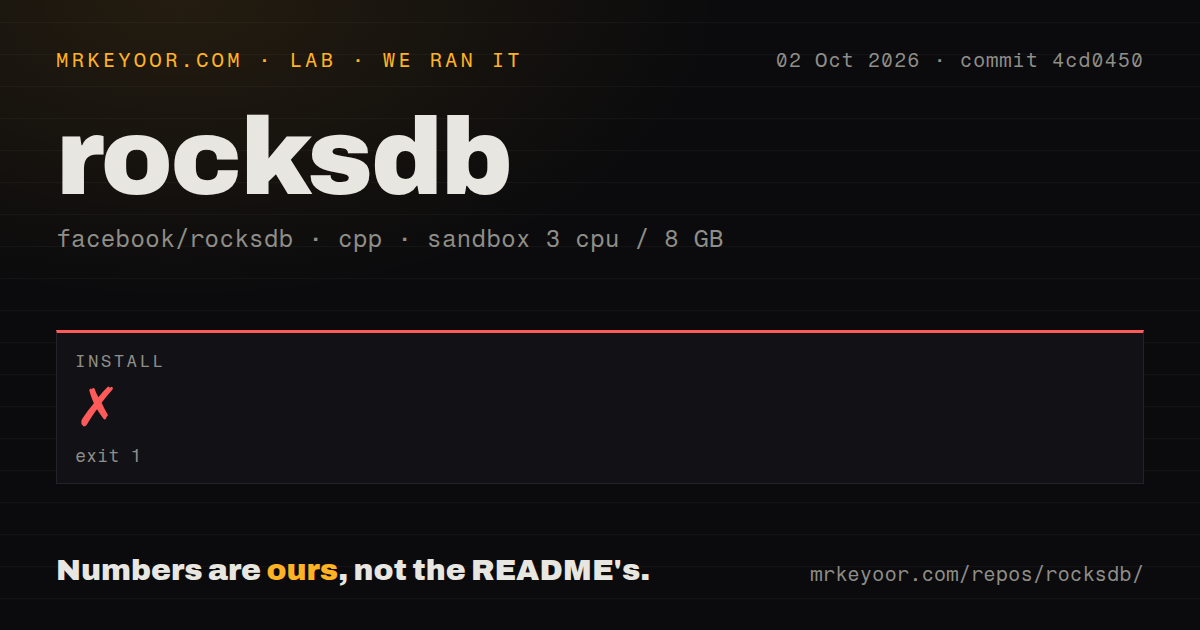
Our measurement setup was an unprivileged Debian container with 3 CPUs and 8 GB of RAM. Our run used commit 4cd0450, whose checkout contained 2,354 files, roughly 1,003,542 lines of source, and 50.9 MB on disk. Its install step failed after 1 second while CMake was configuring the project. The log did not reach compilation.
CMake reported that it could not find gflags. It named gflags_DIR, GFLAGS_LIBRARIES, and GFLAGS_INCLUDE_DIR as missing, then stopped with configuration incomplete. The log supports that finding and nothing more. We did not get a build or test result from this run. The same checkout had 14 CI workflow files, no Dockerfile, and no directory named tests.
Plain CMake and the lean library build start differently
The gflags 2.2.0 requirement applies to RocksDB's tools, while the install guide says the library can compile without dependencies. Its recommended release route is make static_lib, not an unqualified CMake configure. On non-Windows systems, the CMake file enables WITH_GFLAGS by default and searches for gflags. The guide tells Ubuntu users to install libgflags-dev. Our failure is consistent with that documented split.
A current compiler is another gate. RocksDB requires C++20, with GCC 11 or newer or Clang 10 or newer. Release builds target the CPU doing the compilation by default. PORTABLE=1 produces a more broadly compatible binary at a stated performance cost, while the guide gives PORTABLE=haswell as a middle ground for many 64-bit x86 processors made since roughly 2013. Build artifacts therefore need the same care as runtime configuration.
Most non-C++ bindings sit outside the main project
The bindings guide lists 2 Python packages, and both older links are marked unmaintained. C++ is the primary interface, and Java is included in the main repository. Python, Go, Rust, Ruby, PHP, C#, and other users rely on separate projects. That can work, but it divides responsibility: a RocksDB release and a binding release are different compatibility events. Check the binding's maintenance and supported native library version before treating it as part of RocksDB.
The same document lists 3 Rust choices. One of its 2 Go entries is marked unmaintained. Those labels are more useful than a long language list because they expose the handoff risk. Teams outside C++ or Java should review the exact binding they plan to deploy, including its release cadence and native packaging path.
October activity and v11.8.1 show current maintenance
GitHub showed 32,150 stars and 1,688 open issues and pull requests on October 2, 2026. The repository's last push was October 1. Issue 15301 and pull request 15302 both had activity on October 2, covering blob garbage collection and an ARM64 CMake fix. That combination indicates active development, even though the combined open count should not be read as a bug count.
The latest tagged release was v11.8.1, published August 7, 2026, and commit 4cd0450 was dated October 1. Releases and main-branch work are both moving. For adopters, that means version pinning matters more than star count. Read behavior changes and public API changes before moving a database that owns durable local state.
Choose RocksDB only when you want to own the storage layer
Our 1-second CMake stop exposed the first part of owning RocksDB: its build path belongs to your team. RocksDB gives database engineers a capable local engine and enough controls to make informed tradeoffs. That is a good bargain for a storage service, a database product, or an application whose local data path justifies dedicated tuning. It is a poor bargain for a team that mainly needs SQL, a network API, or low-effort packaging.
Start adoption by reproducing a release build on the CPUs you will deploy and writing down every native package it needs. Then test recovery and tune against your actual keys and access pattern. Our 1-second stop at configuration says nothing about RocksDB throughput, but it does establish the first cost: before this 1,003,542-line engine can be evaluated, its build path must be made explicit.