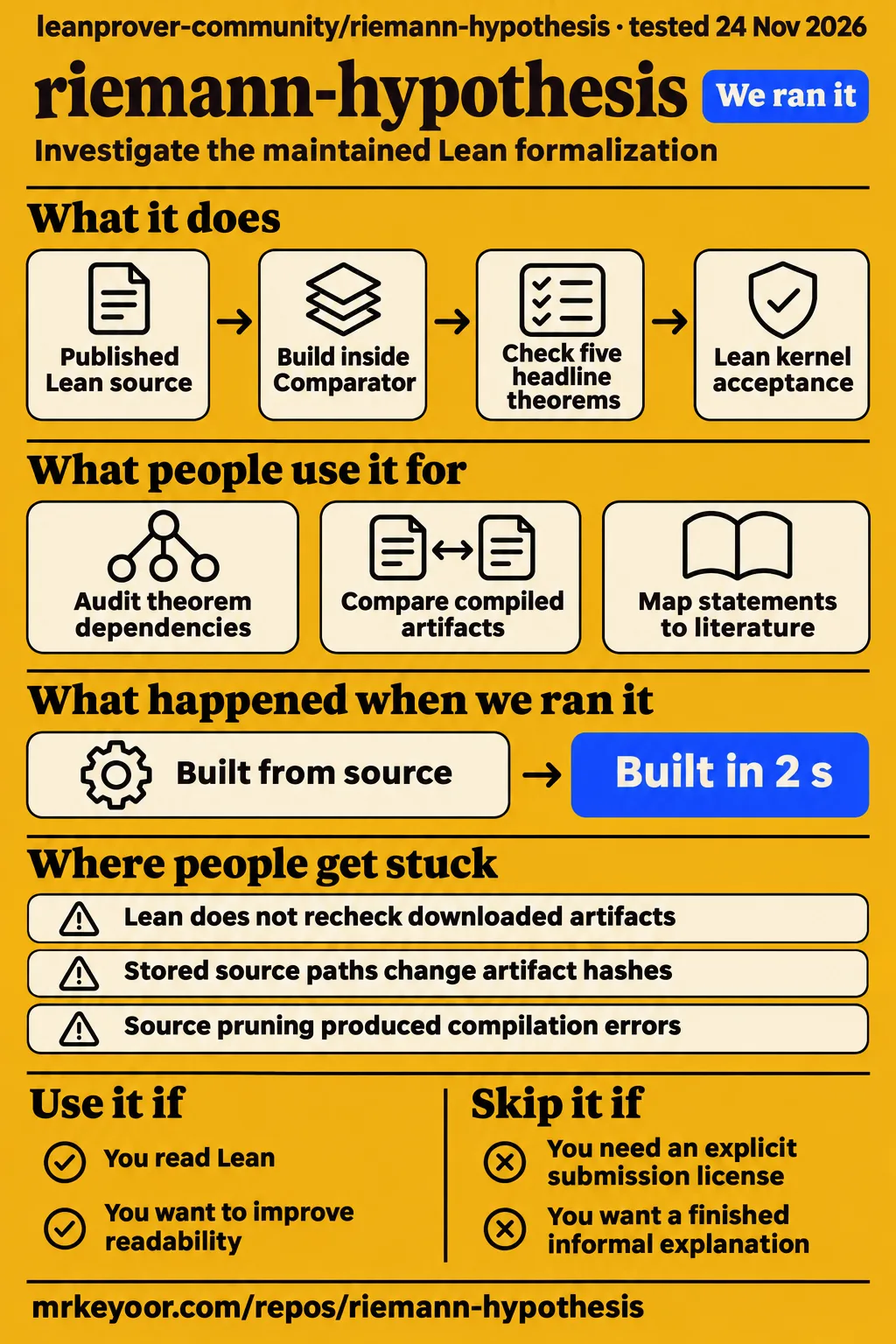
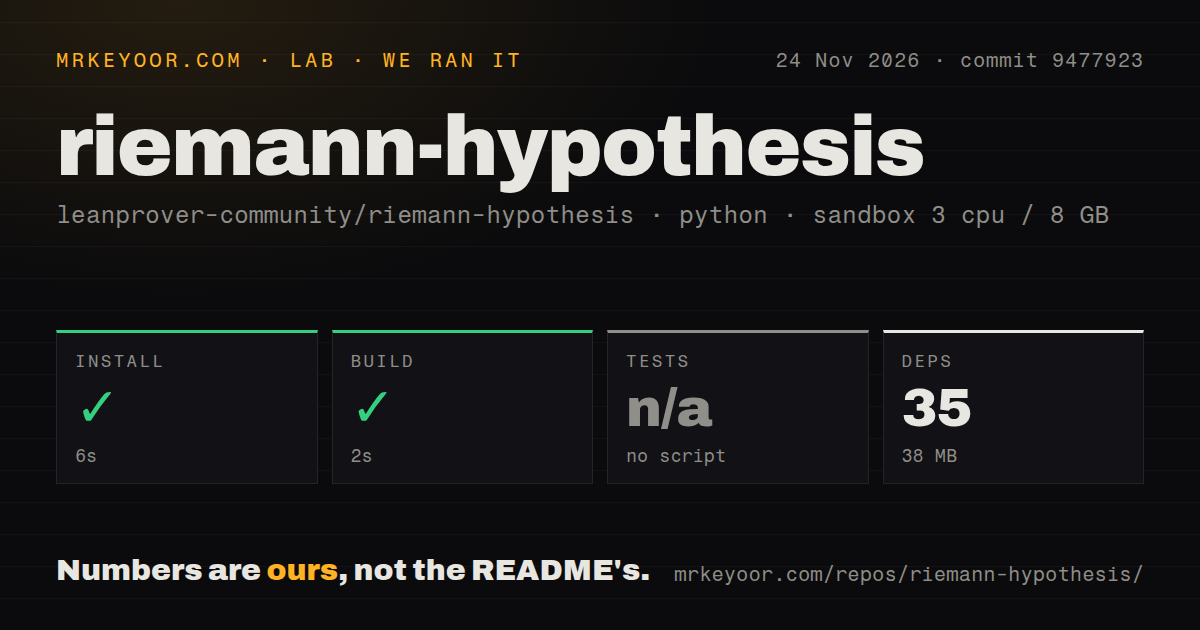
Our November 24, 2026 run at commit 9477923 recorded a 6-second install and 2-second build under a Python ecosystem classification. Use riemann-hypothesis to investigate or improve the maintained Lean development. Choose the original-proof mirror when your question concerns the published submission. The README distinguishes downloading compiled files for reading from rebuilding the submission for a local proof check, and that distinction determines which setup commands to follow.
What people use riemann-hypothesis for
The README describes a maintained Lean formalization of RH and GRH for Dirichlet L-functions, with accessibility and readability among its goals. Its contribution guidance welcomes improvements to performance, modularity, documentation and mathematical references. Lean is a proof assistant, and this repository contains mathematical statements and proofs rather than an application service. The community README identifies five headline theorems in src/Main.lean.
| Contributor | Use case | Reported outcome |
|---|---|---|
| patunz | Compile the original archive and audit its theorem dependencies | Reported a completed build and matching axiom-audit output in issue #6 |
| ishaan2006 | Compare compiled modules with Sutherland's manifest | Reported path-dependent differences and matching reference-path replays in issue #6 |
| JoseClaudioSJr | Map the argument through source and dependency data | Corrected routes absent from the final theorem's dependency cone in issue #5 |
| aapolipponen | Match named statements to mathematical literature | Withdrew a references proposal and checked two statements against quoted sources in issue #39 |
| homeowmorphism | Preserve the published submission with a cache | Reported the original-proof repository and available cache in issue #56 |
These reports describe different jobs: checking a historical artifact, explaining its structure and improving its presentation. The current README assigns maintenance work to main and preserves the first publicly released version on original. It also excludes substantially different proof paths, unnecessary files and claims about contributors' own machine builds or Comparator runs from its requested contributions. Those boundaries help a prospective contributor choose a useful change before starting a large build.
What happened when we ran it
Our run at commit 9477923 recorded installation success in 6 seconds and build success in 2 seconds. The sandbox measurements also record 35 dependencies, 38 MB on disk and a Python ecosystem classification. Tests were skipped because the harness found no script or target. The table preserves the recorded steps and repository scan separately from the project's documented Lean checking procedure.
| Recorded step or scan | Result |
|---|---|
| Install | Succeeded in 6 seconds |
| Dependencies | 35 recorded, 38 MB on disk |
| Build | Succeeded in 2 seconds |
| Tests | No tests script or target, skipped |
| Checkout | 60,280 files, approximately 17,964 source lines, 1,085.3 MB |
| Repository signals | 8 CI workflow files, no Dockerfile, no tests directory |
| Sandbox configuration | 3 CPUs, 8 GB RAM, image label ghcr.io/astral-sh/uv:python3.12-bookworm |
A separate deployment attempt failed its Compose prerequisite. The detailed step records unsafe repo: none of compose.yaml, compose.yml, docker-compose.yaml, docker-compose.yml exists (rule: a compose file is required) in the deployment failure. Here, unsafe repo names the harness rule that stopped the attempt. The concrete failure is the absence of the required Compose file, rather than a reported defect in Lean or the mathematical development.
The deployment summary says the repository was deployed with its own Docker Compose, with every port bound to 127.0.0.1, in the run summary. That description conflicts with the detailed prerequisite failure. The separate teardown record says teardown: ok. The detailed step supports a stopped deployment attempt; the summary and teardown retain their recorded wording without changing that outcome.
Where people get stuck: choosing the cache route
The README says the project cache downloads files compiled elsewhere and Lean does not recheck them. Its reading route runs lake exe cache get followed by lake build --no-build. For fresh checking, the same README instead starts with a fresh Linux clone and fetches Mathlib's compiled files alone. The cache and checking instructions explain why those downloads serve different purposes.
| Task | README commands | Result described by the README |
|---|---|---|
| Read and edit | lake exe cache get, then lake build --no-build |
Restore compiled project artifacts |
| Check the submission | MATHLIB_CACHE_GET_URL=https://cache.mathlib.org/mathlib4 lake exe mathlib/cache get, then lake comparator |
Build Challenge and Main inside Comparator's sandbox |
The commands above reproduce the README's two routes. Mathlib supplies shared mathematical infrastructure; downloading its cache alone leaves the submission for the checking procedure to build. The older instructions explicitly warn that downloading the submission's own cache can leave lake build Main with nothing to compile. That warning in the pinned README explains why a completed cache restoration and a fresh compilation answer different questions.
Different artifact hashes can come from stored paths
Issue #6 reports .olean differences caused by absolute source paths embedded in linter messages. Ishaan2006 reported an independent 401-minute build on a 94-core VM using Lean v4.33.1 and Mathlib 0df444a3. Of 175,187 modules, 76,968 were byte-identical to the reference manifest and 98,219 differed. The contributor reported that every differing module embedded the build path in the artifact comparison.
After Andrew Sutherland identified the reference prefix as /home/ubuntu/grh/src/lean, patunz reported reproducing a reference module's hash. Ishaan2006 also replayed 300 sampled modules with the reference source prefix and reported 300 matching hashes. Those controlled changes explain the observed byte differences. A compiled module stores more than the mathematical statement, so an artifact comparison needs the source revision, build inputs and file type attached to its result.
Issue #6 also contains a corrected download analysis: science-markets withdrew a count obtained from a truncated solution-export stream. The contributor reported having only 263 MB, or 3%, and explained that the fragment had produced misleading axiom counts. Later contributors posted full-export results. Reading the corrections alongside the opening reports prevents a partial download result from becoming a claim about the complete proof artifact.
Proof checking and mathematical explanation need separate evidence
A compiled proof check establishes formal acceptance; a reader's map supplies a provisional mathematical interpretation. JoseClaudioSJr's map labels source observations separately from mathematical readings and says that a source name alone is not evidence of meaning. The map was prepared with Claude's help, and issue #5 records corrections after contributors compared proposed routes with compiled dependency data.
A dependency cone lists declarations reached from a chosen theorem. The map's corrections remove landau_family and related routes from the final path and describe the windowed route instead. Issue #96 likewise distinguishes syntactic reachability from necessity or invalidity when discussing trivial predicates and degenerate constructions. Its author reports ten passes finding only the three permitted axioms in the dependency audit.
DerekNee reports asking Claude to explain the proof, receiving a chart and making a one-minute video in the X account of that explanation. That report belongs with explanations and navigation aids. A chart, a dependency list and a kernel-checking receipt each describe a different artifact. Keeping their labels visible lets readers use the explanation without silently assigning it the status of a formal checking result.
Checking code runs code, and CI receipts need a revision
The README says compiling the submission runs its code and recommends a VM or sandbox. Its Comparator route requires Linux and bubblewrap, builds Challenge and Main without network access, and checks the five headline statements. The checking documentation names the permitted axioms as propext, Quot.sound and Classical.choice, and describes acceptance by Lean's kernel and nanoda.
A-ratz reported a CI gap at 90cc2e12 in issue #526: the identified workflows did not automatically reject added sorry proofs or axioms in the real Main dependency chain. Later comments describe a diff guard, toy controls and a proposed post-build axiom checker. The final comment records submission of that checker as PR #1167. These are revision-specific reports about safeguards on the maintained tree.
Source pruning and literature matching produced corrections
Keithadler reported that 1,087 of the first approximately 7,000 files failed when compiling a reduced source tree. The correction in issue #3 identifies dangling open ... in and set_option ... in prefixes, plus dropped Mathlib class instances. It includes the errors Unexpected name ... after end and failed to synthesize MonObj (splitTorus ...). The failed compilation changed the contributor's reduction claim.
Literature matching also changed an early assessment. Aapolipponen withdrew a proposed references file because its rows lacked checkable source locations. The source-checked follow-up in issue #39 classifies Radford's shuffle-algebra theorem as an exact match and Linnik's theorem as a close match. For Linnik, the archive's least prime in a residue class can equal the residue itself, whereas the cited progression starts with a positive step.
Warning cleanup has a stated order: issue #137 says it should follow performance improvements. Its excerpt records 486,795 warnings in 96,480 modules from the shared cache at c9852685, before #324. Those figures belong to that named cache and revision. The warning-cleanup discussion supplies a concrete starting point for planning work rather than a count for our sandbox run.
Public source comes without a submission license
The README says the submission was published without a license. It separately identifies declarations copied into comparator/ as Apache License 2.0 material, with notices in their files. The license section also identifies 40e56bab as the unmodified copy. Those statements concern distinct parts of the repository and should stay distinct in any reuse decision.
The practical choice is whether you want to inspect the published mathematics or incorporate material into another distributed project. The repository makes the source available for checking and describes its maintenance goals. Its separate notice for Comparator declarations supplies a license statement for those declarations. Readers requiring explicit submission-wide permission should resolve that requirement before choosing this development for reuse.
riemann-hypothesis vs alternatives
The community README recommends riemann-hypothesis-original for unchanged published source with a prebuilt cache. Issue #56 records the repository split and Deicyde's statement that the community repository is intended for upgrades and refactoring. The original-source recommendation therefore gives historical inspection and maintenance separate destinations rather than treating every branch as the same artifact.
| Choice | Pick it when | Evidence for the distinction |
|---|---|---|
| leanprover-community/riemann-hypothesis | You want maintenance and readability work | Current README describes community cleanup |
| homeowmorphism/riemann-hypothesis-original | You want unchanged published source with a cache | Community README recommends it for that purpose |
| CocoSgt/riemann-hypothesis-lean | You want that mirror's presentation of the release | Its README describes an unmodified mirror |
| Project cache | You want compiled files for reading and editing | README says Lean does not recheck downloaded artifacts |
| Fresh checking route | You want the submission built through Comparator | README fetches Mathlib alone before the check |
CocoSgt describes its repository as an unmodified mirror in its release account. The cache rows compare workflows rather than competing proofs. For a historical report, retain the original artifact and revision. For a contribution, follow the maintained repository's requested scope. The original mirror's preservation role is supported by the community README and the split discussion, rather than by a build of that mirror in our sandbox.
Outdated claims, corrected
The pinned older README calls the submitted source unmodified; the current README describes maintenance on main. The older description belongs to its pinned revision. Likewise, CocoSgt's statement that no independent build or review had been published explicitly dates itself to November 20, 2026. Patunz's later completed-build and axiom-audit report in issue #6 makes that snapshot unsuitable as a continuing description of checking activity.
MathWorld repeats a claim that a natural-language rendering exceeded 250,000 pages, while Wikipedia's account records Alpöge's November 23 clarification that the figure was a joke. The figure should therefore be described as a reported joke rather than a measured exposition length. On mathematical scope, MathWorld explicitly says the assertion for arbitrary number fields remains open; the repository names Dirichlet L-functions.
Tribikram Pati's 2007 paper concludes that RH is false in its abstract. That is the paper's claim. It conflicts with the later reports of accepted formal checking discussed here and should not be presented as an established refutation. Keeping the author and date attached preserves the historical record without turning the review into an unsupported diagnosis of the argument.
FAQ
The README separates cached reading from fresh checking, and issue #6 explains path-dependent artifact hashes. The questions below also cover the theorem's meaning, original-source preservation, literature matching and maintained-branch safeguards. Those questions connect the repository's mathematical purpose to the concrete choice between reading compiled files, investigating a historical submission and contributing to the current development.
What is the Riemann hypothesis?
The headline zero-location statement places every zeta zero other than the negative even-integer zeros on the line with real part one-half. The README lists riemannHypothesis as Mathlib's statement and spells out the corresponding claim under riemannZeta_eq_zero_re. Its theorem table also lists three statements concerning Dirichlet L-functions, making the repository's formal targets explicit.
Why is the Riemann hypothesis important?
The Clay Mathematics Institute connects the frequency of prime numbers with the behavior of the Riemann zeta function. Its RH explanation says a proof would illuminate the distribution of primes. The video transcript also introduces RH through the prime-number problem. That background explains interest in the theorem; the repository's build commands and checking reports address a separate question about its formal artifact.
Why do independently built .olean files have different hashes?
Issue #6 traces the reported differences to absolute source paths stored in linter messages. Contributors changed the source prefix and reproduced reference hashes, including 300 of 300 sampled modules in ishaan2006's replay. The hash investigation therefore gives a concrete explanation for those differing artifacts. A hash comparison should name the compiled artifact and build inputs alongside the revision.
Should verification of the original proof and cleanup of the code live in separate repositories?
The community README now directs original-source readers to riemann-hypothesis-original. In issue #56, homeowmorphism reports creating that repository and making its prebuilt cache available, while Deicyde endorses preserving an exact mirror alongside community refactoring. The split lets historical inspection retain the published source while maintenance work changes the development's organization, performance and presentation.
Which named mathematical theorems in the archive match their published statements?
Aapolipponen's checked follow-up identifies Radford's theorem as an exact match and Linnik's theorem as a close match. The literature-matching discussion explains the difference in the least-prime statements and withdraws the earlier references proposal. Its revised approach quotes a source, reads the Lean statement and checks the project definitions used by that statement before assigning a relation.
Why do some deprecation warnings lack a suggested edit?
Issue #137 records a question about missing suggested edits and supplies a warning breakdown for c9852685. The warning discussion identifies cleanup as work to follow performance improvements. The concrete information here is the question, revision and reported warning count. The evidence boundary for explaining the missing edits is collected in the final section with the other unassessed questions.
Does CI automatically reject sorry proofs and extra axioms in the maintained proof?
Issue #526 reports a gap at 90cc2e12 and later records a proposed post-build checker as PR #1167. Its checker discussion describes comparing the five theorem dependency sets with the allowed axioms and recording a source-bound receipt. The thread distinguishes the proposed checker from Comparator's kernel checks and reports experiments using cached artifacts and toy controls.
What we have not tested yet
Our Python-classified harness result is not an independent Lean compilation, Comparator run or mathematical audit. Cached editor access, fresh submission checking, reference-path reproduction and a successful deployment are outside our completed work. The image label does not establish actual runtime or operating-system versions, and we have not reconciled the scanner's approximate 17,964 source lines with the Lean development. The recorded timings describe the harness steps alone.
The readable issue #137 excerpt does not establish why particular deprecation warnings lack suggested edits, including any role for replacement types or dot notation. Issue #526 ends with PR #1167's submission and does not establish its later merge or activation; its author also leaves the real completed-build mode unrun. Issue #96 leaves its author's Comparator run pending. These boundaries prevent contributor proposals and partial audits from becoming broader checking claims.
A complete informal explanation, comprehensive literature attribution, resolution of intermediate-definition questions and diagnosis of Pati's argument are outside this assessment. The README supplies no submission-wide reuse license. Rendered layout, resolved links, recommendation modules and related-page behavior were not tested. Readers proceeding with the repository should first select the original or maintained revision, then choose cached reading or the documented fresh-checking route.