A local index gives agents callers and change history
Before accepting a change to an unfamiliar function, ask RepoWise for its callers and the files that historically change alongside it. The project combines a dependency graph with git history, documentation, and architectural decisions, then exposes that index through a dashboard, CLI, and MCP tools. The caller map gives you a reason to inspect code outside the immediate edit.
Our checkout contained 5,747 files and occupied 65 MB before installation. The product spans code-health scoring, dead-code detection, and multi-repository analysis, with Claude Code integration as well as other agent clients. You should want several of those jobs before adopting the whole stack. If all you need is a repository text bundle or unused-export report, a narrower tool leaves you with fewer moving parts to understand.
What happened when we ran it
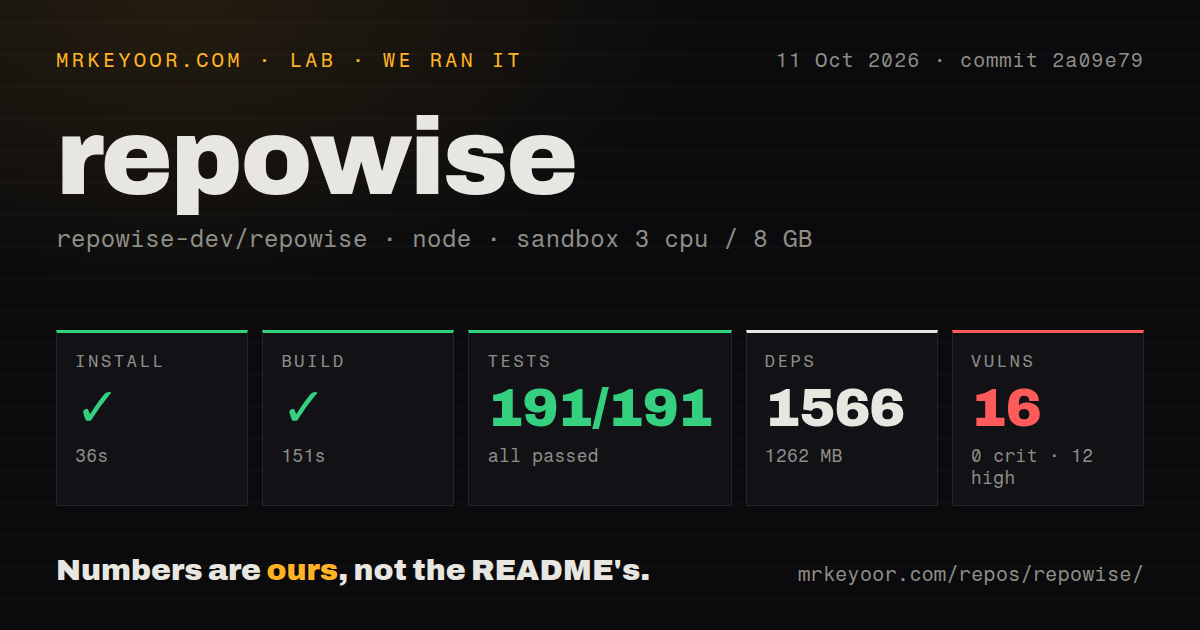
Our sandbox installed RepoWise's npm workspaces in 36 seconds, adding 1,566 packages and occupying 1,262 MB on disk. The build succeeded in 151 seconds. We ran commit 2a09e79 on October 11, 2026, in a fresh Debian lab-node:22 container with 3 CPUs and 8 GB of RAM, without secrets or elevated privileges. The run didn't measure indexing accuracy or agent savings.
The test command exited 1 after 210 seconds. Its tail reports timeouts at 5000ms and a workspace summary with 2 failed tests and 2,357 passed. Another reports 1 failed test and 164 passed, naming fix-first-section.test.tsx. The supplied headline's 191 passed and 0 failed is a separate passing summary, not the whole command's result. The tail doesn't explain the component assertion failure or why the timeouts occurred. We cannot responsibly supply those causes.
The documented user path starts with Python
RepoWise's quickstart requires Python 3.11 or newer and Git, then uses repowise init --yes --no-prose to create the local index. Our npm build covers the repository's JavaScript workspaces, including its web and editor surfaces. It doesn't establish that the Python indexing workflow completed. The manual quickstart is the better place to assess the actual user path.
The measured 1,262 MB footprint belongs to that npm developer setup, so don't budget it as a measured Python package footprint. SQLite is the default local database, and deterministic indexing needs no model credential. Optional model-written documentation needs your chosen provider or a local runtime. Setup also writes editor configuration and hooks unless you pass --no-editor-setup. Read that switch before trying it in a repository with carefully maintained agent configuration.
The audit found high advisories, and telemetry needs a separate decision
Npm audit reported 16 known vulnerabilities in our run: 12 high, 2 moderate, 2 low, and 0 critical. The supplied findings don't identify packages or reachable code paths, so they don't establish a remotely exploitable server flaw. They do warrant inspecting the dependency advisories before using this checkout for a shared service or development base. A successful build gives no reason to wave those findings away.
Neither the 36-second installation nor the 151-second build checked privacy behavior. The README says anonymous CLI usage telemetry is enabled with an opt-out, while optional model features send code-derived prompts to your configured provider. DO_NOT_TRACK=1 or repowise telemetry disable handles the telemetry choice. For offline work, the documentation describes Ollama with local embeddings. The security and data-flow guide distinguishes stored index artifacts from transiently processed source.
Graph reachability is useful evidence with explicit gaps
RepoWise labels test reachability from its graph as inferred, while ingested coverage reports provide measured execution evidence. That's a useful distinction: a possible route from a test to a function doesn't tell you which lines actually ran. An empty recommendation can mean unknown. I would use this to prioritize inspection and select candidate checks, while keeping measured coverage and the project's own release checks. The test-intelligence guide spells out that boundary.
Our run's 3 CPUs and 8 GB of RAM provide context for the workspace results, not proof that RepoWise can resolve your application's dispatch paths. Its language matrix lists concrete gaps: Django/Jinja and other template dialects yield no parsed content, Razor lacks import edges, and some Svelte and Vue bindings are skipped. Those omissions matter if a call map is supposed to justify deleting code or changing a template-heavy application. The language ceilings deserve a read before adoption.
October maintenance includes fixes to refactoring inputs
The last push was October 11, 2026, and GitHub reported 7,494 stars with 300 open issues and PRs. Release v0.55.0 was published October 4. Recent activity includes issue 3396, which reports an Extract Method plan omitting an exception binding from helper inputs. That is directly relevant to code-changing recommendations. Active maintenance is welcome, but a proposed refactor still needs review of the values its extracted helper reads. The exception-binding report gives a concrete example.
Our scan found 5 CI workflow files and a tests directory, yet the workspace command still returned exit 1. That combination suggests taking upstream checks seriously without treating their presence as a guarantee. I'd rate RepoWise as worth a controlled trial for a team drowning in repeated codebase discovery, with lower confidence in unattended use. Keep recommendations advisory until you've compared its graph and suggested edits with code your team already understands.
Pick Serena for editing, Knip for unused code
Serena is the closer alternative when your agent primarily needs semantic code retrieval and editing tools. Knip concentrates on unused files, exports, and dependencies in JavaScript and TypeScript projects. Repomix packages repository content for model consumption when a text bundle is enough. Each solves a narrower job than RepoWise's combined history and health index.
The 1,566-package npm setup and failed workspace suite make maintaining RepoWise's source a deliberate choice. For an adoption trial, pick a backend change whose callers you already know, ask the index what it reaches, and inspect every missing or surprising edge. Then check the recommended tests against your own coverage report. That comparison will tell you more about whether to trust it in your repository than the README's headline savings.