Relate turns chat history into reminders you still need to check
Relate tries to catch the promise you made in a conversation and forgot to put in a task list. Its English README describes extracting commitments and unanswered questions, drafting replies, and answering questions with links back to chat history. The primary README is Chinese. For someone already willing to maintain a local assistant, keeping the source conversation beside a reminder is an appealing way to check whether that reminder belongs there.
Our checkout was 1.2 MB, with 93 files and roughly 9,653 source lines. Relate divides work into relationship, business, or team spaces, each with its own data folder and worker process. That is a more manageable starting point than mixing every conversation into one assistant's memory. The dividing line still needs attention: decide which chats enter a space before asking it to interpret somebody's needs or commitments.
What happened when we ran it
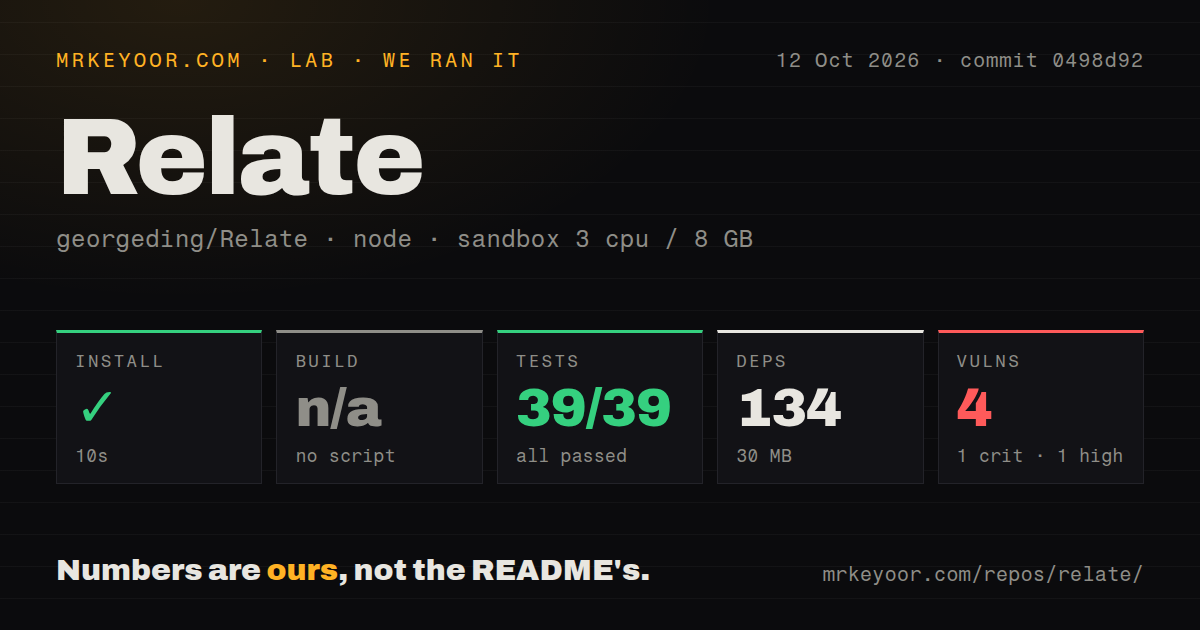
Our sandbox installed Relate commit 0498d92 in 10 seconds, adding 134 packages and occupying 30 MB. Its node:test step passed in 15 seconds, with 39 passed and 0 failed out of 39. The build step was skipped because there was no build script or target. We cloned it on October 12, 2026, using lab-node:22, with 3 CPUs, 8 GB of RAM, no secrets, and no elevated privileges.
Npm audit reported 4 known vulnerabilities: 1 critical, 1 high, 2 moderate, and 0 low. The supplied results don't name the affected packages or show whether those advisories can be reached through Relate's application routes. I would resolve that uncertainty before importing sensitive conversations. Passing tests and a short installation are useful, but neither answers an audit finding. The lab block supports reporting the findings, not assigning an exploit or a fix.
The scan found 2 CI workflow files, a tests directory, and no Dockerfile. A skipped build is consistent with the documented plain-Node source route, rather than a compiler failure. Our measurements don't validate the downloadable Windows installer, live chat connectors, or the quality of inferred promises. In particular, the sandbox had no service secrets, so the test result can't establish that your chosen provider and real conversation source work together.
Local storage still permits text to reach your AI provider
Relate stores messages and memory on your computer, but its privacy section explicitly excepts text sent to the AI provider. A cloud endpoint therefore changes where conversation content is processed. The README offers local Ollama or LM Studio endpoints as alternatives. Choose the endpoint before connecting chats, and check the response quality yourself. Having an API with the right shape doesn't establish that a model will interpret a conversation accurately.
The 30 MB installed footprint is easy to accommodate, while the data boundary deserves more thought. The documented defaults include a password and a loopback listener. Phone access needs an additional network arrangement. Platform documentation also shows separate space configuration and runtime files containing settings and secrets. Back up those directories as private application data. A small codebase doesn't make the conversations inside it unimportant.
Telegram has a connector; other apps may need your bridge
The README's broad list of chat apps needs careful reading. Telegram uses a bot token, while services such as Slack or WhatsApp can require a custom bridge that obtains messages and pushes them over HTTP. The ingest guide explains message identifiers, chat identifiers, and an optional return webhook for sending. This is an integration interface, not proof that connecting every listed app is a settings-only job.
Our 10-second install didn't include writing such a bridge or configuring service credentials. For WeChat, the documented connectors are Windows-only and optional. The connector notes distinguish a separately installed WeFlow application's API from a screen-reader connector. They also warn about account restrictions from automated sending. If your requirement is WeChat on macOS or Linux, the documented route doesn't fit, regardless of how simple starting the Node service looks.
MCP access and plugin permissions need deliberate choices
Each space exposes a read-only MCP interface so tools such as Claude Code can read its chats and dashboard. That makes Relate useful as a source of remembered context outside its own browser interface. It also means another tool holding the space token can request that information. Keep the space boundary aligned with what you want that client to see, rather than handing over access to every conversation by default.
The 39 passing tests don't turn third-party plugins into trusted code. Relate can draft plugin JavaScript, and the plugin guide calls for reviewing it before enabling it. The optional worker sandbox restricts files and child processes but leaves network access unrestricted. The same guide requires tools with side effects to request approval. These are documented controls to inspect, not a reason to assume an arbitrary plugin cannot transmit data.
A September release gives limited evidence of operating history
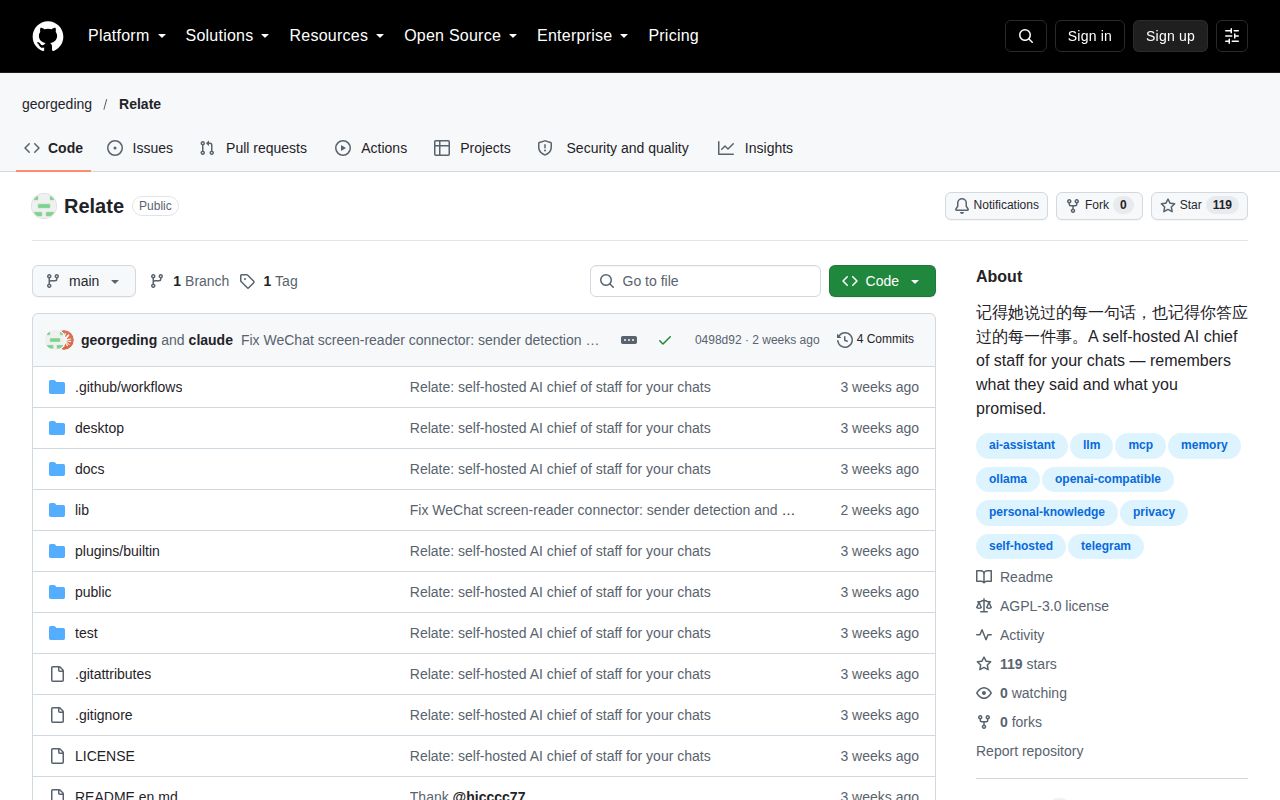
The last push was September 28, 2026. GitHub listed 119 stars and 0 open issues and PRs on October 13, and the latest release was v0.0.1, published September 23. Recent source activity weighs against calling it abandoned. The empty issue queue provides little public evidence about connector failures, corrections, or long-term use. The project uses AGPL-3.0 and documents a contributor agreement for external contributions.
I'd begin with a narrow space and non-sensitive sample conversations, then inspect the promises it extracts before relying on reminders. The 4 audit findings should be addressed before that trial expands to private history. If you mainly want contact notes and dates you enter yourself, Monica is a closer fit. If you're building memory into your own application, compare Mem0. Relate earns consideration when chat-derived reminders are the actual job and you're prepared to own both the integrations and the review of what the assistant infers.