Redash lets SQL authors share the query with the chart
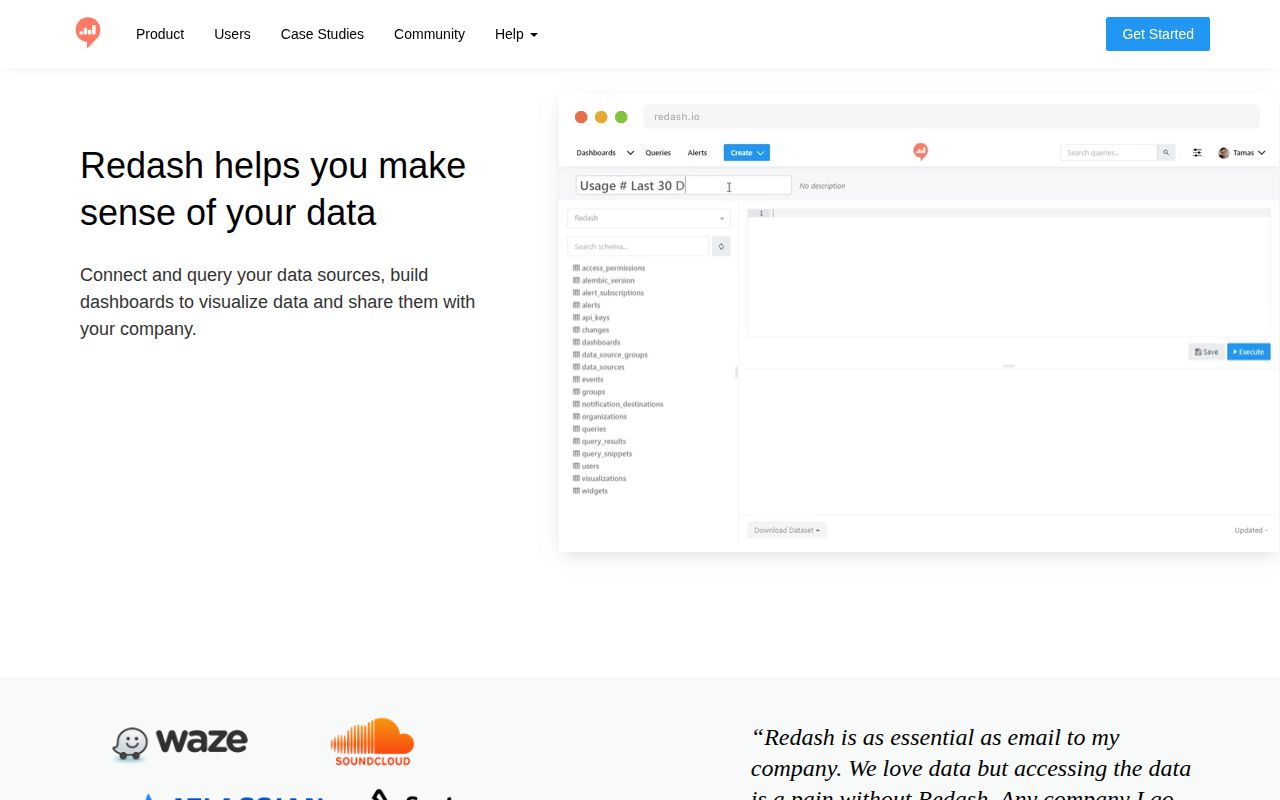
Redash keeps the query available alongside the visualization it produces. For a team that already knows SQL, that is a good reason to evaluate it: when somebody questions a dashboard number, an analyst can inspect the underlying query rather than reconstruct how a spreadsheet was assembled.
The README documents a browser query editor with schema browsing and autocomplete, dashboards, scheduled refreshes and alerts. It also lists SQL and NoSQL data sources, including PostgreSQL, BigQuery and MongoDB. Those are documented connectors, not connections verified in our sandbox. Start with the databases you actually need before deciding that a long connector list settles compatibility.
I'd put Redash on a shortlist for an analyst-led reporting team. People reading a dashboard needn't write its SQL, but somebody still owns that query and its interpretation. A shareable URL makes distribution easier. It does not settle who should be allowed to see the result.
What happened when we ran it
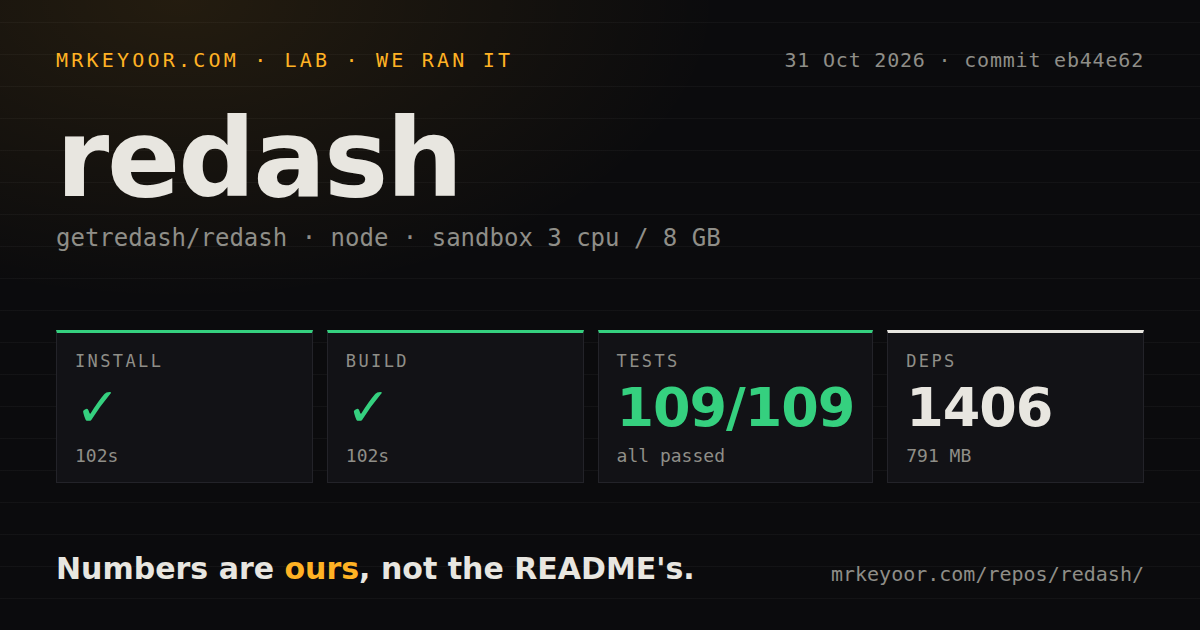
Our Redash installation succeeded in 102 seconds, its build succeeded in 102 seconds, and Jest passed all 109 tests with zero failures in 16 seconds. We ran commit eb44e62 on October 31, 2026, through its pnpm workspace route. The record lists 1,406 dependencies and 791 MB on disk.
The checkout contained 1,971 files, approximately 120,865 source lines and 49.3 MB. The scan found six CI workflow files, a Dockerfile, a Compose file and a tests directory. Those files give developers places to investigate the surrounding application, but their presence does not establish a working deployment.
Our sandbox configuration specified 3 CPUs, 8 GB RAM and image lab-node:22. The label does not prove the actual Node or operating-system version. The recorded result supplies no separate Python backend result, live database-query result or browser permissions exercise. It also contains no vulnerability-audit result. Treat the passing Jest count as evidence for that command's scope.
The checked-in Compose stack is for development
The repository's Compose file explicitly labels itself development configuration and points to getredash/setup for a production example. It defines the server, scheduler and worker, plus PostgreSQL, Redis and a mail service. Running the browser interface is only part of operating the application.
The configuration refers to application secrets and service connection settings. Separately, your query sources need their own credentials and network access. We did not inspect local secrets or connect these services. Before choosing Redash, assign an owner for the metadata database and for diagnosing queries that fail outside the web process.
Do not copy that development configuration into production unchanged. It uses PostgreSQL trust authentication and turns off durability settings for development checks. These are concrete reasons to follow a production deployment path, rather than interpret the presence of Compose as finished operational guidance.
The current release changes what shared dashboards may do
Release v26.9.0 disables custom JavaScript visualizations by default. The September 24 release notes say existing definitions remain saved, but the charts stop executing unless the feature is explicitly enabled. If custom scripts are part of your reporting, review that dependency before upgrading. The notes warn that enabling them trusts chart authors with viewers' session privileges.
The same release tightens query and dashboard-key access, query parameters and access to underlying data sources. It explicitly says workflows that depended on previous permission bypasses will fail authorization. That is a reason to exercise a dashboard as an ordinary viewer, rather than check it only through an administrator account.
Upgrading does not revoke previously disclosed query API keys. The release notes tell operators to regenerate potentially exposed keys and explain that revoking a dashboard share alone does not revoke query keys. They also call for backing up the metadata database and upgrading the application, scheduler and workers together. Our repository run did not verify these protections or perform an upgrade.
For a useful evaluation, publish a disposable dashboard backed by a representative query. Check its refresh behavior, then inspect it through the permissions you intend to give a colleague. Include a denied-access case. This is a suggested acceptance exercise, with no claim that our sandbox completed it.
Recent fixes show active work beyond the release tag
The last push was November 3, 2026, and the latest-release endpoint returned v26.9.0 from September 24. The inspected activity includes a merged pull request addressing user-interface bugs and open work on preserving typed query text. This supports ongoing maintenance, while leaving the outcome of open proposals unsettled.
Those changes postdate the measured commit. Our passing run should not become a claim about every current editor interaction, and active pull requests do not establish predictable support. A team choosing Redash still needs someone to reproduce problems against its chosen revision.
Metabase and Superset suit different authoring needs
Metabase lets users ask questions without knowing SQL. Its README also documents a SQL editor, so consider it when the intended authors include colleagues who need a visual starting point. Check which edition includes the required features rather than assuming everything in the repository description belongs to the same offering.
Apache Superset includes a semantic layer for custom dimensions and metrics. Its README also describes a visual chart interface and SQL editor. Evaluate it when those shared definitions are part of your analytics requirement. We have no comparative workload or deployment measurements for either alternative here.
Documentation earns 4/5 on this editorial scale: 1 means obstructive guidance, 2 scattered instructions, 3 a usable basic path, 4 usage plus explicit boundaries, and 5 independently verified coverage. Other dimensions remain unassessed. For Redash, make the next adoption check a real query viewed under the intended permissions, with somebody responsible for its scheduled refresh.