The 904-star repository explains RLT but does not implement it
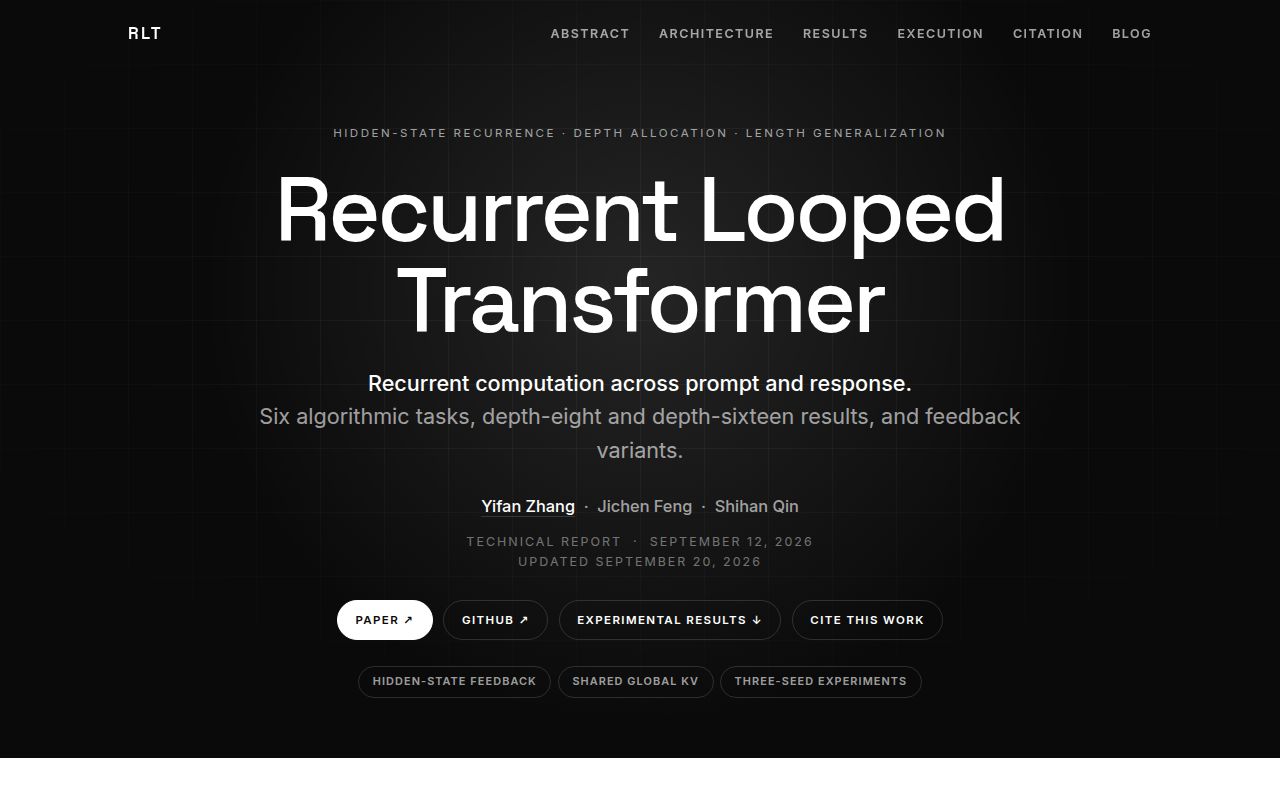
Recurrent Looped Transformer proposes carrying the decoder's final hidden state into the next token while retaining encoder-derived global memory and a local sliding-window cache. The state continues across the prompt and response boundary. That gives researchers a concrete design for asking whether recurrent computation can add useful effective depth without evaluating more decoder blocks per token.
What you can download is the report, a Chinese translation, a project website, architecture diagrams, experiment plots, and linked result data. The repository's primary detected language is HTML. There is no training package, inference library, dependency manifest, or checkpoint. The 904 stars therefore measure interest in the idea and its presentation, not adoption of a working package.
Three models separate full, absent, and chunked feedback
The report defines 3 models around the feedback path. RLT-1 feeds the previous final decoder output into the next token. RLT-0 removes that feedback while retaining global cross-attention and layerwise sliding-window attention. RLT-2 updates feedback only at chunk boundaries, allowing known positions inside a chunk to run together. A chunk size of 1 recovers the token-by-token RLT-1 schedule at the same weights.
The README specifies an 8-token sliding window for the depth-eight experiments, along with what state persists, when caches update, and how prompt prefill differs from generation. It also explains why policy replay must rebuild parameter-dependent caches after weight changes. The equations and diagrams give an experienced researcher enough information to critique the proposal. They do not replace reference code when implementation details decide the outcome.
What happened when we ran it
Our sandbox did not execute commit a070cee. The lab environment had 3 CPUs and 8 GB of RAM, but the harness identified an HTML repository and found no Dockerfile. There was no supported ecosystem for installing dependencies, building software, or running tests. We have no lab timing, dependency, test, vulnerability, or benchmark result for this project.
That absence is a product finding. A reader can open the static page and PDFs, but a team cannot put the repository into a fresh Debian container and follow a maintained command to reproduce the work. Any independent implementation would introduce choices around initialization, masking, cache layout, gradients, data generation, and checkpoint selection. Its result would be a reimplementation, not a run of this repository.
Six models produced mixed results on synthetic tasks
The depth-eight table compares 6 models across six algorithmic tasks after 2,000 optimizer steps. Some parity and state-tracking results favor RLT variants at longer lengths. The same tables show limits: all model means fall sharply on 32-digit addition, flat modular arithmetic approaches its uniform reference at long lengths, and several standard S5 results remain low.
The authors say that comparison changes feedback, attention structure, parameter count, and compute together. A later study trains 42 models around feedback variants, with 40 completed in the published snapshot and 2 still running. It also uses 1 seed, so there are no across-seed error bars. The README labels community results as a separate implementation with a different protocol.
Four CPU threads answer a narrow training question
For one 4+4 configuration on mod-5 tasks, the report lists RLT-0 and chunked RLT-2 as faster per training step than token-recurrent RLT-1. The page says these measurements used 4 CPU threads and FP32 on a shared cluster, excluding validation, checkpoint writes, and logging. It also says they do not measure GPU throughput, inference speed, or reinforcement-learning performance.
That scope matters because the architecture's appeal depends partly on where recurrent work lands in a real system. The artifact discusses prefill, decoding, and current-policy replay, yet it supplies 0 runnable inference endpoints. Use the timing table to understand the reported mod-5 experiment. Do not use it to size a production model or predict latency on an accelerator.
Zero open issues accompany the September 22 update
The repository was pushed on September 22, 2026, two days after the README's stated report update. GitHub listed 0 open issues or pull requests and no latest release. That activity suggests the authors were still refining the public artifact. It provides no release history, package version, or compatibility contract for downstream users.
RLT's 904 stars make it an easy paper to notice, and it is worth reading if recurrence or prefill-to-decode state is your research question. The page is direct about poor cases and confounded comparisons. The stopping point is equally clear: without code or checkpoints, evaluation ends at study and reimplementation. Choose RWKV-LM or Mamba when you need software you can run.