
QuantMind gives every artifact a source and timestamp
QuantMind tackles a specific research problem: collected documents become weak evidence when their page references, timestamps, and source identities disappear during chunking. Its Python objects keep those details with the extracted knowledge. PaperFlow can produce a page-cited structure tree or a semantic result containing chunks and a global summary. collect_news creates replayable PR Newswire windows, and retrieval can use keyword, similarity, or model-guided paths.
The shipped source coverage is narrower than the name suggests. Papers and PR Newswire are the concrete examples. SEC filings and prediction-market knowledge are listed as directions that have not shipped. That makes QuantMind more credible as a focused extraction framework than as a complete quantitative data layer. Buyers should map their required sources before investing in its data contracts.
The repository also treats coding agents as users. It includes AGENTS.md, mirrored Claude and Codex skills, scoped context pages, hooks, import rules, and one verification script that CI also runs. The README recommends opening the checkout in Claude Code or Codex and asking the agent to build a pipeline. A normal importable Python package remains available for teams that do not permit autonomous edits.
What happened when we ran it
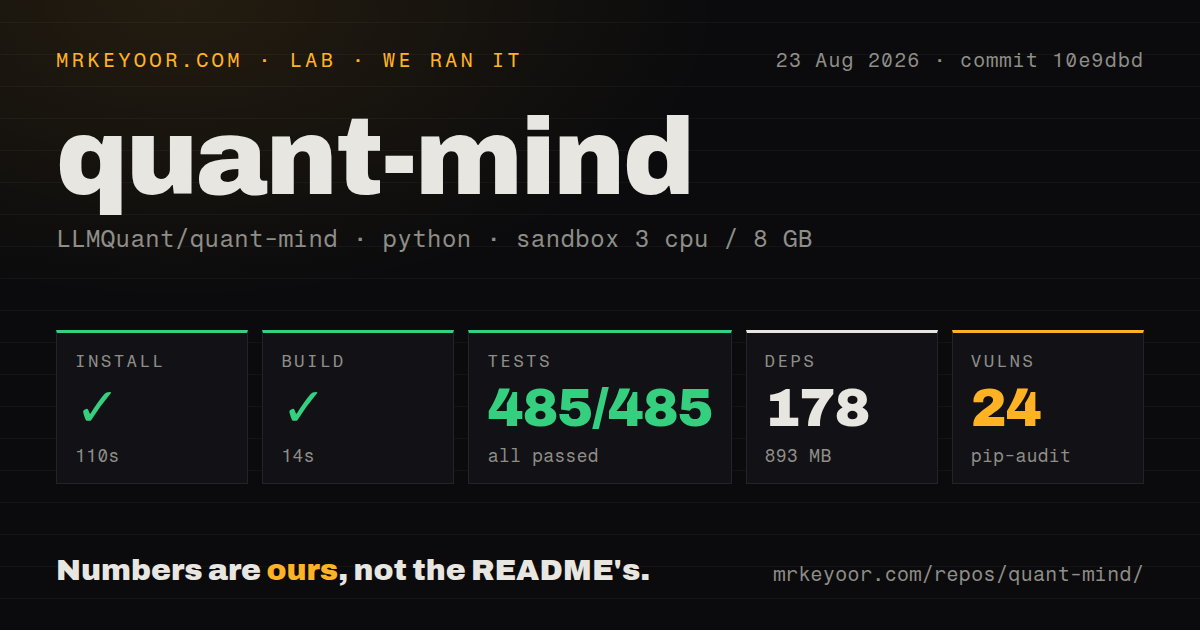
Our sandbox installed commit 10e9dbd in 110 seconds. The environment added 178 packages and occupied 893 MB, while the checkout itself contained 232 files, about 25,202 source lines, and 5.6 MB. The build then completed in 14 seconds. This is a small repository with a comparatively heavy Python dependency set.
Pytest finished in 279 seconds with 485 passed and 0 failed out of 485. The repository has 4 CI workflow files and a tests directory, so the passing result lines up with visible test and automation structure. There is no Dockerfile, which leaves adopters to decide how the Python environment, model access, parsing tools, and persistent data should be packaged.
Pip-audit found 24 known vulnerabilities in the installed environment. The supplied result does not identify their severity, affected packages, or whether every vulnerable path is reachable, so we will not guess. It does make dependency review a required adoption step. Teams should reproduce the audit, identify each advisory, update or constrain packages where possible, and record any accepted exposure before financial documents enter the system.
The first 1,200 characters shape each paper tree
Issue #133 documents an important shortcut in PaperFlow. Deterministic preprocessing reads the full document and extracts headings, but the model drafting the tree sees those headings plus the first 1,200 characters of each page by default. Full page text is attached after the model selects the hierarchy and page ranges. A wrong range can therefore place the wrong full text under a node.
That method may work on clean papers whose headings appear near page tops. It is less convincing for dense reports, sections beginning low on a page, or documents with poor heading extraction. The issue says summaries are also written from the clipped view. A buyer should test formula-heavy papers, annual reports, tables, and awkward PDFs, then compare generated ranges and summaries with the source pages before treating the tree as reliable.
The project calls its evaluation work design-stage and publishes no benchmark results. One proposed suite would compare the same model and tasks with and without the repository harness. Another would score knowledge quality, citation accuracy, and point-in-time correctness. Those are sensible questions, but the README explicitly says no results are claimed. The agent-oriented setup is an engineering approach today, not a measured performance advantage.
Batch runs can finish without a usable cost total
Issue #127 says QuantMind discards token usage already recorded by its underlying agent SDK. Batch results therefore do not expose an aggregate usage total, and declared fields for total input tokens and cost are not enforced. A pull request for usage aggregation and budgets is open, but an open change is not shipped behavior. Cost-sensitive users need their own provider-side limits and accounting.
The news path has another concrete inefficiency. Issue #144 says an incomplete discovery window may fetch as many as 2,000 article bodies before returning complete=false. A caller that correctly splits the range can download the same bodies again. The open report asks for discovery to stop before article fetching or return a reusable staged result. Until that changes, backfills should use smaller windows and track requests outside the library.
These gaps matter because QuantMind encourages agent-built flows and asynchronous fan-out. An agent can produce code quickly, while a wide batch can multiply a flawed assumption just as quickly. Production callers should cap work at the provider, retain source revisions, fail closed when a window is incomplete, and inspect the returned citation and timestamp fields instead of trusting a successful function call alone.
An August 15 push and August 26 PR activity show a young project
GitHub recorded the last repository push on August 15, 2026. Pull request #90 was updated on August 26, and other paper, news, retrieval, and usage changes were active during August. The repository showed 2,627 stars and 35 open issues and PRs combined when fetched. GitHub's latest-release endpoint returned no release object, so adopters should pin a commit rather than expect a current release tag.
The documentation deserves credit for labeling aspirations accurately. It separates shipped paper and news flows from roadmap sources, calls both evaluation suites unfinished, and gives runnable Python examples. The malformed closing markup visible at the end of the README and the absence of a release object still fit a project whose public packaging is catching up with its ideas.
QuantMind is most useful as a source-aware starting point for a narrow financial research pipeline. Its 485 passing tests support a trial, while 24 audit findings demand security work before production. Adopt the typed artifacts if they solve a real evidence problem, then expand only after your own document checks, usage accounting, and dependency review are in place.