A camera image and a point cloud can each look reasonable while disagreeing about the same moment. Rerun gives developers a place to inspect those streams together. That is the reason to evaluate it if your debugging question spans sensors, coordinates and time.
The README describes logging images, point clouds, transforms and time series into a viewer that keeps related data synchronized. It also describes storage and query capabilities. Our recorded run establishes repository setup outcomes, not whether those capabilities work well with your sensor data.
What happened when we ran it
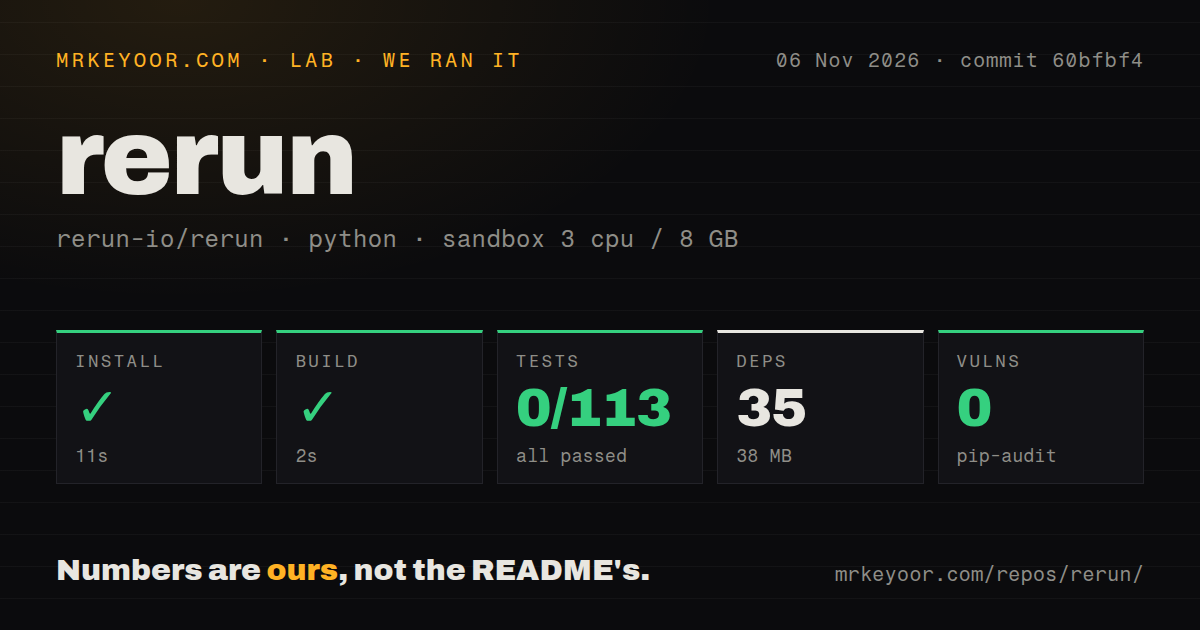
Our November 6, 2026 Rerun run at commit 60bfbf4 installed successfully in 11 seconds, with 35 dependencies recorded and 38 MB on disk. The build succeeded in 2 seconds. The test command exited 1 after 4 seconds, with 0 passed, 0 failed and 113 collection/setup errors of 113.
The failing tail names Python unit files for view blueprints, coordinates and viewer clients. It also names scripts/ci/mdlint_test.py and Python log-benchmark files. Pytest's own summary says 113 errors in 2.74s. That duration covers a different scope from the recorded outer step. These are errors during collection or setup, not evidence that 113 executed assertions failed.
No underlying exception appears in the supplied tail. We cannot attribute the result to a missing package, a runtime mismatch or a project defect. A successful install step did not produce a passing source test command, and the evidence stops there. It also doesn't establish whether the viewer can open a recording.
The configured environment specified 3 CPUs, 8 GB RAM and image ghcr.io/astral-sh/uv:python3.12-bookworm. Actual runtime versions require the raw toolchain logs. The Python-classified run covered a checkout with 9,342 files, approximately 1,050,003 source lines and 50.2 MB. The scan found 52 CI workflow files and a tests directory, with no Dockerfile detected.
Our pip-audit result reported 0 known vulnerabilities. That is a bounded audit result, with no package-coverage detail supplied here. It does not establish the safety of the viewer, every repository component or data received from elsewhere.
Python bundles the viewer, Rust and C++ do not
The README says only the Python SDK includes the viewer. Rust and C++ users need a separate viewer installation. That packaging difference should be settled before you choose an integration language or interpret the Python installation timing as the effort required everywhere.
The Python example initializes a recording and spawns a viewer process. It shows saving logs to a recording file as another route, with a remote viewer connection separately illustrated. These are documented workflows, not interactions verified by our sandbox. Start locally if you want to establish the data model before adding network configuration.
Logging needs some design work, too. The example associates data with a named timeline and an entity path. Your evaluation should check whether related sensor outputs use the time and paths you intended. A viewer cannot answer a timing question if the recording doesn't preserve the relationship you're investigating.
API changes create maintenance work for integrations
Rerun's README explicitly tells adopters to expect breaking changes. The 0.42.0 release, published November 4, 2026, provides a concrete example: DatasetSelection.schema() covers only selected segments. That matters if downstream code assumes a broader schema when preparing data.
Pin the SDK revision used by an integration and review migration notes before upgrading it. For a research script you own, that may be acceptable maintenance. For a shared pipeline whose consumers expect unchanged interfaces, budget for checking the query behavior as well as whether a visualization still opens. Our recorded commit does not independently verify the release's behavior.
The business boundary deserves the same attention. The README says the open source project targets individual developers and describes a separate commercial product for team needs. It also identifies Rerun Hub as a catalog available to selected design partners. Check the product boundary before assuming the local repository supplies the shared data service your team wants.
ROS 2 visualization and standalone charts offer narrower routes
RViz is a 3D visualizer for ROS 2. Consider it when that framework already organizes your robotics work and its visualization route covers the question. This is a framework-fit recommendation. We did not compare RViz recording behavior, resource use or rendering speed with Rerun.
Plotly.py is an interactive browser-based graphing library for Python. Its documentation includes standalone HTML figures. Choose it when the deliverable is a chart you can share, and you don't need to adopt Rerun's recording workflow. Neither alternative has comparative measurements in this review.
Documentation earns 4 on our coverage scale: 1 means missing essentials, 2 means major gaps, 3 means a usable basic route, 4 adds concrete integration choices and limitations, and 5 requires independent verification across that scope. Rerun documents SDK routes, viewer packaging and API-change warnings. Setup ease, support quality and runtime maturity remain unassessed.
For an adoption trial, use a short recording containing the sensor disagreement you actually need to explain. Check its timestamps, replay it and inspect the related outputs together. Until that works on your target machine, the successful installation is only the first completed step.