The README is a project shelf, not a course sequence
Project Based Learning collects tutorials in which the reader finishes a working artifact. The table of contents spans C and C++, Clojure, JavaScript, Python, Rust, Swift, and many other languages. Entries range from operating systems and compilers to games, web applications, bots, mobile apps, and data projects. That range makes the repository useful when the first problem is finding something worth building.
The list does not assign a common beginner, intermediate, or advanced level. A calculator tutorial can sit in the same language section as a database, emulator, or kernel. Prerequisites and tool versions come from each external author. A learner still has to open several candidates, inspect the publication date and dependencies, then decide whether the pace matches their background.
Free and project-based are explicit submission rules
The contribution guide requires each tutorial to be free and open, with no paywall, login wall, or newsletter gate. Following it should produce a complete working artifact rather than explain one concept. Authors and affiliates must disclose their relationship, links must point directly to the tutorial, and each pull request should add or change one tutorial. Those are sensible editorial rules for a directory that attracts promotional submissions.
A Python validator checks the README grammar, table of contents, duplicate entries, and shortened URLs. CI also tests the reachability of links added by a pull request. The guide names 5 examples of sites that may block automated checks: Medium, Reddit, LinkedIn, Udemy, and similar hosts can be reported as unverified without failing a build. Passing automation therefore does not certify every destination.
What happened when we ran it
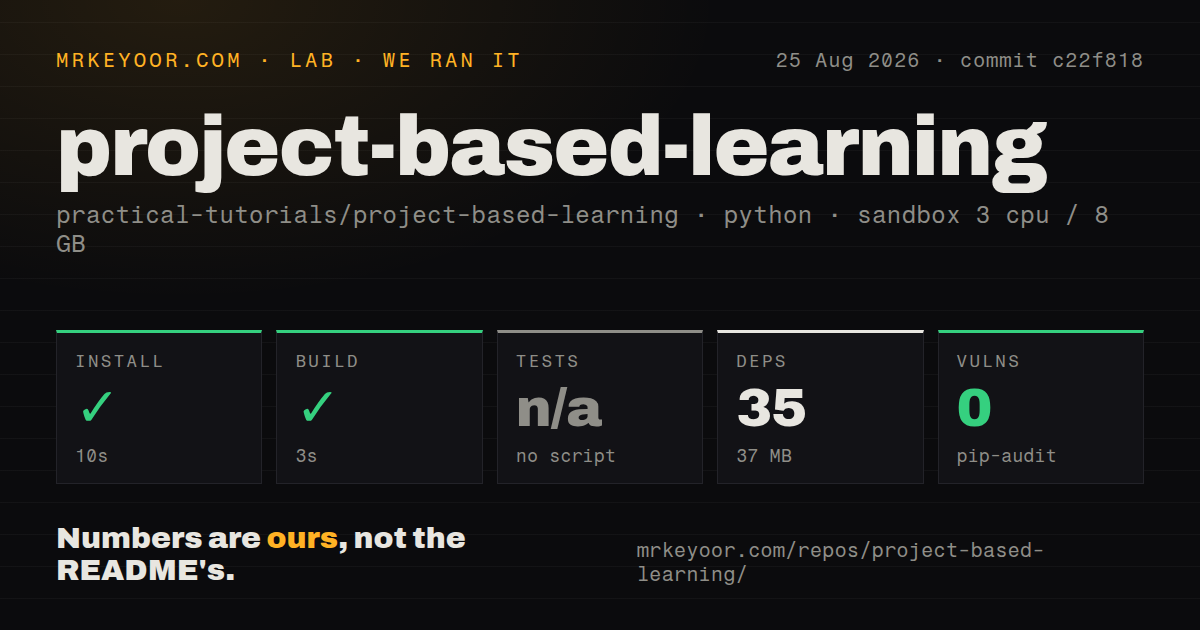
Our sandbox installed commit c22f818 in 10 seconds, adding 35 packages and consuming 37 MB on disk. The available build completed in 3 seconds. Pip-audit found 0 known vulnerabilities. The checkout contained 14 files, roughly 1,179 lines of source, and 0.2 MB before installation.
There was no tests script or target, so our run skipped tests. The repository does have 3 CI workflow files and a custom README validator, but the lab result cannot claim that every linked tutorial loaded or taught what its title promised. The sandbox was an unprivileged Debian container with 3 CPUs, 8 GB of RAM, Python 3.12, and no secrets.
For an index like this, the 3-second build is a small convenience. External-link survival and editorial selection matter more. The repository's weekly link-rot workflow and saved link state address that problem directly, yet an automated request can miss soft redirects, changed content, newly added login walls, or a tutorial that still loads but targets an obsolete library.
Link rot is managed, but it remains part of the product
Open issue #344 asks contributors to clean up dead or outdated tutorials, while issue #899 is a link-rot report. An August 2026 pull request removes a React tutorial whose address no longer serves the lesson and redirects to a landing page. This is ordinary maintenance for a list that has existed since 2017, and readers should expect some bad destinations between sweeps.
The repository is better prepared than a static bookmark dump. Its checker recognizes malformed entries, direct-link rules, duplicate URLs, shortened links, soft 404 phrases, and domain-specific verification limits. Still, it does not control the content behind a URL. Save a local copy of any tutorial you plan to teach, where the license permits it, and test the project before assigning it to others.
Breadth works best for learners who can self-filter
A developer learning a second language can choose a familiar artifact and concentrate on syntax, tooling, and conventions. Someone who already knows web development might build a game or compiler to stretch into different concepts. The language-first organization makes both searches quick, and the 52 KB README is easy to scan with browser find.
Absolute beginners face a harder job. The list does not tell them which project should come first, how long it takes, which lessons have exercises, or whether a series explains debugging. There is no account, progress tracker, grader, or discussion tied to each entry. The Gitter badge offers a general community route, but it is not the same as support from a tutorial author.
August maintenance matters more than a missing release tag
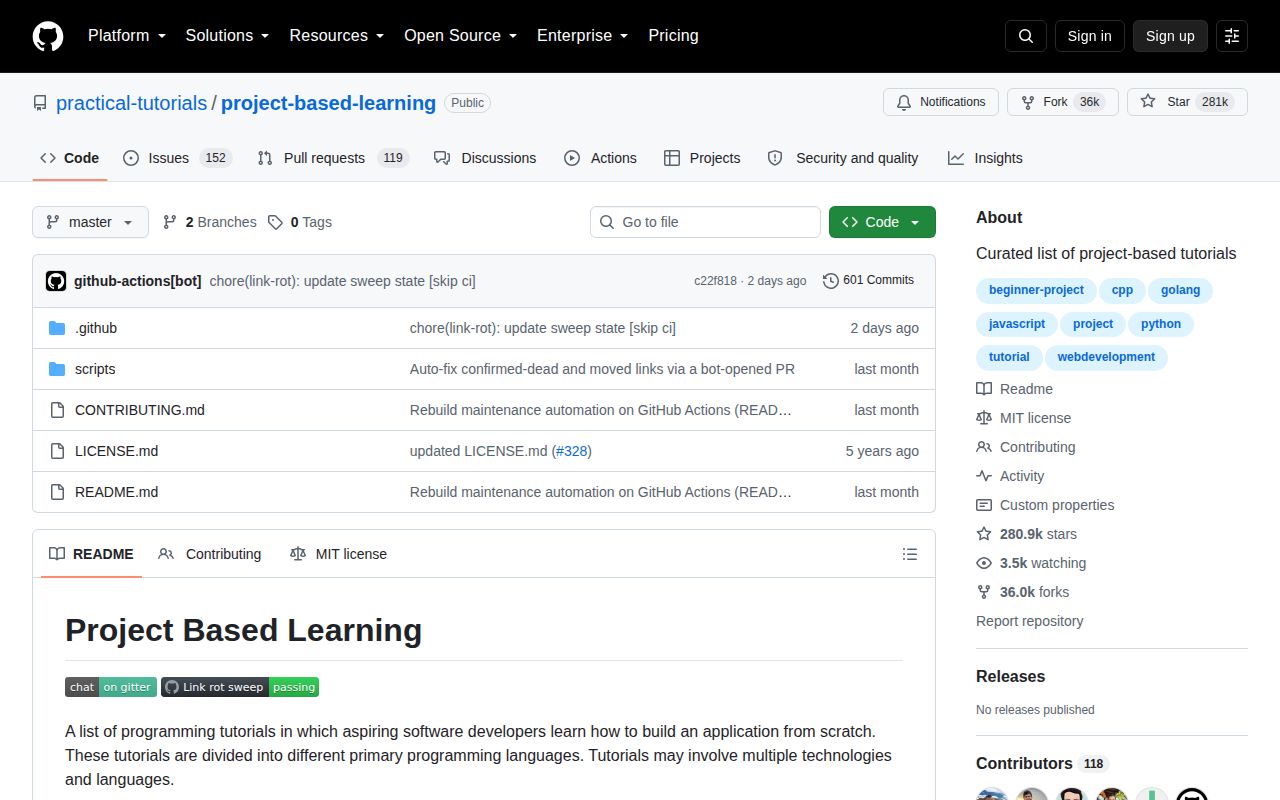
GitHub recorded a last push on August 24, 2026, 280,943 stars, and 271 combined issues and pull requests. The latest-release endpoint returned no release. That absence is unimportant for a Markdown directory: current pushes, link checks, and issue work are better health signals than a tagged binary that the project does not need.
Use Project Based Learning when you want options and can vet them. Its contribution policy gives the list a clearer standard than most collections, while our no-test finding and the open link-rot work keep the verdict grounded. Pick one small tutorial, check every dependency and link first, and judge the resulting project rather than the repository's star count.