Your product components become the film's raw material
Product Film asks Claude Code to read your product before it writes a video. The README describes discovery of design tokens, existing components, logos, and permitted claims. That makes it interesting for a developer whose launch footage looks unrelated to the application. A real settings panel or dashboard can become the scene material, with the product's own typography and colors carrying through the edit.
The strongest design choice is videos/BRAND.md. Your answers go into that file, and the README says it overrides the skill's defaults. That gives the next revision somewhere concrete to start. If the generated film chooses the wrong tone or shows an unsuitable feature, you can correct a written brief instead of repeatedly hoping the agent remembers a conversation. Keeping that brief beside the product code also makes review easier.
What happened when we ran it
We did not run Product Film at commit fe11efc: our lab recorded no supported ecosystem for its TypeScript code and found no Dockerfile. The October 14, 2026 sandbox had 3 CPUs and 8 GB of RAM, with no secrets or elevated privileges. This is a limitation of the execution path our harness could select, rather than evidence that the project's documented toolchain fails.
There is consequently no measured installation time, rendering result, test outcome, or dependency audit to recommend here. The README's final-film checks remain documented behavior, not something our sandbox verified. A team considering this skill should make its first acceptance check a complete export from its own product repository. Inspect the actual encoded files before scheduling a launch around them, especially when the product uses assets that are awkward to render outside the application.
Claude Code is required, and the chat apps cannot run it
The README explicitly excludes the Claude chat apps because this skill runs a local toolchain. You need Claude Code, Node.js, Bun, and uv, with Remotion added to the product project. Python helpers fetch their audio and numerical tooling on demand. Installing the skill through the Claude Code marketplace gets you the instructions, but those instructions still need working local tools and access to the product's source material.
Our 3-CPU sandbox provides no evidence about how that rendering workload behaves on a developer laptop. Keep the distinction clear when estimating effort: copying the skill folder is only the entry point. You still have to choose footage content, supply suitable music, approve visual decisions, and review exports. For a developer already comfortable with a local JavaScript toolchain, those tasks are plausible. For a marketer who wants a browser editor, the required environment is a poor fit.
A written brief and frame reviews keep decisions visible
The documented workflow pauses for style frames before scene construction, then uses stills, contact sheets, and a lower-resolution draft for review. Those are sensible places to catch an incorrect logo, unreadable product text, or a claim the company cannot support. The useful feature is the opportunity to reject a bad direction while the film is still cheap to change. Whether Claude makes good choices remains something the reviewer must judge.
Music gets its own beat analysis and editing helpers, while scene timing lives in a Remotion composition. That arrangement should appeal to someone who wants to revise a product film in code and keep it alongside the application. It will frustrate someone expecting recorded mouse movements to become an accurate tutorial automatically. The README describes constructed scenes and optional cursor interactions, so treat the output as an authored representation of your product.
The skill's MIT license does not cover every input
The repository licenses its own text and code under MIT. Its README separately calls out Remotion's licensing terms and the requirement to use music you have rights to. That is a meaningful procurement detail: approving the skill's license does not finish the review of the rendering engine or soundtrack. Follow the linked Remotion terms for your organization rather than assuming the repository license extends to the whole production chain.
A film that uses your real components can also inherit their content decisions. Check sample customer names, partner logos, and product promises before accepting a draft. The README's discovery phase includes what the product may claim, which is a useful prompt for this review. It cannot establish permission to publish every asset it discovers. Give the agent approved inputs, then verify that the finished scene uses those inputs as intended.
A September 26 push has no public issue discussion behind it
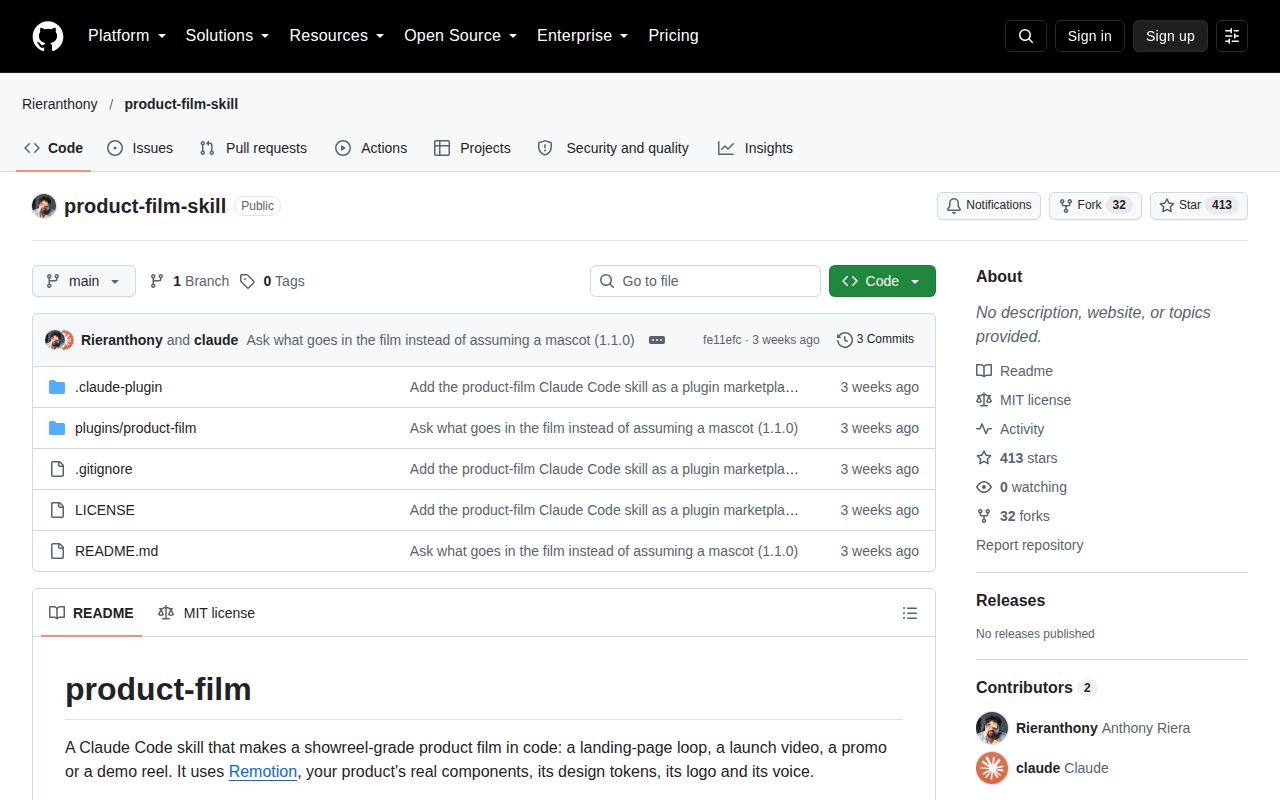
GitHub reported 413 stars, a last push on September 26, 2026, and no open issues or PRs when checked on October 15. The recent issue endpoint returned no entries, and the latest-release endpoint returned no release. That combination shows recent code activity with little public evidence about other users' failures. It does not justify calling the project abandoned, or treating an empty queue as proof of reliability.
Choose Remotion directly if you already know the film you want and prefer to own the scene code without an agent-led interview. Motion Canvas is another option for developers who want to author animation themselves. Product Film earns a trial when translating your existing product identity into a code-based film is the difficult part. Start with a small internal clip, approve the brief, and make the export prove itself before you promise the launch team a finished asset.