mrkeyoor.com_
Tue 01 Sept 17:44 UTC
AI Toolsevaluationupdated 30 Aug 2026

PRAXIST review

Praxist is a Python system that sends parallel coding agents through repeated research and evaluation cycles on an existing project. It is for problems with a runnable baseline and a measurable objective, such as improving a model or algorithm while preserving stated constraints.

+960 / 1dstars / 7d
Verdict

Our PRAXIST run installed 131 packages and used 905 MB, but its build failed and the tests timed out at 900 seconds after showing multiple failures, so commit 7af6a26 is a poor fit for teams that require a clean checkout gate. Its research model is specific and useful for groups that already own a reproducible evaluator, compute budget, and agent operations. Read the Fair Source terms before trialing it inside a company, especially the $1 million revenue threshold and public-output attribution rule.

We ran it

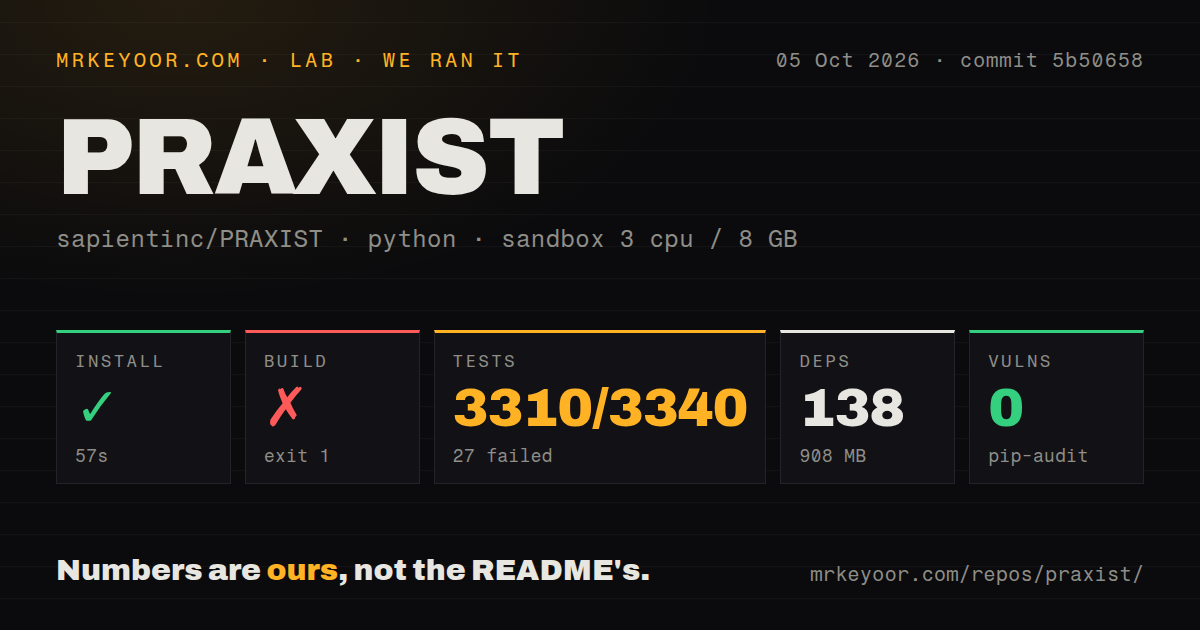
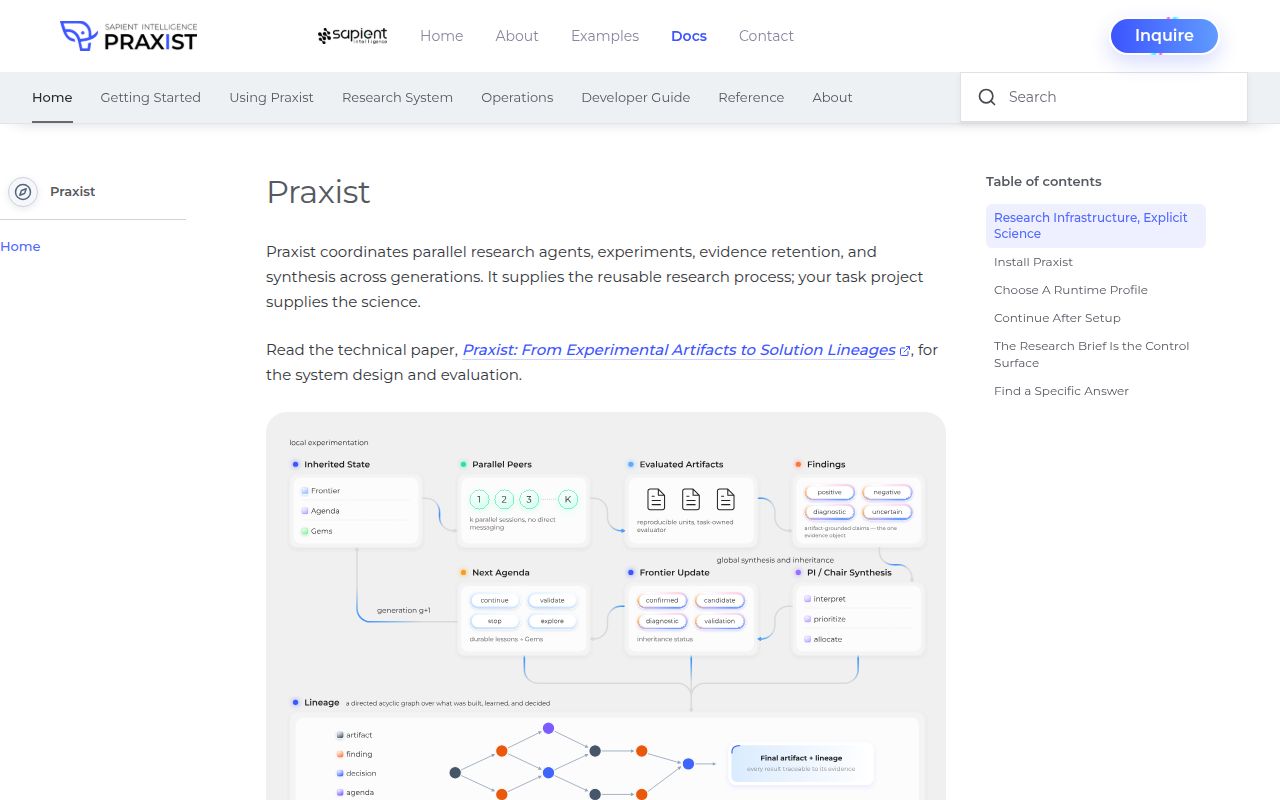
Lab card: what happened when we ran PRAXISTScreenshot of PRAXIST (praxist.sapient.inc/en/docs)
Install✓ · 46s131 packages · 905 MB
Build✗ · 6s
Tests✗ timed out · 900sran, no count parsed
Known vulns0(pip-audit)
Repo1237 files~306,050 lines of source · 23.5 MB · 5 CI workflows · tests dir

Answers from our run

Does PRAXIST build from source?

Dependencies installed in 46 seconds (131 packages), and the build failed. We cloned commit 7af6a26 into a clean Debian container with 3 CPUs and no project-specific setup.

Do PRAXIST's tests pass?

We could not finish them: the suite was still running after 15 minutes in our container.

Does PRAXIST have known vulnerabilities in its dependencies?

pip-audit found none in the dependency tree at the time of our run.

Who should not use PRAXIST?

Teams seeking an OSI-approved open-source license: Praxist uses a custom Fair Source agreement with revenue, distribution, and public-output attribution terms.

What are the alternatives to PRAXIST?

AI Scientist, AutoGen, OpenHands. Our PRAXIST run installed 131 packages and used 905 MB, but its build failed and the tests timed out at 900 seconds after showing multiple failures, so commit 7af6a26 is a poor fit for teams that require a clean checkout gate.

Setup2/546-second install, then a failed build and 900-second test timeout
Docs5/5Setup, task ownership, platforms, privacy, and operations are explicit
Community3/54,484 stars; four current issues and PRs in a very new tracker
Maturity2/5Large codebase with active fixes, but our checkout did not pass

Who it’s for

Research engineers with a working project, repeatable evaluator, and metrics that can rank candidate changes.
Teams prepared to supervise several agent peers across long, resumable experiment runs.
Codex or Claude Code users who want packaged skills for setup, takeover, monitoring, and diagnosis.
Academic groups that can supply their own datasets, compute stack, and task-specific safety limits.

Who it’s NOT for

Teams seeking an OSI-approved open-source license: Praxist uses a custom Fair Source agreement with revenue, distribution, and public-output attribution terms.
Companies with at least $1 million in annual revenue that have not budgeted for a commercial-license negotiation: the free license lapses at that threshold.
Windows-native operators: the platform matrix puts Windows outside the current research-runtime contract and directs users to Linux.
Projects without a runnable baseline or measurable evaluator: the README says Praxist will stop instead of inventing missing data, simulators, or performance evidence.
Anyone expecting a quick prompt-to-result agent: installation, legal acceptance, runtime selection, task takeover, evaluation, and run authorization are separate gates.

Setup reality

Our sandbox installed 131 packages in 46 seconds and used 905 MB. The build failed with exit code 1 after 6 seconds. Tests then reached the 900-second limit; the log showed repeated failures among passing cases and had only reached 26%, so this checkout did not complete its test suite. Pip-audit found 0 known vulnerabilities.

The documented path needs Python 3.11 or newer plus a working Codex or Claude Code installation, or a supported model-provider API key. Research also needs an existing runnable project, its evaluator, metrics, datasets, and any accelerator libraries. Setup records license acceptance separately from optional product-usage consent.

Linux on CPython 3.11 and 3.12 is the release-tested path. macOS and other Python 3.11+ combinations are compatibility targets, while Windows-native is excluded. The package supplies orchestration and skills; it does not install CUDA, datasets, simulators, training frameworks, or a cluster scheduler.

It starts with a runnable project and a measurable evaluator

Praxist takes over the experimental loop after a team has already made its project run. You define the objective, metrics, constraints, baseline, and evaluator. Its peers then try competing changes, turn evaluation results into stored evidence, and carry selected findings into later generations. That boundary is sensible: the tool can coordinate research, but it cannot decide whether a scientific result is valid for your domain.

The checkout we measured is substantial for a young Python project: 1,237 files, about 306,050 lines of source, and 23.5 MB before installation. Much of that surface covers lifecycle control, evidence storage, scheduling, provider adapters, packaged skills, examples, and task templates. This is closer to a research operating system than a small agent loop. Buyers should expect to learn its concepts before trusting an unattended run.

Codex and Claude Code are operator interfaces, not included runtimes

The README recommends operating Praxist through Codex and also documents Claude Code. A takeover skill inspects a project, creates or repairs the task harness, checks the evaluator and evidence contract, then launches only after its gates pass. Other skills cover onboarding, task initialization, control, diagnostics, literature work, and terminal plots. Direct CLI commands remain available for status, monitoring, stop, resume, examples, and setup.

Installation was quick in our Debian sandbox relative to the system's breadth. It succeeded in 46 seconds, pulled 131 packages, and occupied 905 MB on disk. The documented complete install includes agent and Codex extras, followed by an interactive setup wizard. A saved Codex login can support the Codex-native route. API-backed profiles instead require provider credentials, and sustained parallel research can create a material provider bill that the repository cannot predict for you.

What happened when we ran it

Our run at commit 7af6a26 installed successfully, then the build failed with exit code 1 after 6 seconds. The supplied result does not include the build error text, so there is no defensible cause to report. The narrow finding is still useful: a fresh unprivileged Debian container with 3 CPUs and 8 GB of RAM did not clear the project's build step.

The tests ran for 900 seconds and hit the time limit. Their tail showed many passing cases, several skipped cases, and repeated F markers by 26% progress. It did not report a final total because the suite never finished, and the excerpt does not identify the failing assertions. Pip-audit found 0 known vulnerabilities. That audit result says nothing about the correctness failures or code that the timed-out suite had not reached.

The Fair Source license rules out casual corporate adoption

GitHub could not identify the custom license with an SPDX label, and the repository has no latest GitHub release response. The included agreement permits internal use and modification below its revenue threshold, restricts standalone redistribution, and requires product-name attribution when generated output is released publicly. Organizations reaching $1 million in annual revenue must notify Sapient and negotiate a commercial license under stated deadlines. Legal review belongs near the start of evaluation.

The license question matters more than the 905 MB environment cost. An academic-institution exemption covers specified nonprofit teaching and research uses, while a controlled commercial spin-off does not inherit that exemption. Optional product-usage collection is a separate consent choice. The privacy notice says an unset or denied choice sends nothing, and setup must not treat acceptance of the license or user agreement as telemetry consent.

Linux 3.11 and 3.12 are qualified; Windows-native is excluded

Release CI continuously tests Linux on CPython 3.11 and 3.12. macOS and other CPython 3.11+ hosts are compatibility targets that must pass praxist doctor and task checks. Windows-native sits outside the runtime contract. The package also leaves CUDA, model-training frameworks, datasets, simulators, task containers, and cluster scheduling to the project or host administrator. That makes the advertised one-line install only the Praxist layer.

Our 900-second timeout reinforces the need to test the exact host and task stack rather than treating successful pip installation as readiness. Praxist expects writable run directories and user configuration, and detached runs continue after the foreground monitor closes. Long experiments need resource limits, provider budgets, stop conditions, storage policy, and a baseline that stays reproducible while agents modify candidate copies.

August issue activity is fast, while runtime edges are still moving

The last push was August 30, 2026. GitHub listed 4 open issues and pull requests, and the tracker showed same-day work on a stop-signal path bug. Another open report from August 28 describes a saved Codex login being lost when Praxist stages a separate Codex home. Both reports concern lifecycle or authentication paths that can block real runs, rather than cosmetic gaps. A related Codex Desktop environment fix had already merged.

PRAXIST had 4,484 stars when fetched, but the public issue tracker only began days earlier and offers little history for judging support under load. Five CI workflow files and a tests directory are good project signals. Our checkout still failed its 6-second build and did not finish testing in 900 seconds. Trial it on a disposable, representative project first, and make a clean build plus completed suite your adoption gate.

Alternatives

ProjectWhat it isPick it when
AI ScientistAn agent workflow that automates experiments, paper writing, and review for machine-learning research.pick this instead when paper production around a supplied ML template is closer to the job than operating a persistent general research loop.
AutoGen gh↗A framework for building custom applications with collaborating agents.pick this instead when you want to design the agent roles and control flow yourself without adopting Praxist's research lifecycle.
OpenHands gh↗A general software-development agent with a UI, CLI, and SDK.pick this instead when the main need is an interactive coding agent rather than multi-generation experimental research.

What people are saying

  1. [velocity-scout] sapientinc/PRAXIST

Sources

  1. PRAXIST README
  2. PRAXIST repository metadata
  3. PRAXIST installation guide
  4. PRAXIST platform support
  5. PRAXIST Fair Source license
  6. PRAXIST issues

More ai tools reviews

claudian · SkillSpector · robin · mjlab · MoGe · awesome-design-md · the whole board →