More than a prettier issue list
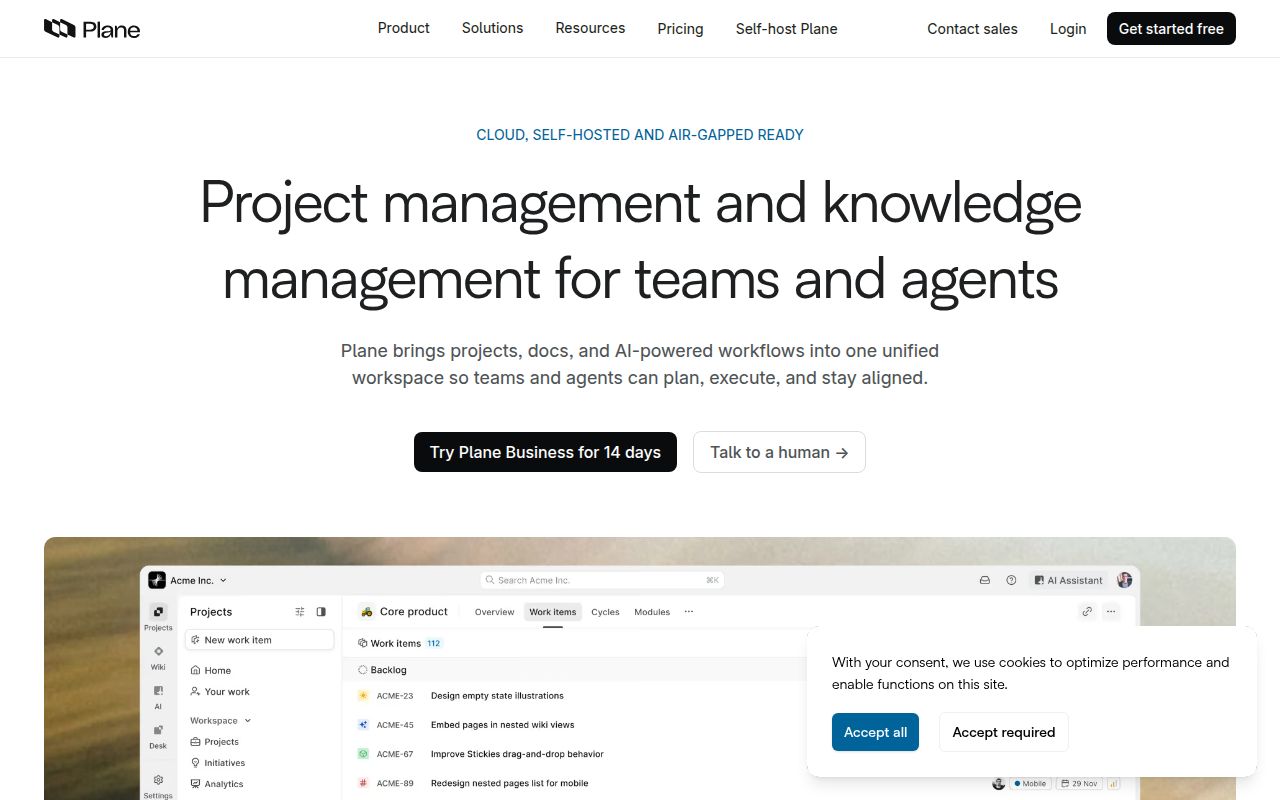
Plane organizes work around work items, cycles, modules, saved views, pages, and analytics. Work items are the unit of delivery. Cycles cover time-boxed execution, while modules group a larger slice of a project. Pages keep notes near the work, and views let each team save filters instead of forcing one board layout on everyone. The result sits closer to Jira or Linear than to a basic Kanban app.
The interface is the main reason to consider it. Plane aims to make common product work feel lighter without stripping away relationships, custom properties, intake, or reporting. Teams can start on Plane Cloud, then self-host if data location or internal policy demands it. The repository is AGPL-3.0, so the source is available, but companies modifying a network deployment need to understand that license rather than treating it like a permissive library.
Breadth can become clutter. A five-person team with one board may have no use for modules, analytics, pages, instance administration, or multiple workspaces. Plane makes more sense when the current tool is losing context across delivery, planning, and documentation.
What happened when we ran it
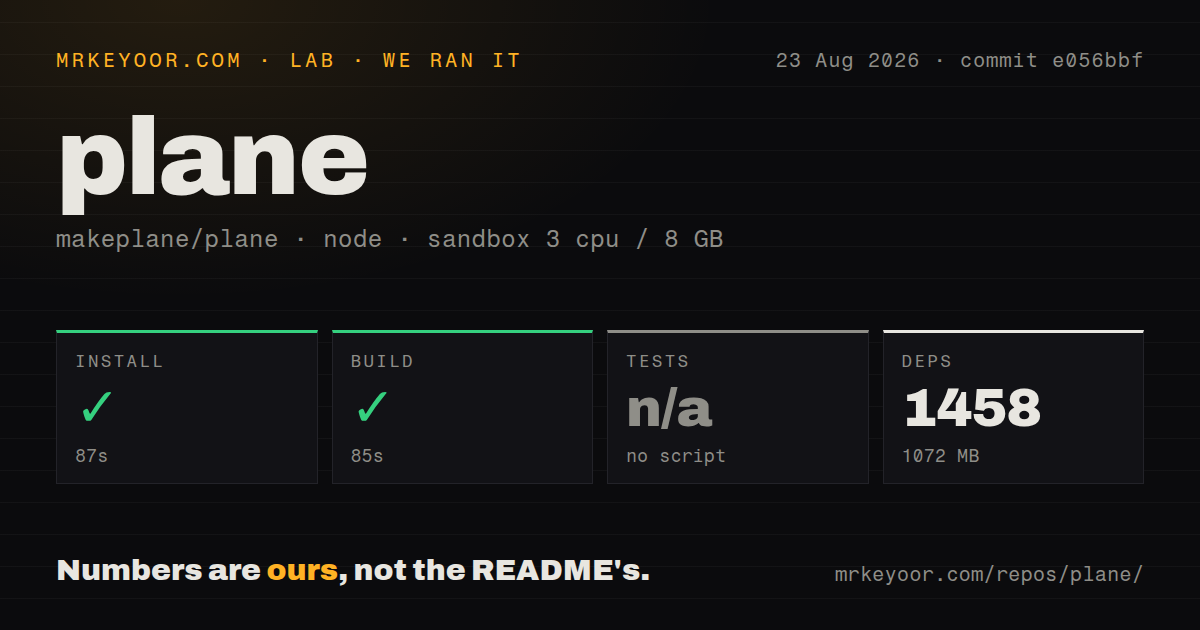
We cloned commit e056bbf into an unprivileged Debian container with 3 CPUs, 8 GB of RAM, no secrets, and Node 22 Bookworm. The checkout contained 5,256 files, about 405,469 lines of source, and occupied 55.8 MB. It is a workspace monorepo, which explains why source size and dependency cost are far above a small frontend.
Pnpm installed 1,458 packages in 87 seconds. The installed tree used 1,072 MB on disk. The build completed successfully in 85 seconds, a good result for a monorepo of this size under the fixed sandbox limit. Our harness found no standard test script or target and skipped tests, so the successful build says nothing about behavioral coverage.
The scan found nine CI workflow files and a compose file. It found no root Dockerfile and no tests directory. Those repository signals show automation and deployment intent, but only the installation and build were exercised in our run. We did not launch the application or connect its backing services.
Self-hosting is an operations decision
Plane's README offers Docker Compose and Kubernetes paths, plus a managed hosting partner. The example environment makes the moving pieces clearer than the marketing screenshot: Postgres stores application data, Redis supports fast shared state, RabbitMQ handles queued work, and uploads go to S3-compatible storage. The bundled route can use MinIO. Proxy, web, API, worker, and live-update services then sit around those stateful dependencies.
That is a normal shape for a serious collaboration product, but it is not a one-container weekend install. An operator owns database backups, uploaded files, secrets, TLS, mail settings, upgrades, monitoring, and recovery.
Self-host only when control, policy, or integration access repays ongoing care. A deployment that nobody patches is a worse bargain than a paid hosted account.
Daily work feels familiar, with useful structure
Cycles and modules avoid forcing every team into Scrum vocabulary. A product group can plan a short cycle, attach work to a module, write supporting context in a page, and save views for an owner or state. Analytics and burn-down charts cover the reporting most delivery teams ask for. File uploads and a formatted editor keep work-item discussion inside the system.
The design also has room to improve. Issue #7183 has remained open while users ask for automatic refresh in work-item views, reporting that they reload the page to see teammates' changes. For a collaborative tracker, stale views are more than cosmetic. Test concurrent editing and status changes with the number of users and tabs your team expects.
A migration pilot should include the awkward work, not only creating a sample card. Import existing data, exercise permissions, attach files, search a large project, test notifications, and run the API clients your automations use. Plane's broad feature list matters only if those routine paths survive real data.
API edges deserve a staging pass
Two fresh reports illustrate why integrations need their own acceptance suite. Issue #9672 says the email-and-password sign-in endpoint returns HTTP 500 when a client sends no User-Agent header. Credentials are accepted, then saving a null header value violates a database constraint. Browsers normally send the header, but some programmatic clients do not.
Issue #9674 concerns work-item link metadata. The reporter found that an API update returns 200 with the submitted value, then a background crawler overwrites it moments later even when the URL did not change. The report includes a reproduction against v1.4.1 and says the code path remains in v1.4.2. Teams syncing link data should test for eventual state, not trust the immediate response alone.
These are bounded bugs, not proof that the whole API is unreliable. They do show the value of staging with actual clients and polling after background jobs. Pin a release, record the migration steps, and rehearse rollback before moving the team's source of truth.
Health and the buying decision
Release v1.4.2 was published on August 23, 2026, and the repository was pushed again on August 24. GitHub listed 1,083 open issues and pull requests combined. Fresh reports were receiving replies, while the release fixed stale frontend chunks during navigation. Plane is actively maintained; the large queue also means buyers should search their exact workflow before assuming an edge case is covered.
Documentation is unusually well separated. Product docs explain usage, while developer docs cover self-hosting, APIs, webhooks, extensions, and instance administration. The repository README stays short and points operators outward instead of pretending production is one command.
Plane should be piloted by teams that need serious planning features and value control over their data. Keep Wekan for a board-only workflow, or pay for Linear when operating software is a distraction. Plane earns the extra work when its modules, pages, views, and self-hosting boundary solve problems you already have.