PiliPlus documents offline playback and casting for Bilibili
PiliPlus lists offline caching, playback and DLNA casting in its Chinese README. Those are useful reasons to investigate a separate Bilibili client, particularly if you want control over how you watch on your own devices. We have no hands-on playback result, so the recommendation stops at an evaluation of those specific functions.
The Flutter project is a third-party client for Bilibili. Its primary documentation is Chinese, with a shorter English README that explains what it is, where to download it and the maintainer's disclaimer. The English page does not translate the full feature inventory. An English-speaking reader can identify the project, but checking the finer playback options will require working through the Chinese documentation.
The main README also lists account features, private messages and several ways to manage favorites or watch-later videos. That makes this a client for an existing service rather than an independent media library. Decide which Bilibili actions you need before treating a long checked feature list as a reason to move your routine into it.
What happened when we ran it
We did not run PiliPlus at commit c7ff968 on November 4, 2026 because our sandbox did not support its Dart ecosystem. The scan also found no Dockerfile. There is no installation duration, build result, test count or playback measurement to report.
The recorded sandbox configuration listed 3 CPUs and 8 GB RAM, with no image specified. It establishes no actual runtime or operating-system version. More importantly, nothing in this record establishes whether a Flutter environment could compile the project or whether a release download would work on your device. Unsupported lab coverage cannot answer either question.
That boundary matters when choosing a client. We cannot tell you whether login survives a restart, whether an offline item plays without a connection or whether casting discovers your receiver. Those are evaluation questions suggested by the documented features, not failures observed in this application.
The learning-and-testing disclaimer limits a daily-use recommendation
The English README says PiliPlus is for learning and testing and asks users to delete it within 24 hours of downloading. It also says the project provides no cracked content. Read that statement before choosing it as your everyday Bilibili client. It is the maintainer's stated scope, regardless of how many capabilities the interface appears to offer.
The Chinese feature list explicitly says high-definition quality is not unlocked. Hardware acceleration depends on the device, while audio-quality and decoding choices depend on the video. If your reason for switching is access to a particular quality level, the README gives you no basis for assuming the switch grants it.
Downloads and local compilation are both documented routes. Neither is verified here. If you are evaluating a release, start with the package for your actual platform rather than assuming the same behavior across the platform checklist. For source work, the English summary does not establish a complete toolchain or configuration procedure.
A PC playback report deserves a device-specific check
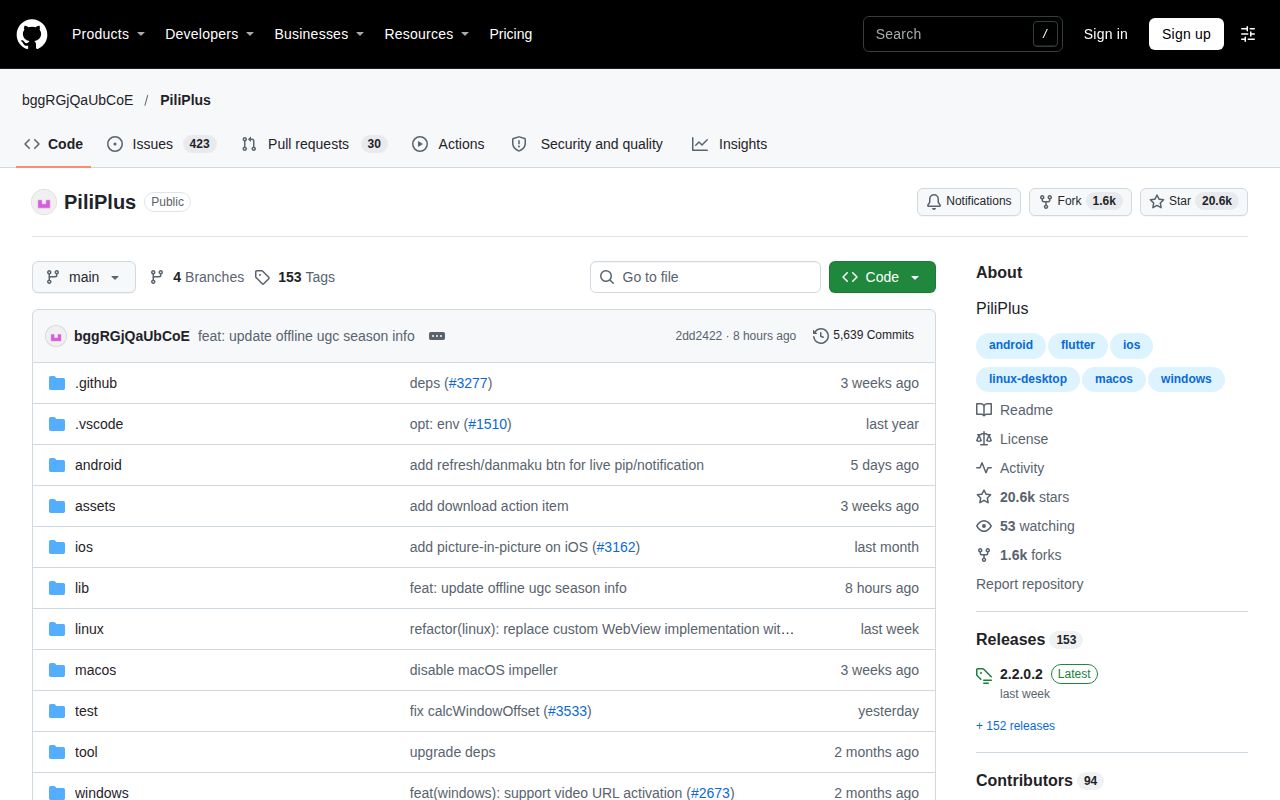
GitHub records the last push on November 10, 2026, and the recent issue feed contains reports updated that day. There is current code and user activity. That supports describing an active repository, without answering whether its maintainers can resolve your particular problem quickly.
One open PC playback report, issue 3558, describes black flashes and stuttering and supplies a video link for reproduction. The reporter says repeated playback reduces the problem. No error log is supplied. This is a user's report, not a defect we reproduced or evidence that every desktop installation stutters.
Use the report as a reason to check representative playback on the intended device. Keep the client version and the video you tried alongside the observation. A successful launch alone would leave that report's actual complaint unanswered.
PiliPala and PiliPalaX document narrower platform targets
PiliPala is the original Flutter Bilibili client credited by PiliPlus. Its README focuses on Android and iOS and says desktop and tablet adaptation are absent. Evaluate it if the original mobile project is the starting point you want. That narrower stated target does not establish better stability.
PiliPalaX is another upstream project credited by PiliPlus. Its README focuses on mobile and tablets and says desktop adaptation is absent. It also documents a Flutter framework workaround. Consider it for that upstream codebase and target, after checking whether its toolchain instructions still fit your environment. Neither alternative has a comparative playback result in our lab.
Documentation earns a rating, while operation remains unassessed
Documentation receives 3/5 under this editorial rubric: 1 means no identifiable usage route, 3 means concrete guidance with material gaps, and 5 means the relevant guidance has been independently verified within this review. PiliPlus names platforms, features and limitations, but its English documentation leaves source setup largely unexplained. This score describes the evidence available to a reader, not the quality of playback.
Setup ease, support quality and production maturity remain unassessed. During a permitted evaluation, check the function that drew you here: play a cached item without a connection or cast to the receiver you own. If that function cannot be confirmed on your device, the feature checklist has not settled your decision.