Pi 0.86.1 gains Claude Code as a provider and a tool
pi-claude-bridge has 2 jobs. Select claude-bridge in Pi's model picker and Claude Code becomes the model behind the conversation, while Pi keeps control of its terminal UI and tools. Or enable AskClaude, stay on another provider, and delegate a bounded question or coding task to Claude Code. That second route supports read, no-tool, and full modes, plus isolated sessions and model selection. Full mode can write files and run shell commands, which makes allowFullMode a security setting rather than a convenience toggle.
The bridge is useful because Pi and Claude Code do not share the same tool or session format. It translates Pi tools through MCP, forwards Pi skills, carries steering messages at tool boundaries, and tries to keep Claude Code's session synchronized with Pi's history. Version 0.8.0 requires Pi 0.86.1 or newer and Node 20 or newer. AskClaude is disabled until you turn it on, while strict MCP configuration defaults to blocking servers inherited from Claude configuration files. Cloud MCP connections are always blocked.
Rebuilds lose the prompt cache about 58% of the time
The README's sharpest warning comes from the project's own bridge log. A session rebuild lost the prompt cache about 58% of the time, compared with 26% for a plain resume. Aborts accounted for 46% of rebuilds. Pi can force a rebuild after an abort, compaction, tree navigation, or API error, so the cost appears in ordinary interactive use. The edit survives in history, but Claude Code's post-edit file snapshot does not carry across the rebuild.
Open reports make the risk easier to picture. Issue 114 describes history loss after an idle recap, while issue 115 says compaction can outlive Pi's 30-second extension timeout. Other reports cover abort races, resumed-session prompt capture, and a multi-turn history collapsing after compaction. These are specific state-management failures, not complaints about answer quality. If your agent works for hours without supervision, test those transitions before trusting the transcript as durable state.
What happened when we ran it
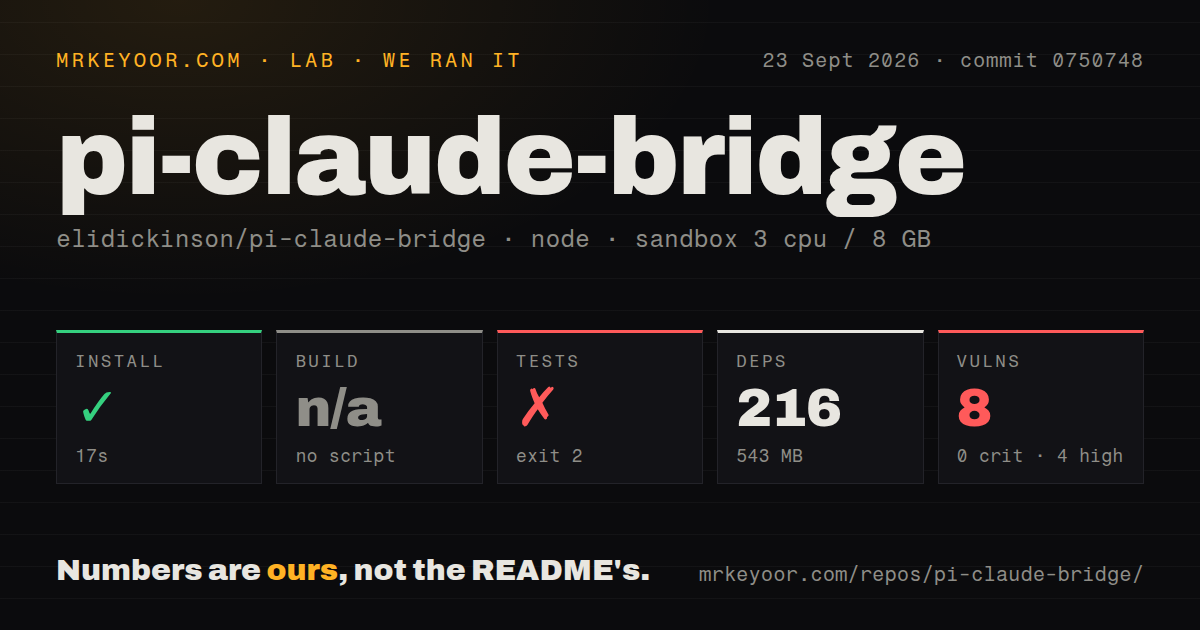
Our sandbox installed commit 0750748 in 17 seconds. Npm added 216 packages and occupied 543 MB on disk. The repository had 110 files and about 14,241 lines of source in a 1.2 MB checkout. There is no build script or target, so the build step was skipped rather than counted as a pass. The dependency footprint is substantial for an extension, largely because it brings in the Claude Agent SDK and Pi development packages.
The full test command failed with exit 2 after 1 second. Its log printed the npm script and then stopped at sh: 1: .: .env.test: not found. No unit-test or integration-test result followed, so our run cannot claim either suite passed. The log does not establish why the file lookup failed. The useful result is narrower: the documented full command did not complete in our fresh Debian container, even though installation itself succeeded.
Npm audit reported 8 known vulnerabilities in the installed tree: 4 high, 3 moderate, and 1 low. The repository has a tests directory, but GitHub showed 0 CI workflow files and no Dockerfile. Those facts do not prove the package is unsafe or untested elsewhere. They do mean a team adopting it must inspect the advisories, run the offline unit command separately, and decide how to reproduce the integration suite before allowing full mode to modify a real checkout.
Session files and inherited variables can change the result
The integration tests spawn real Pi and Claude Code processes and need write access to ~/.claude for session state. The README says a sandbox that blocks those writes makes a later --resume fail with no matching conversation. Debugging also writes a bridge log and per-query Claude Code logs under ~/.pi/agent. Those files can contain operational detail, and debug mode can record the full prompt when the compatibility guard stops a turn, so shared machines need sensible permissions and retention.
Environment inheritance deserves the same care. Issue 107 documents exported Anthropic variables redirecting the child process, causing every turn to fail against an unintended gateway. The README tells users to unset ANTHROPIC_BASE_URL, ANTHROPIC_API_KEY, and ANTHROPIC_AUTH_TOKEN for the Pi process when another tool exported them. Plan settings also control which models receive a 1M context window. A copied config can therefore change routing, cost eligibility, and context behavior.
Version 0.8.0 is active and still settling
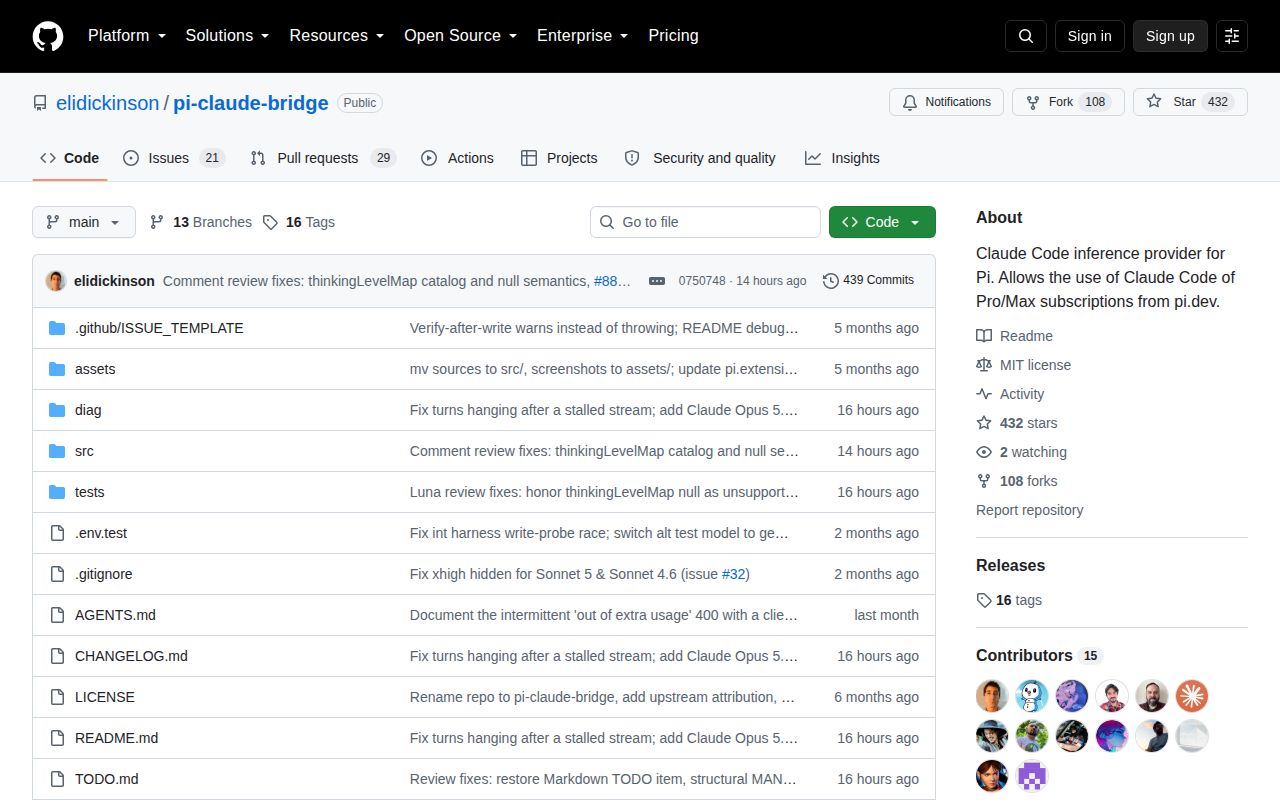
GitHub recorded a push on September 23, 2026, the date of our review. The repository had 432 stars, 21 open issues, and 29 open pull requests. Those separate counts matter because GitHub's repository total combines both. There was no latest GitHub release returned by the API, while package.json identified the npm package as version 0.8.0. Current activity is high, but release notes on GitHub are not available as a second history of shipped changes.
The maintenance pace cuts both ways. Compatibility fixes can land quickly, yet the bridge sits between Pi, the Claude Agent SDK, Claude Code, MCP tools, and Anthropic account rules. One README warning already documents how Pi 0.86 broke bridge 0.7.0 sessions and tool serving. Use pi-claude-bridge when that integration is the point, pin the working versions, and keep a direct Claude Code route available. A plain terminal session is the safer fallback when the bridge's history machinery becomes the problem you are debugging.