Outline is a company wiki built for people who dislike wikis
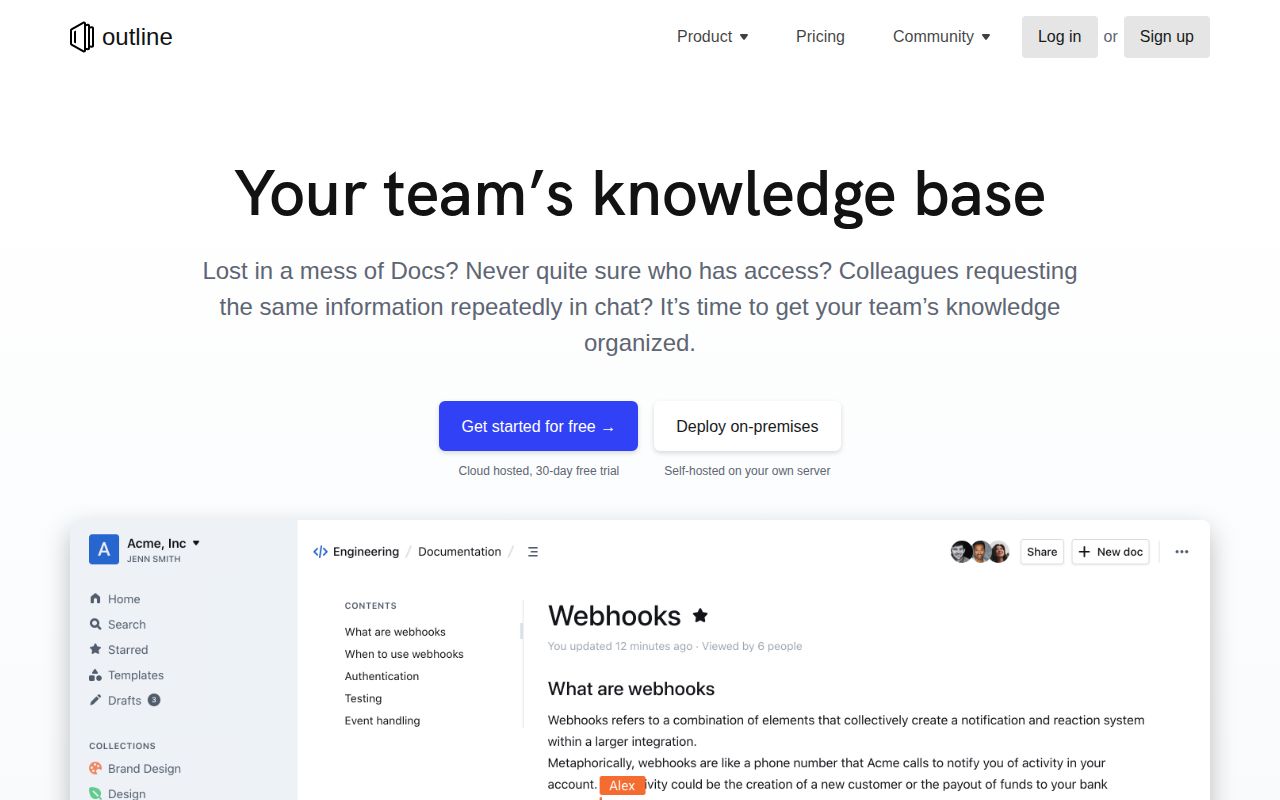
Outline presents documents and collections through a polished React interface with real-time collaboration and Markdown compatibility. The product aims at internal knowledge: onboarding guides, operating procedures, project notes, and reference material that several people must edit. Its strongest argument is usability. A wiki only works when employees can find and update pages without learning a markup dialect, navigating a repository, or asking a documentation maintainer to merge a change.
The project was pushed on August 25, 2026, and its latest release was v1.9.2 on July 21. GitHub showed 80 open issues and pull requests combined. Same-day work included React upgrades, HTML export, OIDC authentication, editor fold state, and document insights. That mix suggests active product maintenance across editing, identity, and administration. The issue count is not 80 confirmed bugs, and the recent release date is only one health signal beside the current pull-request traffic.
Self-hosting needs a database, cache, identity, and storage plan
Outline supplies published container images and points operators to a production hosting guide. The sample configuration names PostgreSQL and Redis, plus a public URL and 2 generated application secrets. Authentication can use OIDC, Google, Slack, and other configured methods. File uploads may stay on a local volume or use S3-compatible object storage. SMTP settings cover mail. These are normal dependencies for a collaborative product, but they make the phrase "run your own copy" an infrastructure commitment.
The default port in the sample file is 3000, and the local upload limit is shown as 262,144,000 bytes. Neither value decides production architecture. Operators must make data volumes durable, back up PostgreSQL and uploads together, secure secrets, configure TLS at the edge, test mail, and make identity recovery possible when an external provider fails. If a company cannot name the person responsible for restore drills and upgrades, Outline Cloud is the saner buying decision.
Collaboration is the reason to choose it over files in Git
Outline puts concurrent editing, document navigation, search, and permissions into one application. That matters for departments that will never submit a pull request to correct a policy page. Markdown compatibility keeps import and authoring familiar, while collections provide a clearer unit for organizing team knowledge than a flat folder of notes. Production JSON logs can feed an existing logging system, and HTTP logging can be enabled when request-level diagnosis is needed.
The repository has 340,903 source lines, so customization is not a weekend theme edit. Contributors are asked to read the architecture guide and discuss a change in an issue before writing code. The README also tells contributors not to submit AI-generated pull requests, citing repeated low-quality submissions from people unfamiliar with the codebase. That policy is unusually specific. Teams planning a private fork should expect to understand the existing models, services, editor code, and migration practices before changing core behavior.
What happened when we ran it
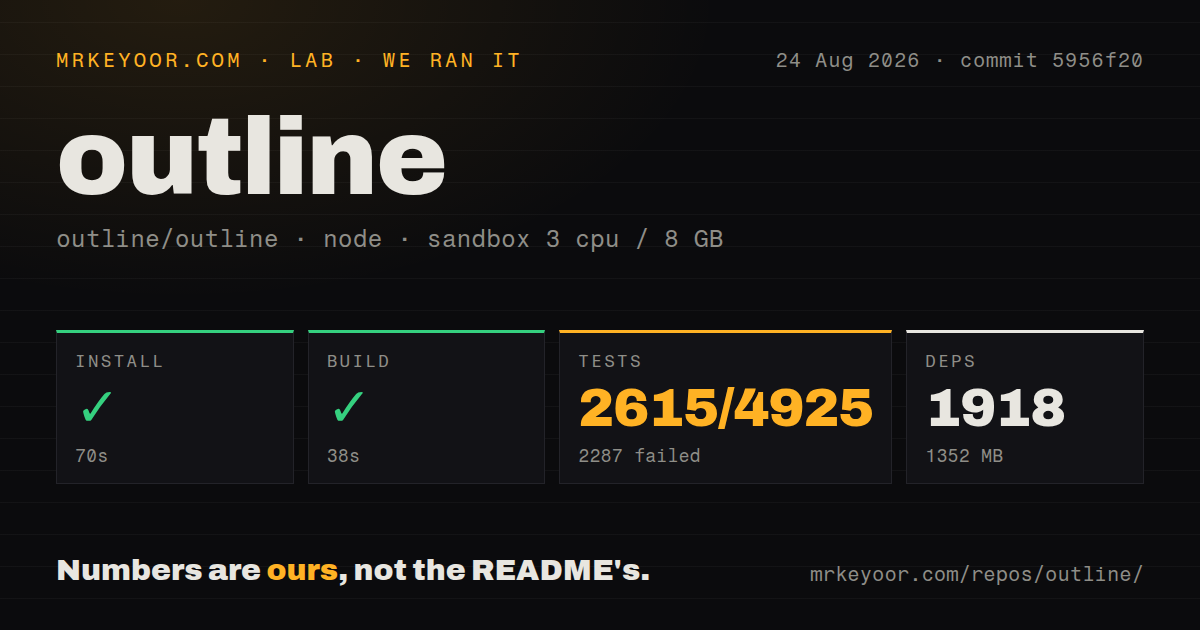
Our sandbox cloned commit '5956f20' into a 17.6 MB checkout containing 2,718 files and about 340,903 source lines. Yarn installed 1,918 packages in 70 seconds, occupying 1,352 MB on disk. The application build then succeeded in 38 seconds. The checkout contained 10 CI workflow files, a Dockerfile, and a compose file. Tests live beside code, so the absence of a root tests directory did not mean the project lacked tests.
The full test command ran for 357 seconds and exited 1. Vitest reported 4,925 tests: 2,615 passed, 2,287 failed, and 23 were skipped. At the file level, 159 failed, 199 passed, and 1 was skipped. The tail included many authentication-related test names plus warnings that prosemirror-codemark sourcemaps pointed to missing source files. Those final lines do not prove why thousands failed, so the correct finding is that the bare sandbox did not reproduce the required test environment.
A successful 38-second build beside a failing 357-second suite is useful evidence. The source compiles in the pinned environment, but compilation alone does not validate authentication, API, editor, or database behavior. A contributor should follow the documented 'make test' path, which creates the test database, and compare its environment with the project's CI setup. A self-hoster evaluating the packaged image should run a separate product smoke test covering login, editing, search, upload, email, and restore.
BSL 1.1 changes the open-source calculation
Outline's README identifies the code as Business Source License 1.1. Source is visible, and self-hosting is a supported use case, but BSL is not the same permission set as MIT, Apache 2.0, or AGPL. Review the actual license terms for production use, modifications, redistribution, and any service that could compete with the vendor. A technical team should not promise an "open-source wiki" to procurement solely because the repository is public.
The hosted product and self-hosted distribution come from the same 2,718-file repository, which is helpful for transparency. It also means commercial product development and community use share a codebase with licensing boundaries set by the vendor. Docmost is worth comparing when AGPL terms suit the organization. Wiki.js offers a mature administrative wiki model. AppFlowy reaches further into databases and personal workspaces, which may be useful or distracting depending on the job.
Pick Outline when editing quality outweighs operating simplicity
Outline is best for a team that has outgrown folders of Markdown but still wants documents to feel fast and pleasant. The editor, collaborative model, collections, and active maintenance make it more inviting than many traditional wikis. Its hosted option is part of the product decision, not an afterthought, because it removes a multi-service stack from the company's operations queue.
Self-hosters should trial with their real identity provider and a representative import. Verify export, backups, file restore, permissions, and mail before migrating the only copy of company knowledge. The 2,287 failing tests from our sandbox are a contributor warning, not proof that the packaged application is broken. They do show why a successful build and an attractive editor are insufficient evidence for a production rollout.