Three services turn Docmost into a collaborative team wiki
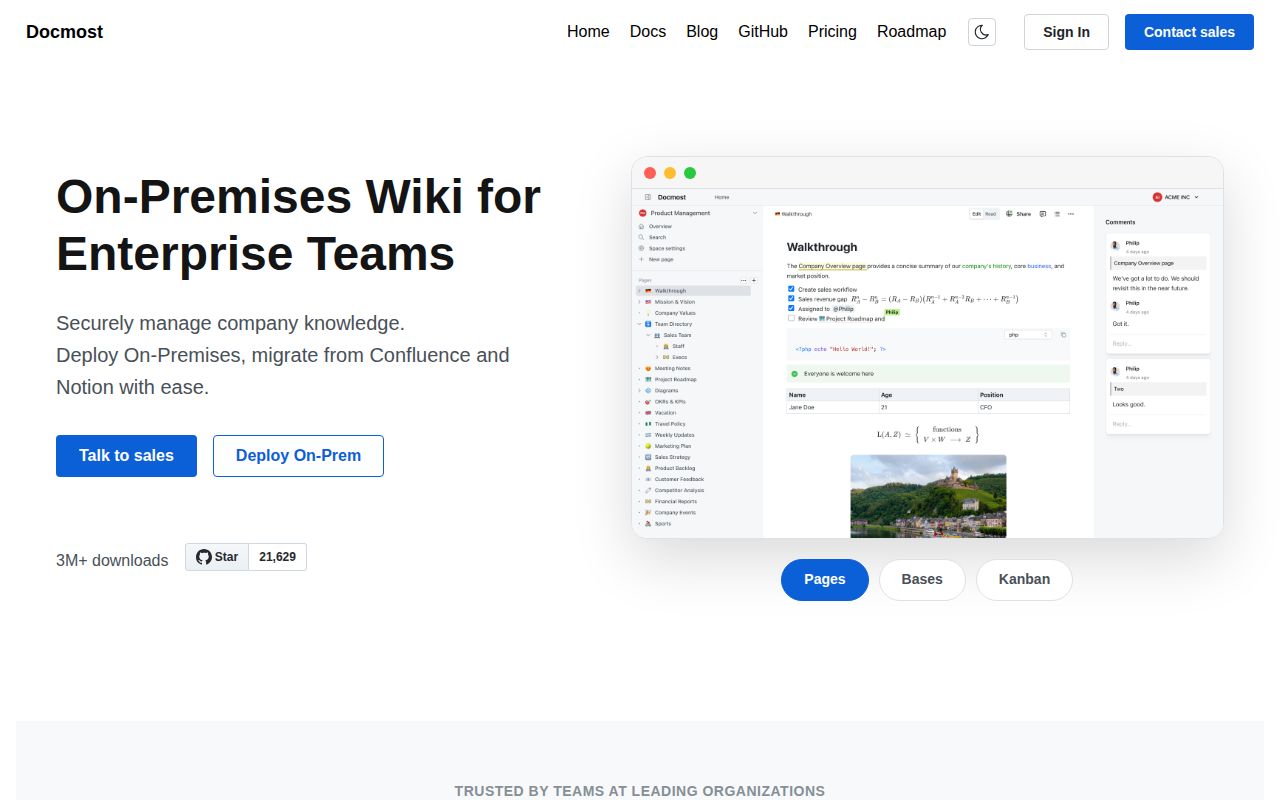
The recommended deployment runs 3 services: Docmost, PostgreSQL, and Redis. Users get real-time editing, spaces, permissions, groups, comments, page history, search, attachments, and embeds. Draw.io, Excalidraw, and Mermaid cover diagrams, while the README lists more than 10 interface languages. The result suits engineering handbooks, operations runbooks, and internal knowledge bases whose writers prefer a visual editor.
Release v0.96.0 added footnotes, version comparison, an attachment gallery, richer search filters, right-to-left text, and public spaces in beta. These features are useful for working documents, where several people may edit and discuss one page. They also make the permission model, WebSocket path, and upgrade behavior more important than in a static documentation generator.
The open edition stops before SSO, AI, and MCP OAuth
Docmost has 2 self-hosted editions. The open edition provides core documentation and collaboration under AGPL-3.0. Enterprise requires a license and adds Bases, SSO, AI, audit logs, and SCIM provisioning. Version 0.96.0 also introduced MCP OAuth as enterprise code. You can try the writing experience freely, but identity or agent requirements may change the price before rollout.
The enterprise license validates offline and can be removed without deleting accounts or content. After expiry, paid functions stop and the workspace returns to the open feature set. Buyers still need the seat count, renewal terms, and current feature comparison before budgeting. Settle that before migration, since SSO and audit requirements are painful to discover after hundreds of pages and account mappings exist.
What happened when we ran it
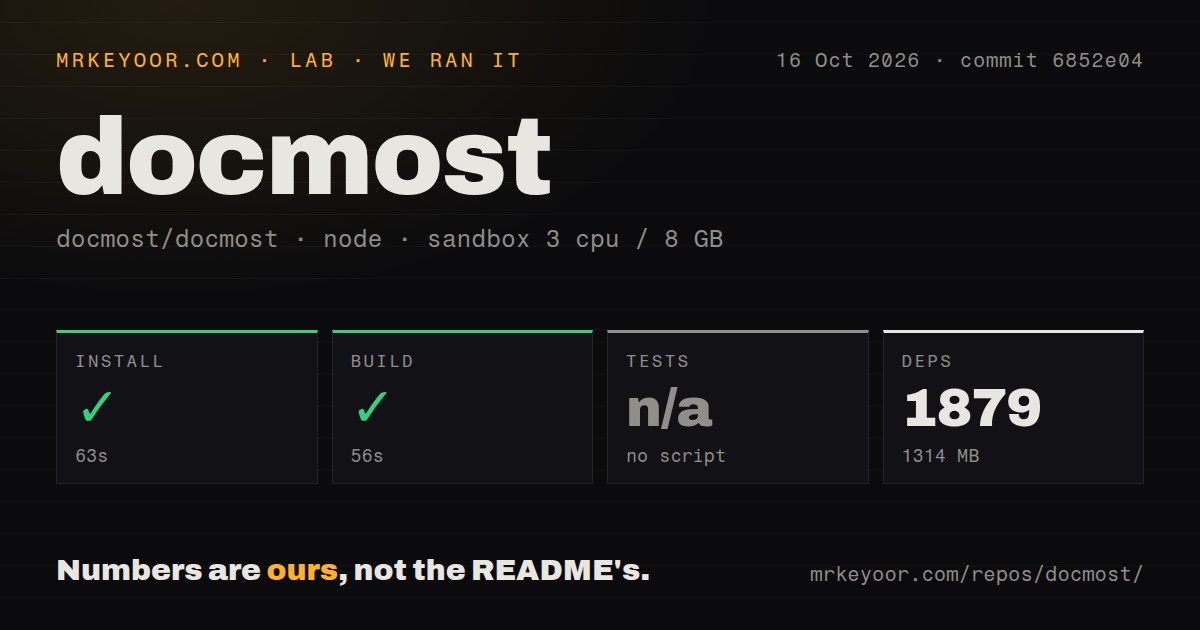
Our sandbox installed 1,942 pnpm packages in 99 seconds and used 1,306 MB on disk. The monorepo built in 42 seconds at commit 6205bbe. Our measurement setup was a fresh unprivileged Debian container with 3 CPUs, 8 GB of RAM, and no secrets. The checkout contained 1,615 files, about 152,513 source lines, and 6.8 MB before dependencies.
There was no test script or target, so tests were skipped. A successful 42-second build proves the TypeScript and packaging path completed in our environment, but it says nothing about collaboration, permissions, migrations, imports, or browsers. The repository had no tests directory and 1 CI workflow file in our scan. Stage an upgrade with representative pages, attachments, users, and simultaneous editors before production use.
Docker Compose starts three services, not one appliance
The Compose path asks for APP_URL, an application secret of at least 32 characters, and a PostgreSQL password in 2 places. Leaving the placeholder secret makes Docmost refuse to start. The documented health endpoint is /api/health, and the first browser visit creates the workspace owner. Local file storage works without an object-store account.
PostgreSQL holds application data, Redis uses append-only persistence, and a volume holds local uploads. Email needs SMTP or Postmark; S3 and Azure Blob Storage are optional. A reverse proxy must pass WebSockets or live editing breaks. Source work requires Node.js 22+, PostgreSQL 16+, and Redis or Valkey 7+. Development migrations are manual, so contributors have a longer checklist than Compose users.
AGPL core and enterprise directories need separate review
The core uses AGPL-3.0, which matters when modified software is provided over a network. Enterprise server code, client code, and packages/ee use the separate Enterprise license. This is an open-core product with the boundary visible in the repository. Organizations that reject AGPL or source-visible proprietary components can rule it out quickly.
Contributors must accept a CLA before a pull request can merge. Release v0.96.0 lists security fixes, recommends upgrading, and says advisories for vulnerabilities fixed in older versions are also being published. Operators should pin an image version instead of following latest, read each release note, and back up all 3 persistent stores. Rehearse restoration before an upgrade is urgent.
A no-expiration API key was reported to expire anyway
Open issue 2465 covers the Enterprise API on a self-hosted v0.95.0 instance. A credential created with No expiration inherited that instance's 30-day JWT setting and later became invalid, although its database record had no expiry. The reporter gives a far-future custom date as a workaround and labels the code diagnosis as partly inferred because the enterprise service is outside the public repository.
Automation owners should test issued tokens and renewal alerts instead of trusting the UI label. The issue remained open with no comments on September 10, 2026. Development was active: the last push was September 9, v0.96.0 shipped September 8, and GitHub showed 325 combined issues and pull requests plus 21,629 stars. The queue is large, while recent fixes and issue updates show current maintenance.
Choose Docmost when collaboration matters more than wiki machinery
Outline is the closest polished team-knowledge comparison, although its license differs. Wiki.js has more traditional wiki administration and authentication choices. XWiki has an older enterprise extension model. Docmost fits between them when users want spaces, comments, diagrams, and simultaneous editing, and administrators accept a 3-service stack.
The missing test target rules out a blind production switch. Trial imports, permissions, WebSockets, backups, and an upgrade before inviting the company. If the open edition meets the requirement, the 99-second install and 42-second build make the code approachable. If SSO, audit logs, AI, API automation, SCIM, or MCP OAuth are mandatory, evaluate Enterprise from day one.