The OP Stack repository is a chain operating system, not one node
The monorepo contains the consensus client, batch submitter, state-root proposer, dispute challenger, contract deployer, fault-proof machinery, high-availability sequencer support, monitors, tests, and smart contracts. Rust workspaces add Kona, op-reth, OP Stack EVM support, and related types. An operator chooses and connects these pieces to Ethereum rather than starting one process that becomes a complete rollup.
Scale is visible before deployment. Our commit 07bc020 checkout held 8,421 files, about 792,784 lines of source, and occupied 135.6 MB. The README warns that full Git history is several gigabytes and recommends an archive or shallow clone for CI. Go is the primary language reported by GitHub, but contributors also cross Solidity, Rust, TypeScript, shell tooling, generated artifacts, and specifications in another repository.
A complete testnet runs at least 6 named roles
The operator quickstart describes L1 smart contracts, a sequencer, batcher, proposer, and challenger, with the sequencer itself combining an execution client and consensus client. The batcher publishes layer 2 transaction data to Ethereum. The proposer publishes state roots for withdrawals, while the challenger monitors disputes and contests invalid roots. Genesis and rollup configuration files tie the execution and consensus sides to the deployed contracts.
The full tutorial requires intermediate EVM experience and labels itself testnet-only. Its dependency table includes Go, Rust, Node, pnpm, Foundry, just, Docker, make, jq, and direnv. The Sepolia example also needs an L1 RPC URL, a private key, and about 2 to 3 Sepolia ETH. That list is a useful reality check against the 9-second build we measured for the Go-oriented sandbox path.
What happened when we ran it
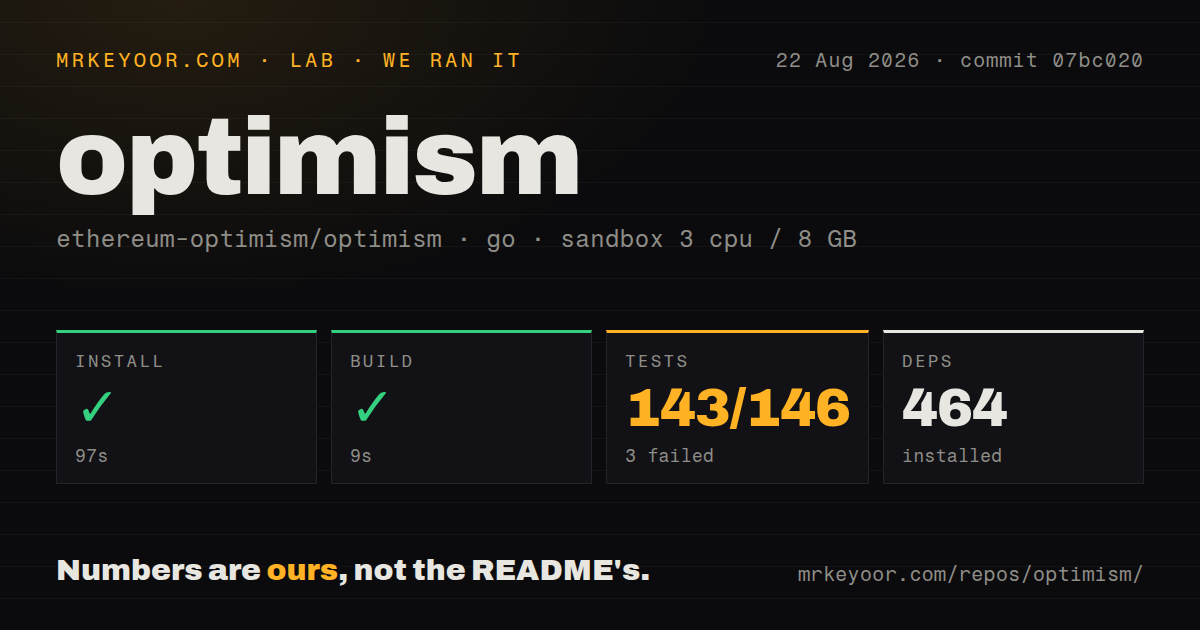
Our sandbox installed 464 Go packages in 97 seconds. The build succeeded in 9 seconds. We used commit 07bc020 in a fresh unprivileged Debian container with 3 CPUs, 8 GB of RAM, and no secrets. This run evaluated repository setup and the supplied Go commands; it did not deploy contracts, start a sequencer, connect to Ethereum, or exercise a live rollup.
The Go test step exited with code 1 after 242 seconds. It reported 143 packages passed and 3 failed out of 146. The provided tail shows successful checks for contract interfaces, reinitializers, layout spacers, strict pragmas, test validation, unused imports, semantic versions, and snapshots, then ends with FAIL. It does not expose the failed package names or errors.
That output supports only a limited conclusion: most tested packages passed, but the command did not. We cannot say whether the 3 failures came from the container, a missing service, or the source itself. Our scan found 5 CI workflow files, no Dockerfile, and no top-level tests directory. Component-specific test suites still exist, including op-e2e and contract tests documented in the contributor guide.
Running it yourself means holding keys and owning incidents
Optimism's August 2026 launch-path guide is direct about self-operation. The team runs every service, holds every key, performs upgrades, and handles every incident. A single sequencer is a chain-wide point of failure for unsafe blocks. Op-conductor can coordinate a high-availability cluster, but the design assumes honest nodes and protects against failures and partitions rather than a malicious cluster member.
Private-key risk reaches beyond the batcher and proposer. Proxy admins can upgrade system contracts, the System Config Owner can change configuration, the Guardian can pause withdrawal logic, and challenger roles affect dispute handling. The docs recommend deliberate choices around hardware security modules or cloud key management. Monitoring also spans component metrics, peer count, dispute games, bridges, L1 access, and L2 archive data. Someone must be available to act on every alert.
Component tags matter more than the latest repository release
Optimism does not publish the monorepo as one product version. Production tags use component names such as op-node/v... or op-batcher/v.... Plain v... tags cover Go code and exclude smart contracts. The README lists 5 component families with releases: batcher, contracts, challenger, node, and proposer. It says every other component and package should be treated as development-only.
The latest GitHub release on August 20, 2026 was op-batcher/v1.16.13, an optional but recommended patch for blob-fee estimation. It did not represent a synchronized release of every directory in the 135.6 MB checkout. Operators should pin component versions from network notices and release documentation, preserve deployment artifacts, and test mixed-version rollouts instead of treating the newest tag returned by the API as a monorepo-wide upgrade.
Active development includes operator-facing sharp edges
Open issue 22667 reports that 2 Kona sequencer flags are accepted but silently ignored: a maximum-safe-lag setting and a conductor RPC timeout. The report says one missing timeout can leave a sequencer call without the documented bound. The issue was opened on August 26, 2026, so it is a current report rather than an established fault across production deployments. It still supports checking effective configuration, not only command-line parsing.
GitHub showed a last push on August 27, 2026, with 6,465 stars and 861 combined issues and pull requests. Same-day activity covered challengers, contracts, interoperability, alternative data availability, Kona, and sequencer fees. This is an active protocol workspace whose production and experimental edges sit close together. The right buyer has protocol expertise, release discipline, funded Ethereum operations, and people assigned to defend the chain after launch.