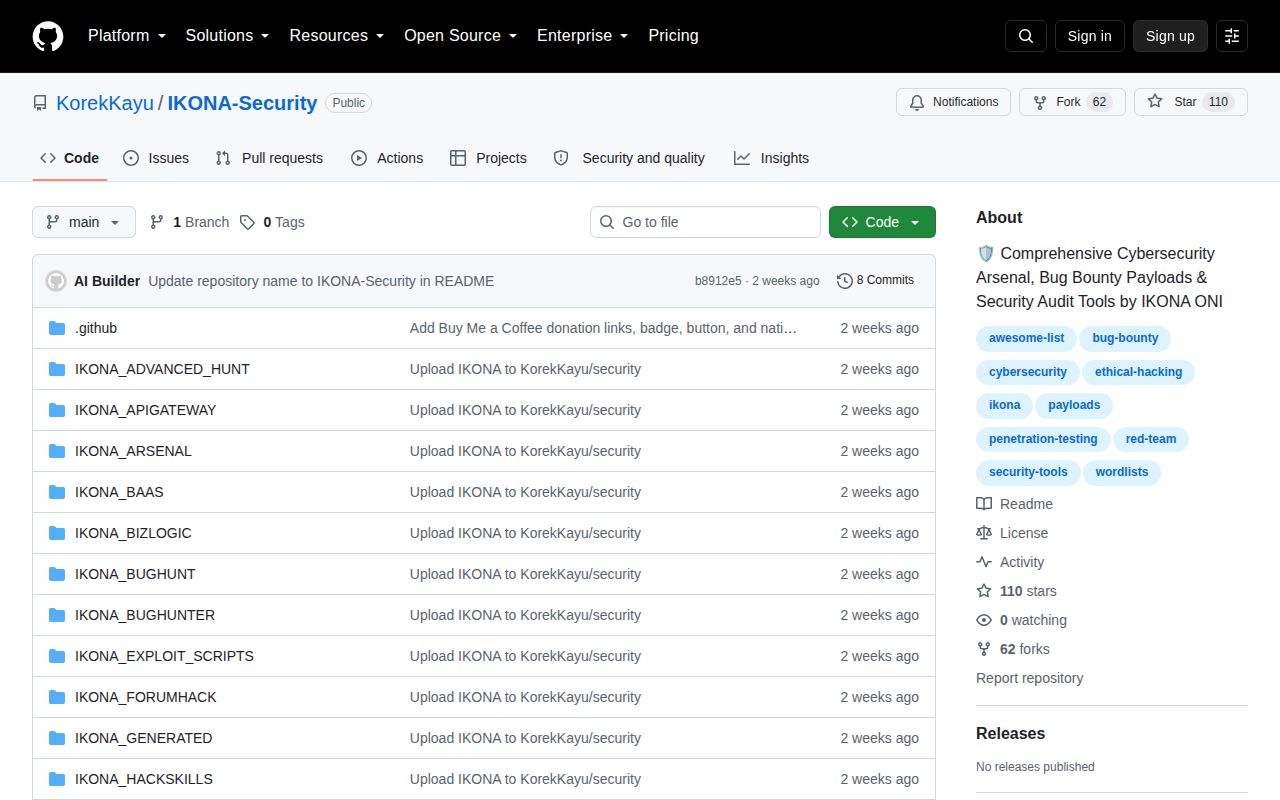
The repository is a corpus rather than one installable suite
The README calls IKONA Security a security audit suite, yet the tree reads more like several collections copied under one roof. GitHub lists 1,524 entries. Our source inventory found 542 Markdown files, 287 Python files, 201 files named SKILL.md, and 73 text files, plus payload samples, images, archives, and compiled Python cache files. Topics cover web flaws, cloud and identity systems, mobile work, wordlists, reporting, and agent-directed security playbooks.
That breadth is useful only after you choose a narrow task. Many skill files are written in Indonesian and carry metadata for Hermes, while the root README never explains how to install those skills or which folders supersede others. Generated Python versions repeat some of the same material found in Markdown. At measured commit b8912e5, a reader has to infer the intended entry point from filenames and individual headers. There is no root command that turns the collection into a single application.
What happened when we ran it
We did not run IKONA Security. Our lab examined commit b8912e5 on September 16, 2026, but Python was not a supported ecosystem in this batch and the repository supplied no Dockerfile. The sandbox allocation was 3 CPUs and 8 GB of RAM. Since execution never began, we have no measured install time, package count, build result, test result, disk result, or vulnerability-audit result.
That boundary matters more for this repository than it would for a static list. The tree includes Python programs that make network requests, enumerate services, accept authentication material, write findings, and optionally install more tools. None of those behaviors was exercised in our 3-CPU, 8 GB sandbox. A source file being present does not establish that its command works, that its detection is accurate, or that it avoids changing a target.
Two hundred and one skill files still need manual selection
The SKILL.md collection covers many recognizable audit jobs, including authorization, OAuth, API behavior, file upload, server-side request forgery, framework checks, evidence handling, and report writing. Some are detailed operational notes. Others sit beside generated Python files or duplicated topic folders. The top-level README names only broad categories, so it does not tell you which of the 201 skill files is canonical, maintained, safe to automate, or compatible with your agent runner.
Python setup is similarly uneven. The main arsenal describes several standard-library scripts, but another probe imports requests, and optional paths call third-party security tools. The tree for commit b8912e5 has no root requirements.txt, pyproject.toml, lockfile, or Dockerfile to define one environment. Eighteen compiled .pyc files are committed under __pycache__, and a sample results JSON sits beside scanner code. Copying the whole repository into an agent's executable skill directory would give it far more material than most assignments require.
The main scanner turns off TLS identity checks
The arsenal's hunter.py creates an SSL context with hostname checking disabled and certificate verification set to CERT_NONE. It can also take a cookie, JWT, bearer token, proxy, thread count, and slow-scan switch. Those options are normal for some authorized assessment jobs, but together they make source review mandatory. A mistyped target or over-broad scope could send authenticated probes somewhere you did not intend. The tool writes findings to a JSON file beside the script, so evidence handling also needs a local policy.
The repository's own license and README repeatedly require written authorization, which is good advice. The license is not the stock MIT text, though: its permission grant is limited to educational, research, and non-malicious testing, and GitHub labels the license NOASSERTION. Our 3-CPU, 8 GB lab made no outbound probe and passed no credentials to these files. Before internal redistribution or commercial use, have the modified terms reviewed and keep the selected code inside an environment you can discard.
Eight same-day commits do not establish a maintenance record
The repository was created and last pushed on August 30, 2026. All 8 visible commits landed that day through the same bot test account, mostly adding the bulk upload, README translations, contact details, donation links, and repository naming changes. On September 16 it had 110 stars and 62 forks, but GitHub showed no releases, issues, or pull requests, open or closed. There is no public issue activity to reveal how maintainers handle false positives, broken scripts, or unsafe defaults.
A quiet issue tracker does not prove abandonment, especially for a repository less than 3 weeks old. It does leave maturity unproven. commit b8912e5 is best approached as an imported snapshot that happens to contain useful pieces. Start with one documented need and one file, compare its behavior with a known lab target, and record every dependency and outbound request. If you need a scanner your team can standardize on today, the missing run evidence and single-day history are enough reason to look elsewhere.