What you can do with OpenTCM_Discovery
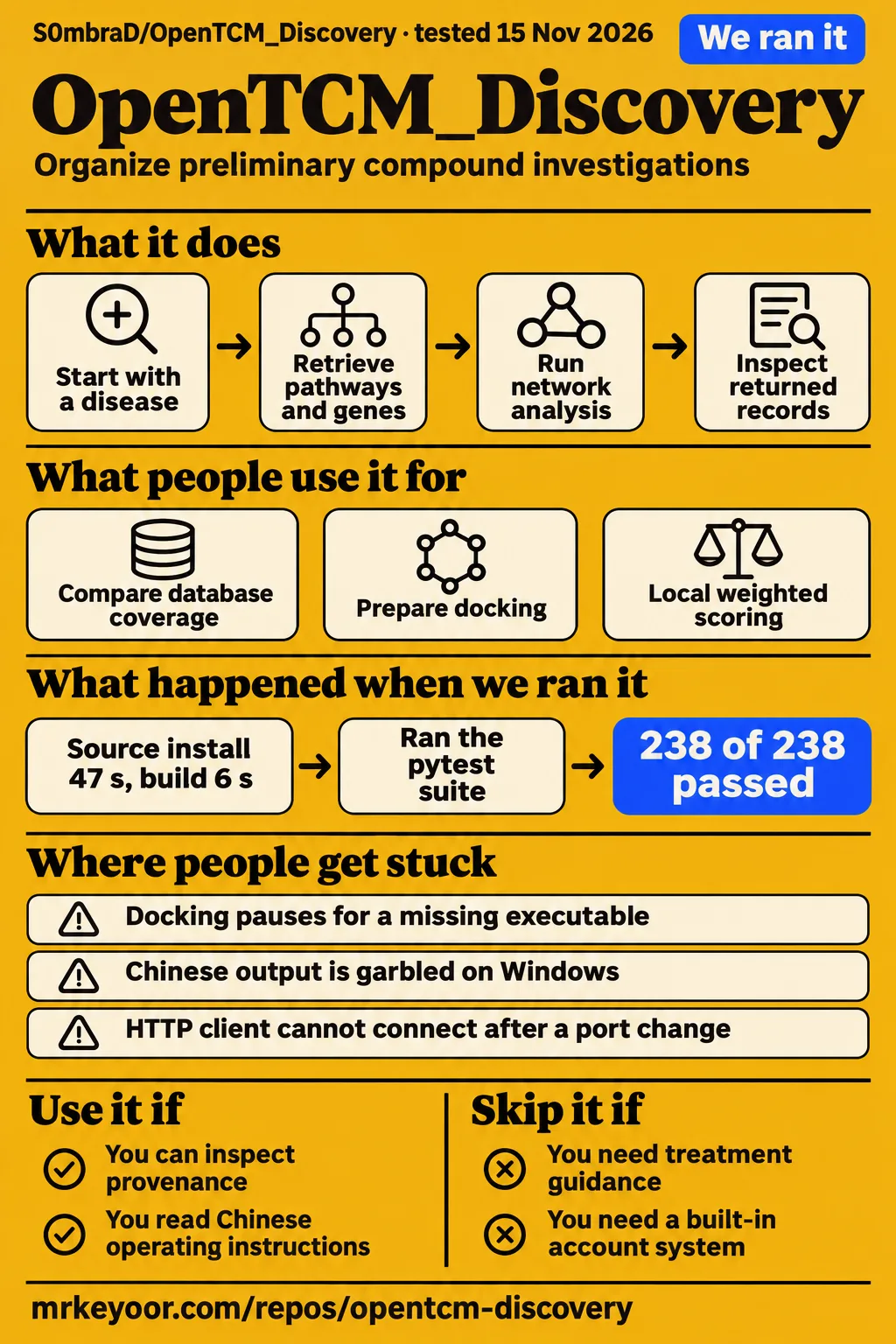
OpenTCM_Discovery passed 238 tests in our sandbox at commit 34f43f3 and documents an MCP workflow for preliminary compound research. It connects disease searches, database records, network analysis, and literature-guided docking. Researchers who can inspect provenance and read Chinese operating instructions are its intended audience. Readers seeking treatment advice or experimentally validated candidate rankings should choose another route: the README specifies research and teaching and describes its ranking as heuristic.
The OpenTCM_Discovery README explains how to interpret the returned evidence. A compound appearing in several databases means those databases contain the entity. Recorded interactions and predicted targets receive separate counts. Literature co-occurrence identifies papers to read, while clinical-trial matching returns registration information. Those distinctions give a researcher a practical way to organize a preliminary investigation without turning every retrieved association into a biological conclusion.
S0mbraD/OpenTCM_Discovery and OpenTCM01/OpenTCM are separate repositories. The former organizes compound investigations through MCP; the latter describes question answering with supporting passages and article metadata. Keep the repository owner in your notes when comparing them. Their similar names make the distinction consequential: evidence about one project's literature application belongs to that project. The separate OpenTCM README establishes its question-answering role.
What people use OpenTCM_Discovery for
The README describes disease-first searches, cross-database checks, docking preparation, and local weighted scoring as four investigation routes. MarkdownRegistry also lists disease-first screening among the skill's capabilities. The table names the author as the source of these workflows so readers can distinguish project instructions from a reported user experiment. Each route starts with a different research input and produces a different kind of record to inspect.
| Who describes the workflow | What the workflow does | What the evidence supports |
|---|---|---|
| S0mbraD, in the README | Start with a disease, retrieve pathways and genes, then branch into network analysis or enrichment | An author-documented investigation route with source fields to inspect |
| S0mbraD, in the README | Check a compound or gene across several databases | A way to compare database coverage while separating predictions from recorded interactions |
| S0mbraD, in the README | Prepare docking after literature identifies pocket residues | A proposed docking model using the documented inputs and Vina |
| S0mbraD, in the README | Read local Excel and CTD inputs in the workflow engine | A weighted-scoring route using the caller's input tables and weights |
All four routes appear in the upstream workflow instructions. A useful first task is to take a familiar compound and inspect its returned records across sources. That gives the researcher something concrete to compare: identifiers, source names, timestamps, and channel errors. Save the individual channel results alongside the consensus score so a colleague can understand how the aggregate was formed.
The local scoring workflow reads the user's Excel and CTD files and opens a dashboard, while MCP retrieval records database sources and query times. Upstream explicitly tells users to cite these outputs separately. For retrieval, preserve the database and timestamp; for weighted scoring, preserve the input tables and weights. This distinction should carry into a notebook, report, or proposed experiment rather than disappearing into one combined ranking.
What happened when we ran it
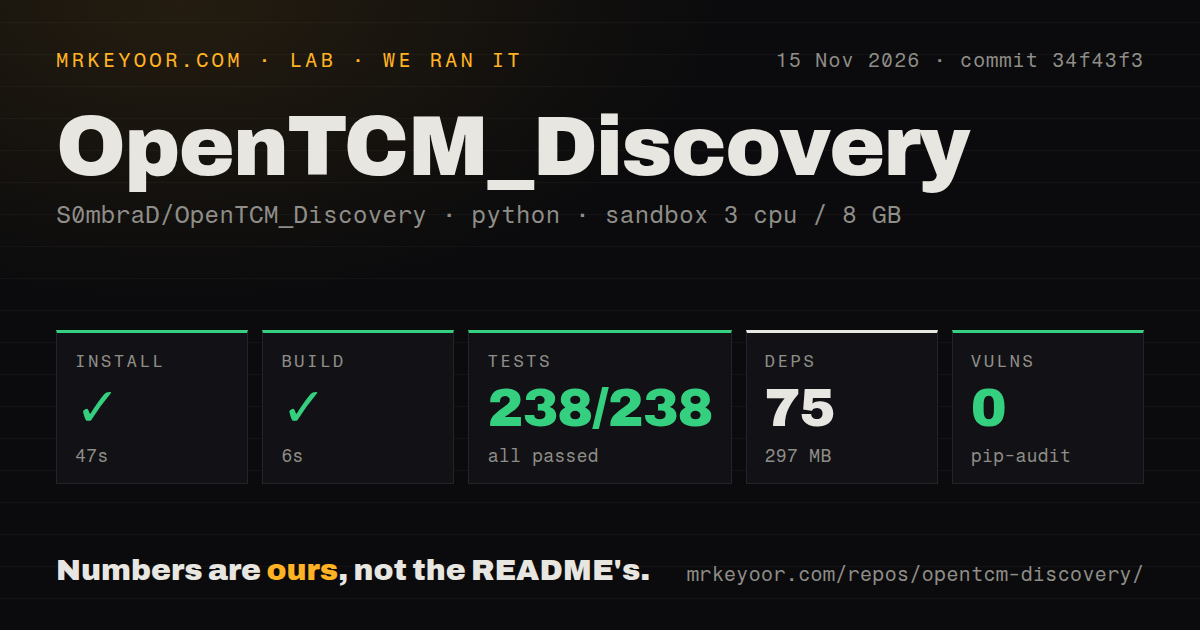
Our run at commit 34f43f3 passed 238 of 238 pytest tests in 8 seconds on November 15, 2026. Installation took 47 seconds and build took 6 seconds. These results come from the supplied build and test harness. A separate hands-on runner recorded a failed safety prerequisite because it required a Compose file. The following table keeps each source-check result attached to the operation that produced it.
| Source check | Our recorded result | What it tells a prospective user |
|---|---|---|
| Installation | Succeeded in 47 seconds; 75 dependencies, 297 MB on disk | The recorded Python environment installed successfully |
| Build | Succeeded in 6 seconds | The recorded build step completed |
| Tests | Succeeded in 8 seconds; 238 passed, 0 failed of 238 | The supplied pytest run passed |
| Dependency audit | pip-audit: 0 known vulnerabilities | The recorded audit found no known advisories |
The recorded sandbox configuration was 3 CPUs, 8g RAM, and image label ghcr.io/astral-sh/uv:python3.12-bookworm. The checkout contained 163 files, approximately 35,995 source lines, and 6.2 MB of repository data. The harness also recorded one CI workflow file, a tests directory, and no Dockerfile. These figures describe our source-check environment and checkout, with the dependency footprint reported separately in the installation row.
The separate hands-on run summary says the repository was deployed with its own Docker Compose and every port bound to 127.0.0.1. Its detailed safety-step record instead reports failure: none of compose.yaml, compose.yml, docker-compose.yaml, or docker-compose.yml exists, and the runner requires a Compose file. The detailed failure is the actionable finding. The teardown record says "teardown: ok."
Where people get stuck: parameters, ports, and empty results
The README says arguments belong inside params; placing goal at the outer level produces a validation error. That gives readers a concrete first check when an agent receives an unexpected response. A malformed request, an unreachable upstream endpoint, and a successful query with no rows each require a different response. Start with the request shape, then inspect the returned error and provenance fields before interpreting the scientific content.
| Symptom documented upstream | Check or action described upstream | Interpretation |
|---|---|---|
| Parameter validation fails | Put tool arguments inside params | Correct the request shape before interpreting the response |
| The client exposes only retrieval tools | Use unified_mcp.py for the combined service | The retrieval-only entry point starts a different process |
| HTTP client cannot connect after a port change | Change the client URL alongside the server port | Server and client must use the same endpoint |
| Docking pauses for a missing executable | Supply Vina through its documented path or VINA_EXE | Read needs and session_id before resuming |
| TCMSP returns several herbs but no ingredients | Select a returned herb_en_name through latin_name | The request needs an explicit choice among herb rows |
| Chinese output is garbled on Windows | Pass PYTHONUTF8=1 to the process | Correct the process encoding first |
These actions come from the README troubleshooting instructions and deployment guide. The guide also distinguishes the unified HTTP port, 8002, from retrieval on 8000, standalone docking on 8001, and the dashboard on 8765. When changing a port, update the client registration too. Opening the MCP endpoint in a browser is different from connecting an MCP client through Streamable HTTP.
An online response can contain source and queried_at alongside an error and an empty ingredient list. The README directs users to read those fields together. Cached responses retain their original queried_at value. Likewise, tcm_check_database_status reads a saved probe table when refresh is false; setting refresh to true probes a limited set of endpoints again. The saved snapshot date and the current request time answer different questions.
Security: the documented service starts on loopback
The deployment guide binds unified HTTP to 127.0.0.1:8002 and says the repository has no account system. It recommends stdio, where an MCP client starts a local subprocess. For access from another machine, the guide assigns authentication and firewall configuration to the operator. Those documented deployment choices help a researcher decide whether to start with a local client or take responsibility for a shared service.
PolicyLayer describes a separate gateway that checks tool calls before they reach the MCP server. Its pages discuss rate limits and allow, deny, or approval rules. Those are features attributed to PolicyLayer's gateway. To use that configuration, its instructions say to register the server, apply rules, and point the client at the proxy URL. A client connecting directly to the local Python service follows the upstream deployment path.
For a first investigation, select the tools required by the research question and review their documented actions individually. The upstream catalogue distinguishes planning, retrieval, execution, session writing, and report generation. Those differences give an operator a more useful starting point than treating every call alike. Keep the allowed tool names with the client configuration so the access decision remains understandable when the investigation or server entry point changes.
English readers need the Chinese operating instructions
The README provides a short English summary, while its setup, troubleshooting, and result-reading instructions are primarily Chinese. Its English summary names pathway search, cross-database checks, and literature-guided docking for TCM small molecules. The detailed Chinese instructions explain how to launch the service and interpret returned fields. An English-speaking research team should therefore include those operating instructions in its preparation rather than relying on the summary alone.
The fields session_id, status, needs, source, and queried_at are useful anchors for a shared glossary. Upstream says done marks a completed online chain and paused identifies a request waiting for inputs or reaching max_runtime. It lists missing literature pockets, Vina, or structure files among the pause reasons. Retaining those field names in translated notes helps colleagues connect an explanation back to the response they are reviewing.
OpenTCM_Discovery vs OpenTCM and AutoDock Vina
OpenTCM describes literature question answering, while AutoDock Vina describes docking and virtual screening. OpenTCM_Discovery combines preliminary retrieval and analysis with a documented Vina docking branch. Choose among these projects by the task you need to perform: exploring source-linked literature, assembling compound records, or running a docking engine. The table compares those documented roles and gives each project a distinct reason to consider it.
| Project | Documented role | Pick it when |
|---|---|---|
| S0mbraD/OpenTCM_Discovery | Disease and compound searches, database checks, analysis, and literature-guided docking through MCP | You want an agent-accessible preliminary investigation workflow |
| OpenTCM01/OpenTCM | Connects classical TCM knowledge graphs with modern literature and large language models | You want literature question answering with passages and article metadata attached to citations |
| forlilab/AutoDock-Vina | Docking and virtual screening program | You already have molecular inputs and need the docking engine |
The OpenTCM question-answering README invites readers to ask about herbs, formulas, symptoms, and research topics, then inspect citation passages and article metadata. It describes a web application supporting Simplified Chinese, Traditional Chinese, and English. That makes its stated job different from gathering compound records through MCP, even though both projects concern traditional Chinese medicine and may interest the same research team.
The AutoDock Vina README describes a docking and virtual screening program with simultaneous multiple-ligand docking and batch screening support. OpenTCM_Discovery's README specifies AutoDock Vina 1.2.5 and Meeko for its docking branch. Using Vina directly is the narrower choice when the receptor, ligands, and docking question are already selected. Using the MCP project adds the surrounding retrieval and investigation workflow described upstream.
What the other reviews get wrong
PolicyLayer's FAQ reports three write tools, while the same page's summary reports nine. Its headline inventory is 69 tools, with 60 described as read-only. Upstream also publishes inconsistent totals: the README contains 67 and 80, the deployment guide expects 80, and the tool catalogue says 81. These are attributed documentation counts. The practical inventory is the list_tools response from the exact process and checkout a reader launches.
Record the commit, entry point, and returned tool names together. The upstream deployment instructions explicitly recommend listing tools after connection, and the retrieval-only process intentionally exposes a smaller family. This gives a prospective user a concrete response to the conflicting catalogues: inspect the selected service rather than copying a headline count. The upstream tool catalogue also describes what each tool does and which returned fields to read first.
PolicyLayer says every tcm_smart_plan call changes real data; the upstream catalogue describes that tool as planning only. Preserve that disagreement when evaluating the PolicyLayer planner description. Its other risk explanations also show their reasoning: the disease-normalization page infers behavior from the tool name, and the gene-information page refers to sibling tools. These are attributed classification explanations, useful to distinguish from an observed call trace.
Activity shows repository attention
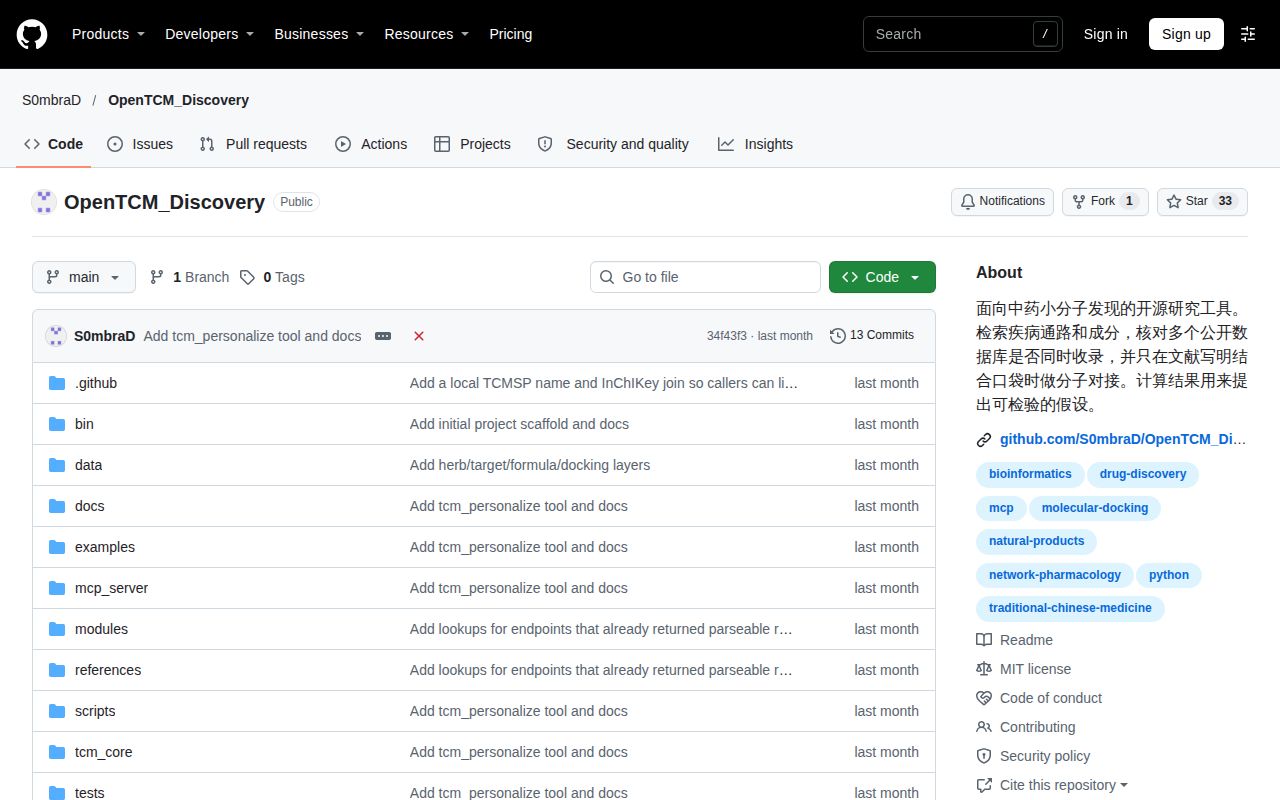
Trendshift reports 29 additional stars, one additional fork, and zero merged pull requests over 35 days in its October 12 to November 15, 2026 window. GitHub metadata observed on November 15 records 33 stars, zero open issues and PRs, and a last push on October 18, 2026. These records describe repository activity at their stated dates and provide a modest amount of context for a researcher inspecting the project.
The Trendshift activity record also says the repository was outside its top 25 during that period. The supplied X search has an empty data array. The Bilibili search results include similarly named music, game, educational, and drug-discovery videos. Those search records belong to this evidence collection; the README remains the source for the specific operating routes described on this page.
FAQ
The deployment guide tells users to inspect list_tools after connecting the MCP client, which answers the inventory question operationally. The three questions below come from PolicyLayer's supplied FAQ and concern tool counts, repeated modifications, and policy enforcement. Their answers distinguish upstream connection instructions from the gateway vendor's proposed configuration. The full numerical inventory disagreement appears in the catalogue section above so the same count explanation need not appear twice.
How many tools does the OpenTCM_Discovery MCP server expose?
The exact launched process supplies its tool inventory through list_tools. Upstream's deployment guide tells users to inspect that response after connection; its retrieval-only entry point exposes a subset of the combined service. Save the returned names with the commit and entry point. This produces a useful environment record even when documentation counts disagree. The connection instructions describe the check.
How do I prevent bulk modifications through OpenTCM_Discovery?
PolicyLayer recommends gateway rate limits to constrain repeated tool calls before they reach the server. Treat this as the vendor's proposed control and select permissions for the particular tools your investigation needs. The PolicyLayer FAQ supplies that recommendation. For an operator, the useful distinction is between limiting call frequency and deciding which actions a client may request; record both decisions in the gateway configuration.
How do I enforce a policy on OpenTCM_Discovery?
PolicyLayer says to register the server, apply rules, and point the MCP client at its proxy URL. That routing places its gateway in the call path. The PolicyLayer configuration instructions describe the sequence, while the upstream deployment guide describes direct local connections through stdio or HTTP. Keep the selected endpoint in the client configuration so the route used for an investigation is explicit.
What we have not tested yet
The separate application attempt stopped before a research task ran, and its failed Compose prerequisite conflicts with its deployment summary. Our evidence therefore covers successful source checks and that blocked attempt, without a completed disease investigation or application screenshots. Fresh retrieval accuracy, experimental candidate prioritization, docking reproducibility, concurrent users, the local dashboard, and an English-language operating workflow remain outside the completed work. The supplied pack contains no completed known-answer application Q&A.
The upstream catalogue describes tcm_smart_plan as planning only; the supplied implementation extract does not verify its side effects. It ends during SmartPlanInput, before the relevant function body. PolicyLayer enforcement and imported helpers also fall outside the observed execution. The zero-advisory dependency audit is not a security assessment. Actual runtime and operating-system versions require raw toolchain logs; the sandbox image label records configuration. Support responsiveness and research adoption are also unassessed: zero open issues and PRs supplies neither an issue-response history nor experimental outcomes.
Alternative-project comparisons here cover documented roles rather than comparative performance. The supplied OpenTCM extract supports question answering and citation inspection, without the setup-index or offline-screenshot details previously attributed to it. A useful next evaluation would pin one disease-and-compound question, expected source records, and a commit, then capture returned fields and failed channels for scientific review. That is a proposed next step, not a completed test or a claim that corrected instructions were executed.