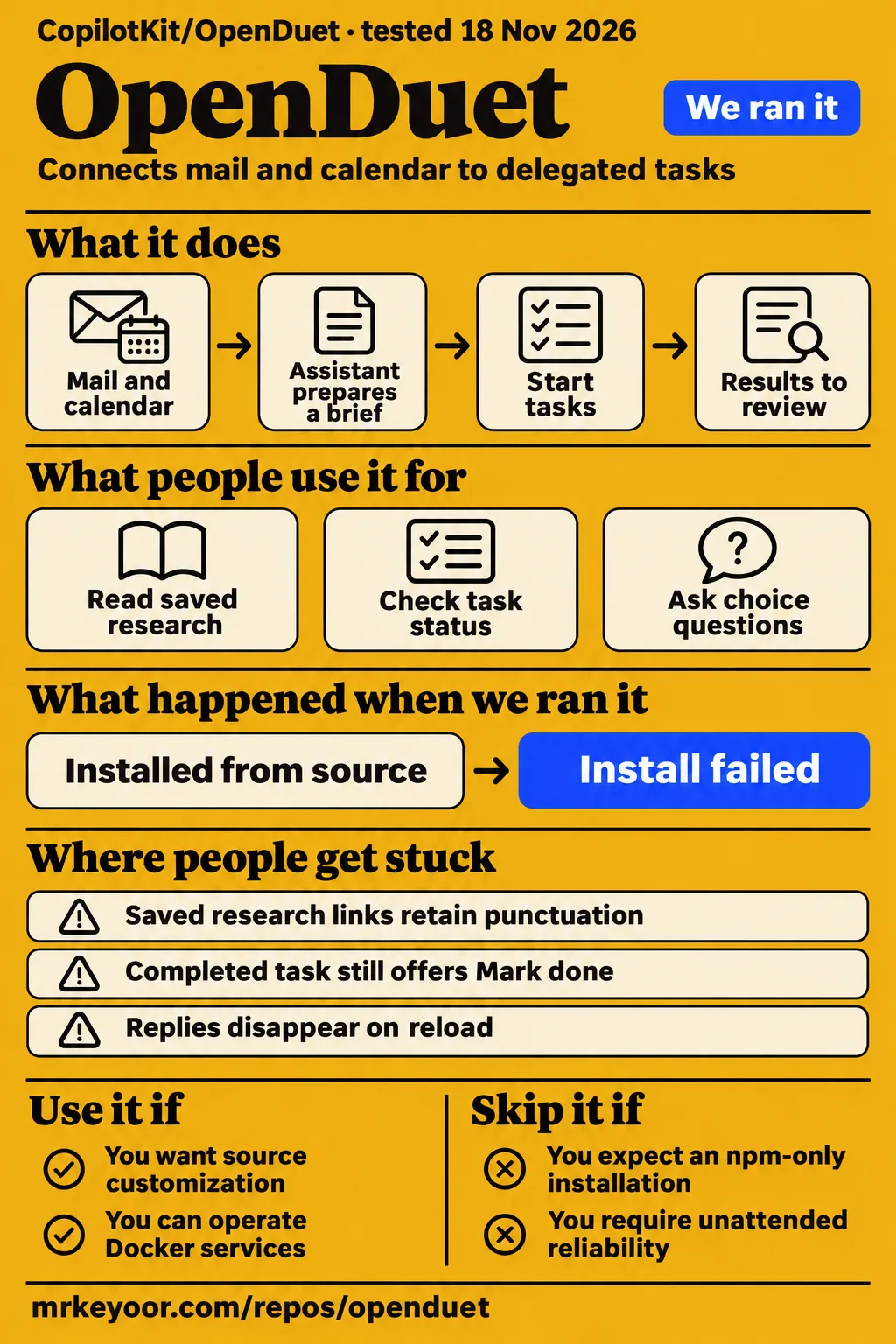
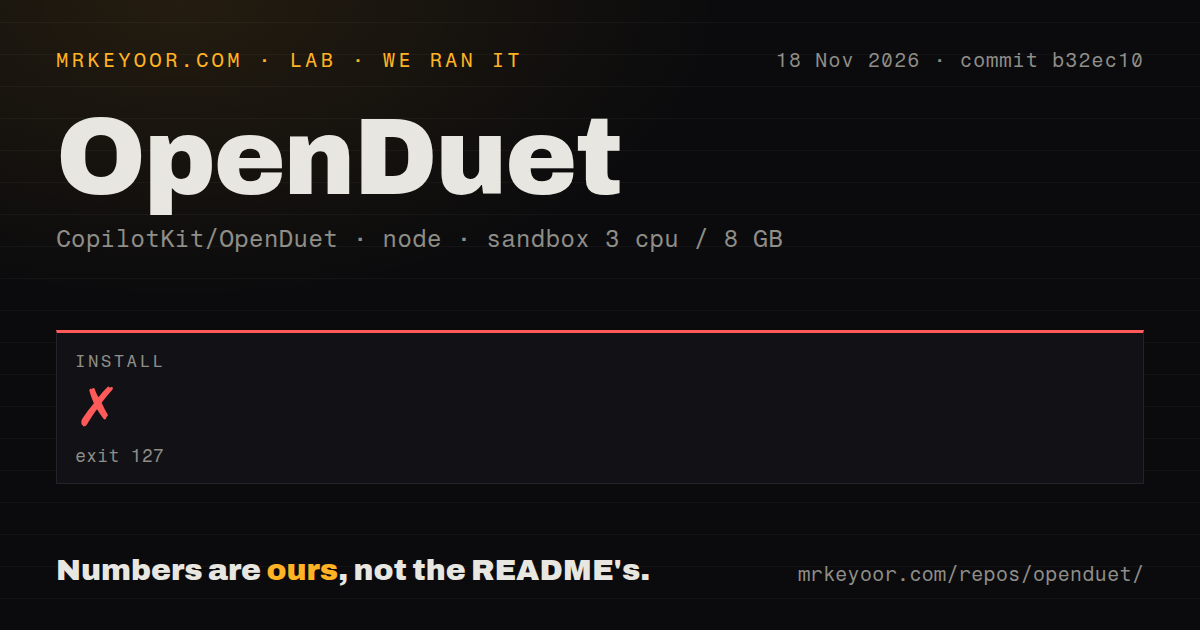
Our npm install of CopilotKit/OpenDuet stopped after 3 seconds because its postinstall command could not find Bun. The current README identifies this repository as a community-maintained starter and directs teams needing sign-in, per-Bot permissions and an audit trail to CopilotKit-maintained OpenBot with the OpenDuet skin. Choose this starter for source customization; evaluate the documented OpenBot route for those team requirements. OpenDuet README and maintenance guidance.
OpenDuet connects attention to delegated tasks
CopilotKit/OpenDuet documents a workflow connecting mail, calendar and delegated tasks, with approval before consequential actions. CopilotKit's introduction calls it an early, single-owner starting point. The current README adds an important operating distinction: OpenDuet runs on OpenBot, is available there as a skin, and this repository remains a starter for building your own project. That makes the repository choice part of the decision, before any comparison of assistant features. CopilotKit introduction, current repository guidance.
The README describes a morning brief that separates mail needing attention from mail that can wait, adds today's calendar and names sources it could not check. A Start control hands an email to the assistant. Tasks organize work in progress, results to review and questions needing an answer. The practical attraction is the connection between noticing work and delegating it: the documented interface carries an item into a task and brings the next decision back to its owner. Documented capabilities.
What people use OpenDuet for
The supplied use reports cover saved research, completed-task controls, attention states and choice questions. The people exercising these flows were issue reporters and project reviewers. Their examples give a developer concrete interactions to inspect when adapting the starter, including the transition from a readable answer to a usable source link or a clear request for input.
| Who exercised it | What they did | Reported outcome |
|---|---|---|
| Reporter of issue #102 | Rendered saved research through the real PageBlocks component on Windows with Bun 1.4.3 | Two citation destinations retained punctuation; a control passed. Citation reproduction |
| Reporter of issue #103 | Opened the real Tasks screen with mocked HTTP responses for a resolved task with an unanswered question | The list offered Mark done again and called the resolve endpoint. Task-control reproduction |
| Project reviewers cited in issue #51 | Started tasks and inspected their status after the agent ended on a question | All five reviewed runs appeared Ready for review despite needing an answer. Attention-state report |
| Project reviewers cited in issue #53 | Asked everyday choice questions, then explicitly requested options | Four natural choice turns produced no reply chips; the explicit request did. Reply-chip report |
The citation example concerns whether a saved brief remains useful after generation. The task examples concern what happens after an answer arrives: whether a person can see a pending question, finish the task or reopen it. Those are useful evaluation targets for an assistant intended to continue work while its owner steps away, because each one affects how the person resumes the interaction.
What happened when we ran it
Our sandbox install failed with exit 127 in 3 seconds at commit b32ec10 on November 18, 2026. The log shows the root postinstall invoking Bun to install the nested openbot project, followed by sh: 1: bun: not found. We measured an installation failure at that command, with 3 CPUs, 8 GB RAM and the recorded image label lab-node:22.
| Recorded observation | Result |
|---|---|
| Dependency installation | Failed, exit 127, 3 seconds |
| Sandbox configuration | 3 CPUs, 8 GB RAM, image label lab-node:22 |
| Checkout | 2,365 files, approximately 565,475 source lines, 37.8 MB |
| Repository scan signals | 2 CI workflow files; no Dockerfile detected; no tests directory detected |
| Failing command | bun install --cwd openbot during postinstall |
The log also contains npm's warning that --force disables recommended protections. The missing executable is the explicit reason shown for this stop. An npm entry point reached a Bun command, which explains why an npm-only recipe failed in this environment. The repository scan records file and directory signals, while the install log records the command that actually failed.
The separate hands-on safety step failed because its guard rejected .env.example as a symlink and found none of compose.yaml, compose.yml, docker-compose.yaml or docker-compose.yml at the expected location. The record states the runner's rules: environment files must be regular files inside the run directory, and a Compose file is required.
The run summary says the project was deployed with its own Docker Compose on November 18, 2026, with every port bound to 127.0.0.1. That summary conflicts with the failed safety step. The separate teardown record reports success. Keeping all three records visible matters because a successful cleanup and a deployment summary describe different events from the failed prerequisite check.
Where people get stuck: citations and completed-task controls
Issue #102 reports that saved research links retain sentence punctuation in their destinations. Its examples include a pricing URL ending in a period and a plans URL ending in a comma after surrounding brackets are removed. The visible paragraph stays unchanged, so reading the text alone misses the destination error. Inspecting the saved link is the practical check suggested by this reproduction. Issue #102 citation destinations.
The reporter traces the sequence to punctuation trimming before unmatched closing brackets are removed. Their proposed correction checks the suffix again after bracket removal while preserving balanced parentheses in genuine URLs. Issue #103 describes a separate state conflict: a resolved task with an unanswered question offers Reopen on its detail page but Mark done in the Tasks list. Clicking the list control sends another resolve request. Both records are open. Issue #103 completed-task control.
| Symptom | Evidence and practical response |
|---|---|
| Research source opens an unexpected path | #102 reproduces trailing punctuation. Inspect the saved destination; the reporter proposes another suffix check after bracket removal. |
| Completed task still offers Mark done | #103 reproduces conflicting controls. Compare the detail page's Reopen action with the list before resolving it again. |
| Reply stays Queued after leaving a task | #52 describes replies held in a browser-tab queue and proposes server-side delivery. Queue report |
| Question appears as work ready for review | #51 requests Needs input detection and an attention-badge change. Status report |
Issue #52 describes replies disappearing after page closure or reload, with a second tab's reply staying Queued and disappearing on reload. Its proposed server queue would deliver replies after the running turn ends. Issue #51 focuses on the signal that brings a person back: the task should show Needs input when the agent finishes by asking a question, then return to Working after the person answers. Both issues are recorded as closed.
Setup requires an Intelligence project as well as a model key
The documented source quick start requires Docker, Bun 1.3 or newer, Node for npx, a model key and a CopilotKit Intelligence project. Intelligence holds threads and memory, and the README says the server will not start without its key. The free Developer plan is described as sufficient. These prerequisites belong in the operating decision alongside the source code and web interface. README source quick start.
After signing in and selecting the Intelligence project, the instructions run bun openbot/scripts/setup-learning.ts from the repository root. The supplied setup discussion explains that this script copies the selected project's key into the server's setting and prepares the Learning container. Project selection and server preparation are therefore separate steps. Keep the commands together when following this source setup instead of stopping after the CLI selects a project.
For team operation, the current README directs readers to OpenBot, then Settings → Skin → OpenDuet. It names sign-in, per-Bot permissions and an audit trail as reasons to start there. The same README says CopilotKit maintains OpenBot and ships fixes to it, while OpenDuet is community maintained. Choose the starter when changing its source is the purpose; evaluate the documented team route when those operating controls are the requirement. OpenBot route in the OpenDuet README.
Approval controls are documented operating features
The README describes a reviewer checking every action that changes something and pausing consequential actions for Refuse, Allow once or Always allow. Outgoing messages show their recipient and text for approval. It also describes masked secret entry and encrypted, write-only saved credentials. Attribute these controls to the documentation when deciding what behavior to inspect in a configured installation. Approval and credential descriptions.
A useful first assignment is a draft reply that requires a decision before sending. Inspect the recipient and outgoing text, decline an action, then allow the intended action once. This is a proposed evaluation procedure. It gives the operator observable questions about the documented controls: what appears before authorization, what gets recorded and how the task continues after a refusal. The team-route decision also belongs here because the README associates per-Bot permissions and an audit trail with OpenBot.
Attention is easier to document than dependable delegation
The supplied records show a failed installation and specific interface reports; dependable delegated work needs completed workload results. The most concrete interaction evidence here comes from issue reproductions and small internal reviews. Those records help identify what to exercise next: saved citation destinations, task completion, unanswered questions and queued replies. They also keep the decision grounded in observable behavior instead of launch descriptions.
The discovery posts come afterward in that evidence order. The r/LovingAIAgents post shares OpenDuet and explicitly says resources are not independently vetted. The r/AISEOInsider entry links an explanatory video. Atai Barkai's launch post calls the template enterprise-ready and says it works with any agent harness; CopilotKit's introduction calls it an early, single-owner starting point. For a technical owner, the starter's documented customization route is the concrete reason to inspect it. Discovery post, video-sharing post, launch post.
OpenDuet vs alternatives
OpenBot is the README's documented team route; this OpenDuet repository is the community-maintained customization starter. The other supplied comparisons address hosting and workflow choices. Start with the operating requirement: changing source, running team controls or producing a draft through a hosted service. That question makes the alternatives easier to compare than treating every similarly named assistant as the same product.
| Candidate | Documented distinction | When to consider it |
|---|---|---|
| OpenBot with the OpenDuet skin | CopilotKit-maintained platform; the OpenDuet README directs teams needing sign-in, per-Bot permissions and an audit trail here | Evaluate the documented team route. Repository guidance |
| Claude Duet | ScriptByAI describes Anthropic hosting alongside OpenDuet's self-hosted route | Consider the hosted positioning described by that comparison. Published comparison |
| SpringBrand | Its vendor-authored comparison proposes a reusable task for a draft-only weekly digest | Consider a workflow where a manager reviews the finished draft. Proposed workflow |
| ychampion/openduet | Its repository documents packaged Docker installation without Bun or Node.js | Investigate that separate project's deployment route. Separate repository |
Repository identity matters before following any of these instructions. The packaged installer belongs to ychampion/openduet. Eclipse openDuT's EDGAR troubleshooting concerns connections to ECUs, and the OpenDUET boot-project changelog concerns boot behavior. Their names can appear near this assistant in search results, but their instructions solve different problems. Use the owner and repository name as the first check when choosing a setup guide. Eclipse EDGAR documentation, OpenDUET boot changelog.
What the other reviews get wrong
The current source prerequisites differ from the launch instructions, and broad readiness claims exceed the supplied validation. The launch blog gives an npm-based setup route, and daily.dev repeats it. The supplied README instead requires Docker, Bun, Node, model credentials and Intelligence, with a Learning setup step. Our missing-Bun failure makes the difference between an npm entry point and the complete documented setup concrete. Launch instructions, daily.dev summary, README prerequisites.
The X roundup's zero-key promise also conflicts with CopilotKit's documented source prerequisites. It lists several similarly named assistants, while this setup needs both model credentials and Intelligence. The enterprise-ready launch label should be read alongside the official introduction's single-owner description and the current README's separate OpenBot route for team controls. Those distinctions change which repository a reader should evaluate. X roundup, official introduction.
The README's typed-reply description also has a specific historical counterexample in #52's browser-tab queue. Likewise, #102 and #103 qualify the broad statement that listed capabilities work today with concrete citation and task-control reproductions. Read each report for its affected interaction: a saved URL destination, a completed-task action or a queued reply. That is more useful than turning either a feature list or an issue title into a judgement on the entire assistant.
FAQ
CopilotKit/OpenDuet's source setup requires Docker, Bun, Node, a model key and an Intelligence project. The questions below address the supplied search intents and research questions, starting with project identity and installation. Keep that identity attached to each answer because the separate ychampion repository and the OpenBot team route have different roles in the decision. Source requirements.
What is OpenDuet AI, and which OpenDuet project does a review cover?
This review covers CopilotKit/OpenDuet, the community-maintained proactive-assistant starter built on OpenBot. CopilotKit introduced it as an early, single-owner starting point. Its README now also directs teams to OpenBot with the OpenDuet skin for sign-in, per-Bot permissions and an audit trail. The separately owned ychampion/openduet repository has its own deployment instructions. CopilotKit repository identity and guidance.
What do I need to install and run OpenDuet?
The source quick start requires Docker, Bun 1.3 or newer, Node, a model key and an Intelligence project. After project selection, run the documented Learning setup script from the repository root. Our npm installation stopped at the nested Bun command, with exit 127 after 3 seconds. The missing executable is the explicit error in that installation log. README quick start.
Is OpenDuet free, and what costs remain when I self-host it?
OpenDuet's code is MIT licensed, while the documented setup uses a model provider and CopilotKit Intelligence. The README says the free Intelligence Developer plan is enough for setup. Separate the software licence from the services needed to operate the assistant: hosting the web app and selecting a model are operating choices beyond obtaining the source. Licence and service discussion, Intelligence requirement.
How is OpenDuet related to Claude Duet?
ScriptByAI compares OpenDuet's self-hosted route with Anthropic-hosted Claude Duet. That source positions the products by hosting and model choice. For this review's reader, the concrete decision is whether source customization and operating the assistant's services are desirable responsibilities. CopilotKit's starter and its documented OpenBot team route should be distinguished before choosing between self-hosted and hosted options. Published Claude Duet comparison.
How does OpenDuet work proactively while asking before it acts?
The README describes checking connected work, preparing a morning brief and continuing delegated tasks while pausing consequential actions for approval. Its outgoing-message flow shows who receives the message and what it says. The listed approval choices are Refuse, Allow once and Always allow. These are the documented interactions to inspect when evaluating a configured assistant and deciding what authority to grant it. Documented approval flow.
What does the morning brief tell me about today's plans and changes?
The README describes mail needing attention, reasons for that judgement, mail that can wait, today's calendar and anything it could not check. It says the brief appears on the first daily Chat visit after the first day and can also be requested. A Start control on an attention item hands that email to OpenDuet, connecting the brief to delegated work. Morning-brief description.
Why do saved research citation links include trailing punctuation?
Issue #102 reports that punctuation trimming happens before unmatched closing brackets are removed, leaving newly exposed punctuation inside the destination. The reporter proposes checking the suffix again while preserving balanced parentheses. The supplied examples concern a pricing URL ending in a period and a plans URL ending in a comma. Inspecting the rendered destination exposes the difference even when the paragraph looks unchanged. Citation parser reproduction.
What we have not tested yet
Our run establishes the failed npm installation at b32ec10, not a working assistant session. The complete Bun and Intelligence setup, delegated-task completion, build success, test results, answer latency, time saved, recurring-work cost and reliability at volume remain outside the measurements. The failed safety step and contradictory deployment summary also prevent an end-to-end deployment conclusion. The pack contains no screenshot records or known-answer task results.
OpenBot with the OpenDuet skin was not tested. Its team controls and maintenance distinction are attributed to the current OpenDuet README. The README extracts are not pinned to our measured checkout, and the issue reproductions use revision edb912666beb113ebeba65b2884faa4af26da8c6. We have not rerun those component reproductions at b32ec10. The image label also leaves the actual operating-system and runtime versions unresolved without raw toolchain logs.
Closure of #51, #52 and #53 supplies no successful implementation result for question detection, cross-tab reply recovery or reply-chip evaluation in these extracts. The issue reports are small component and internal-review samples. The discovery posts and explainers supply no representative customer workload. Approval bypass resistance, adversarial credential handling, universal agent-harness compatibility and comparative performance against the alternatives also lack independent test results here.
Rendered layout, resolved evidence links, related links, recommendation modules and template content remain outside this correction's validation. A next evaluation should complete the documented setup, exercise a queued reply across reloads and tabs, inspect saved citation destinations and reopen a completed task. Those proposed checks follow the supplied failures; this draft reports no execution of them and no new test result.