Native DWG editing is the reason to try it
Open CAD Studio handles technical drawings without asking users to upload them to a conversion service. The same Rust editing core powers desktop and browser builds, and the README says it reads and writes DWG and DXF from R14 through 2018 save targets. It also opens backup and autosave files, imports OBJ and LandXML data, exports STL and STEP AP203, and plots PDF on desktop. That is an ambitious file surface for a young CAD application.
The drawing toolset covers lines, polylines, splines, hatches, snaps, layers, blocks, external references, dimensions, tables, paper space, viewports, and plot styles. Solid work includes primitives, extrusion, revolution, sweep, loft, and Boolean operations. GPU rendering uses wgpu for 2D and 3D views. These features make it more than a format viewer, though compatibility with one DWG does not prove compatibility with every drawing produced by AutoCAD or BricsCAD.
The browser edits drawings, while desktop keeps the deeper integrations
The hosted web app is the lowest-friction trial. A drawing is chosen in the browser and saved back as a local download. The desktop application adds native file associations, thumbnails, system printing, PDF output, plugins, scripts, and headless conversion. Release packages cover Windows x86-64, Linux x86-64 through AppImage, and Apple Silicon macOS. The Mac build is ad-hoc signed and not notarized, so Gatekeeper may require manual approval.
There are 20 interface languages, including English, Arabic, Hindi, Japanese, Korean, Spanish, and both simplified and traditional Chinese. Interface translation does not settle text layout inside drawings: an open request about Arabic right-to-left shaping covers the editor and PDF export. Anyone exchanging multilingual plans should test the actual fonts, direction, plotting, and receiving application before depending on that language list.
What happened when we ran it
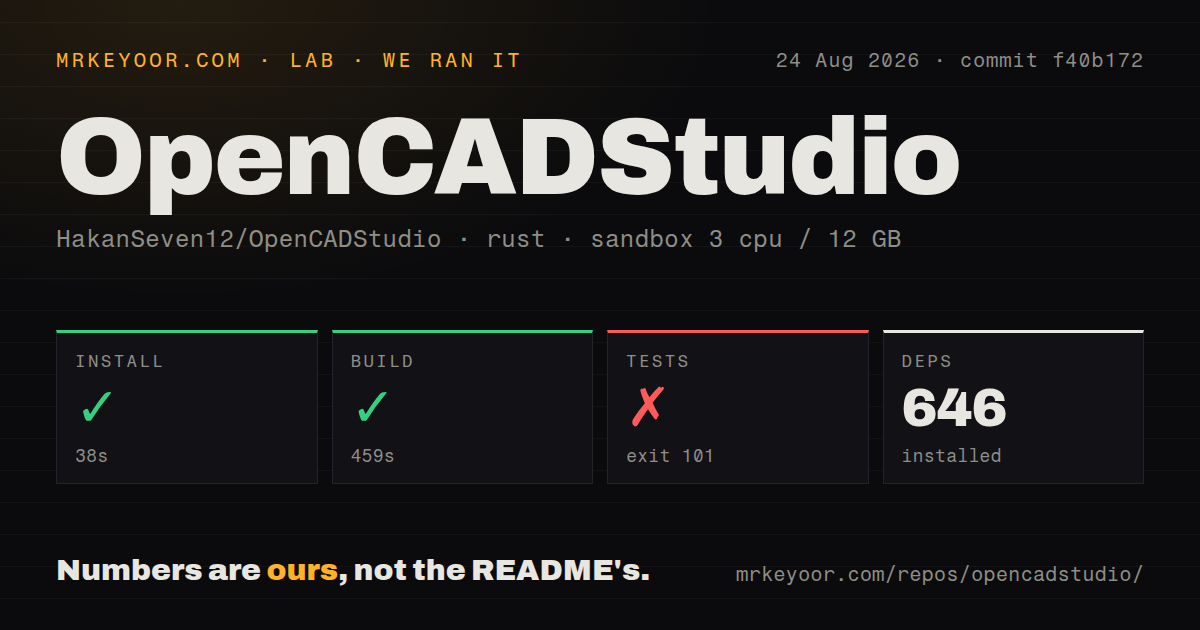
Our sandbox installed 646 Rust packages in 38 seconds and built commit f40b172 successfully in 459 seconds. The checkout held 971 files, about 287,939 lines of source, and occupied 56.2 MB before dependencies. We found 3 CI workflow files and a tests directory, but no Dockerfile. The successful build shows the application compiled in the stated unprivileged Rust environment.
Tests did not pass. After 71 seconds, Cargo exited with code 101 because mesh_from_solid could not be found in src/scene/model/solid_model.rs. The compiler reported the same missing function while building the OpenCADStudio binary test and library test targets. The log does not say why the normal build resolved its code while test compilation did not, so we will not assign a cause. The practical result is that commit f40b172 built but could not complete its test suite on our box.
JSON automation is useful, but plugin selection has a hole
The desktop binary can perform a one-shot export or stay alive as a headless server. Its automation protocol sends one JSON object per line over standard input and output or a local TCP socket, with a Python client included in the documentation. This is a refreshingly plain integration boundary for batch conversion, drawing inspection, or an internal tool that should not drive the graphical interface.
Native plugins run as separate processes and communicate through a versioned API. That separation limits how much plugin code shares with the host, but the interface is unfinished in a place that matters. Open issue 879 reports that SelectionChanged exists in the API yet is never emitted in v0.9.7. A plugin can read a document, but it cannot observe the user's current selection without asking the user to select objects again through an interactive command.
Existing drawings still need a qualification set
The README calls the project active development and tells users to keep backups of important production drawings. Current reports explain why. Issue 851 says a DWG opened by drag and drop on an Apple Silicon Mac but failed through the operating system's Open With action. Issue 635 describes certain BricsCAD 3D drawings crashing when entering model space, with no crash log found by the reporter. Issue 791 reports recovery mode followed by severe lag on another DWG.
These are individual reports, not a measured failure rate. They still point to a sensible adoption test: copy 10 or 20 representative drawings, including external references, layouts, plot styles, solids, and awkward fonts. Open them, edit them, save copies, reopen those copies in the application that created them, and compare plots. A CAD editor earns trust through round trips on your files, not through the length of its feature list.
August 2026 activity is strong, while v0.9.7 remains pre-1.0
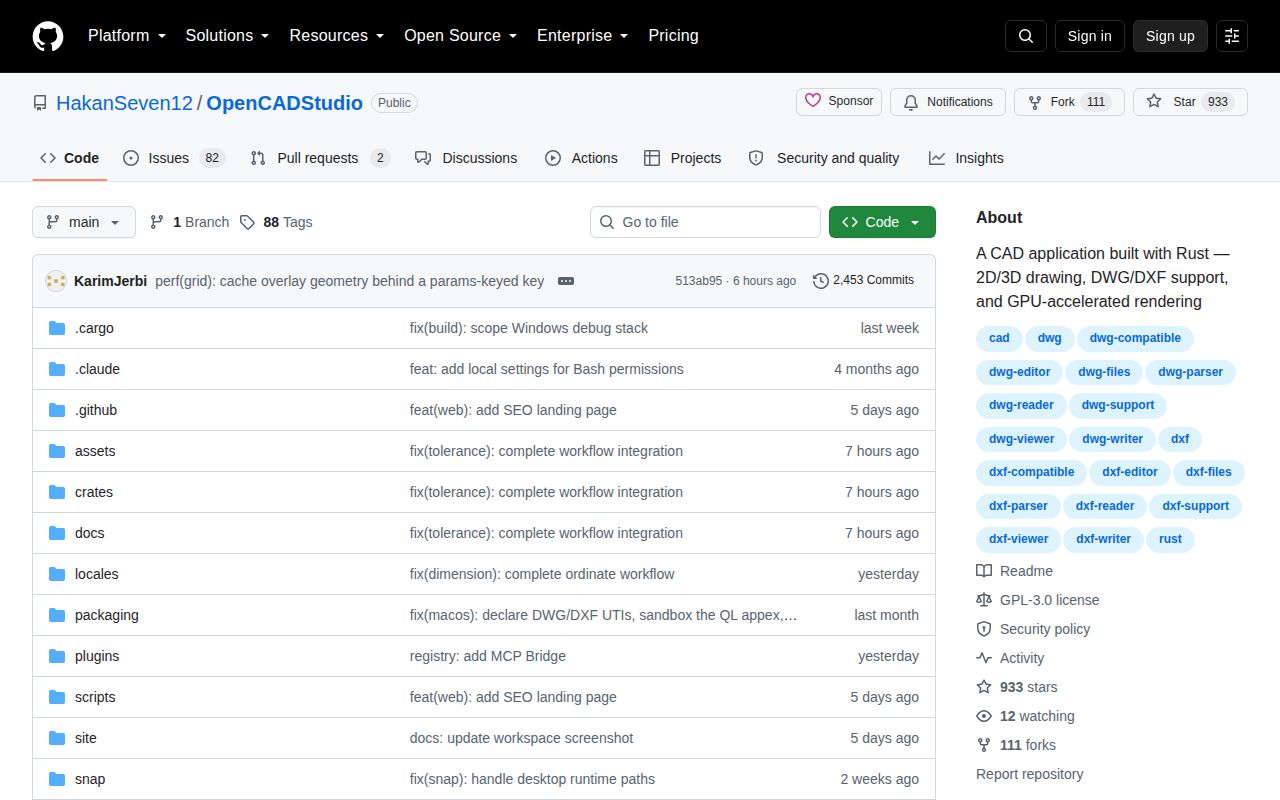
GitHub showed 933 stars, 84 combined issues and pull requests, and a last push on August 26, 2026. Release v0.9.7 arrived on August 20 with work on sketching, wipeouts, revision clouds, splines, ellipses, rendering, plotting, browser recovery, and plugin types. Several open bug reports were also updated in August. The dates show active development and active feedback rather than an idle repository.
The project is easiest to recommend as a trial, a secondary editor, or an automation component around controlled files. Free browser access and direct DWG editing lower the cost of evaluating it. The 459-second source build, failed test compilation, pre-1.0 version, and file-specific reports make a wholesale switch premature for drawings that carry contractual or manufacturing risk. Keep the original application available until repeated round trips prove this one fits your work.