OpenKnowledge 0.67.2 edits ordinary Markdown and MDX folders
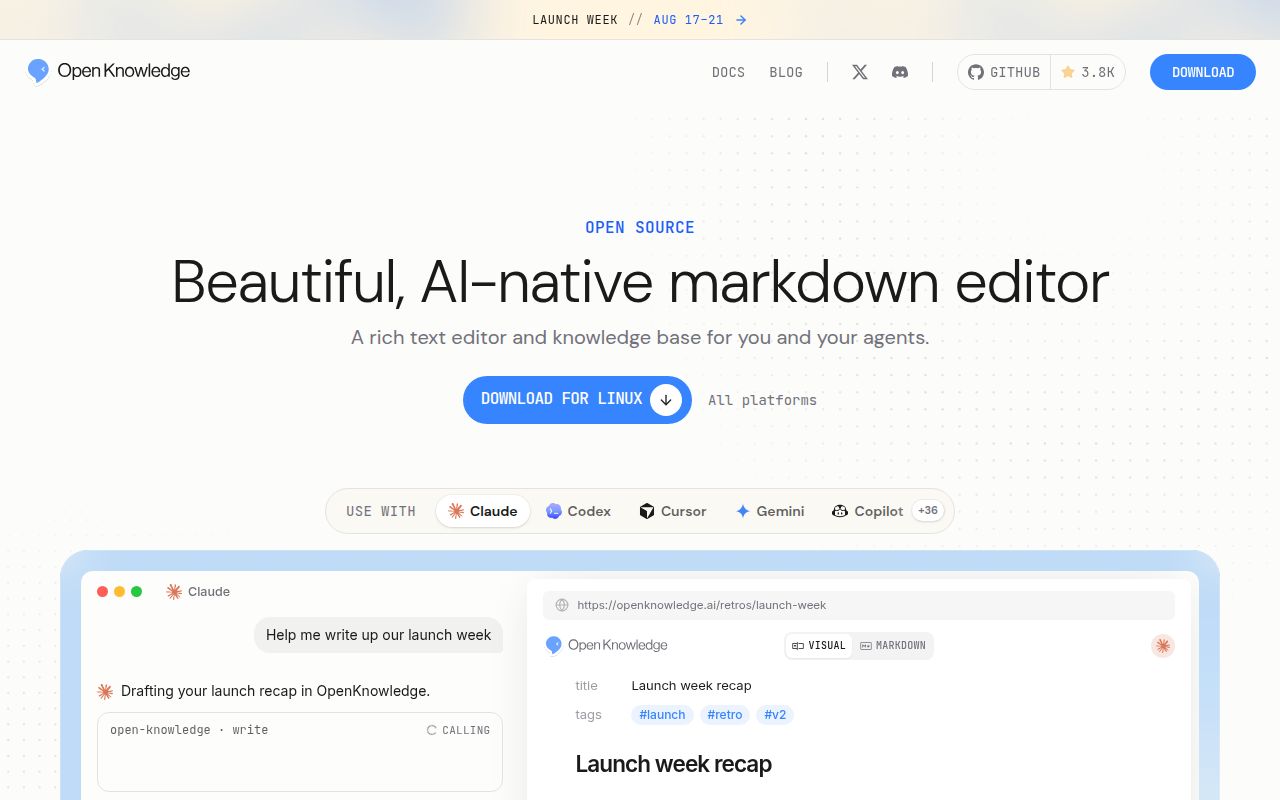
OpenKnowledge 0.67.2 opens an existing folder of Markdown or MDX and adds a WYSIWYG editor, source view, file navigator, search, and a graph of wiki links. The files remain usable by Git and other editors. Desktop applications cover Apple Silicon macOS, Windows, Debian or Ubuntu, and Fedora or RHEL. A Node.js CLI serves the same editor in a browser, making servers and Intel Macs possible without a dedicated desktop package.
The breadth comes with a large source tree. Our measured checkout contained 5,656 files, about 1,111,015 lines of source, and 70.5 MB before dependency installation. Workspaces cover the app, server, core Markdown machinery, CLI, Electron desktop shell, documentation, and a Rust-backed native configuration package. Nineteen CI workflow files show substantial automation, while the repository has no Dockerfile or root tests directory. Tests live inside packages instead.
What happened when we ran it
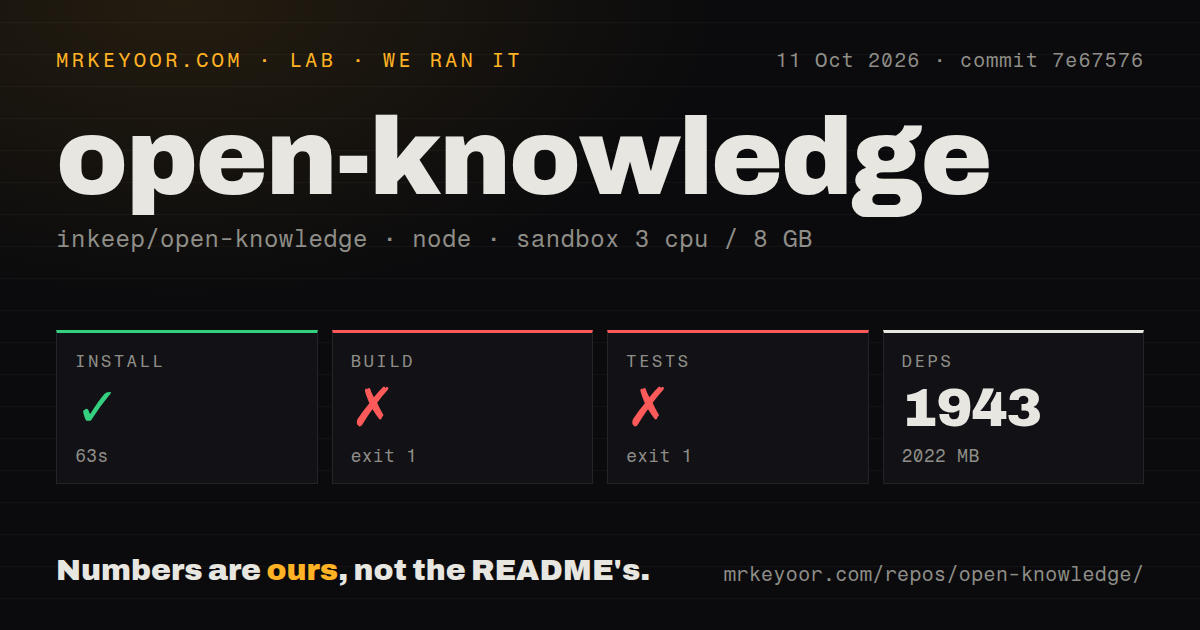
Our sandbox installed 1,934 pnpm packages in 78 seconds and used 1,829 MB on disk. The build then failed with exit code 1 after 7 seconds in a fresh unprivileged container with 3 CPUs and 8 GB of RAM. Turbo reported 0 successful tasks out of 2. The tail named @inkeep/open-knowledge-native-config#build as failed and showed a core build lifecycle failure, followed by the top-level lifecycle exit.
The test command failed with exit code 1 after another 7 seconds. Its summary reported 0 successful tasks out of 4, with failures for the native-config test and core test lifecycle. The supplied tails do not contain the first diagnostic that caused native-config to exit, so they do not justify blaming Rust, pnpm, the container, or a missing system package. They establish a narrower fact: commit 80817f2 did not build or complete its test command in our stated environment.
Seven release installers avoid the failed source path
Release v0.67.2 publishes 7 installers: one Apple Silicon DMG, 2 Windows packages, 2 Debian or Ubuntu packages, and 2 Fedora or RHEL packages. The patch suppresses a false crash prompt after an Electron GPU process recovers. Those artifacts use a separate delivery path from our source checkout. A failed monorepo build is a reason to pause contribution work, but it does not show that any installer fails to launch.
Source development is materially heavier. Our successful dependency step pulled 1,934 packages and occupied 1,829 MB before the build stopped. The repository requires Node.js 24 or newer and pnpm 10, while native-config uses a Rust N-API build for format-preserving edits to agent configuration. The contributing guide says a fresh clone should build and test without environment variables. Our 7-second failures contradict that expectation for the measured Debian sandbox, even though the log tail is too short to identify the missing condition.
MCP and Claude Code integration writes project trust configuration
OpenKnowledge can help agents search and edit a project through MCP, CLI commands, and installed skills. The app detects Claude Code, Claude Desktop, Cursor, Codex, OpenCode, and OpenClaw, then offers to wire the project into their configuration. This is useful when a specification should remain readable Markdown while an agent searches it with more structure than a raw file scan. Git and GitHub provide optional sync and team sharing underneath the editor.
Issue 1477 shows version 0.66.2 marking Claude and Codex connections as installed while still displaying yellow approval guidance, leaving the reporter unsure whether another security step remained. The message does not prove MCP access failed, but it warrants checking the generated .mcp.json and .codex/config.toml, confirming the 1,829 MB local installation you intend to run, and approving only projects whose instructions and tools you trust.
Remote users share one owner-level permission surface
Open issue 1017 describes remote access as a trust-the-tunnel system. Cloudflare Access, Tailscale, or ngrok can decide who reaches the server, but every admitted browser or agent then receives the same read-write owner surface. There is no built-in reader, editor, or administrator role, no per-agent revocable project credential, and no application-level attribution for each remote person. That is acceptable for a personal project and a poor fit for a shared company service.
GitHub is the supported collaboration provider, while issue 1428 says Gitea auto-sync fails. The 19 CI workflows and million-line monorepo do not fill that product gap. Forgejo or Gitea users can manage the Markdown repository outside the app; they should not expect no-code sync until their provider is documented and tested. Outline is the more direct alternative when user roles and a central team wiki are mandatory.
Source and visual editing still have a shared undo bug
Open issue 1475 reports undo corruption in version 0.64.1 when switching between WYSIWYG and source views. One reproduction removes an earlier paragraph after edits cross between views. Another adds table columns when two fast edits fall into one 500-millisecond Yjs undo frame, then places redone text before the table. The issue remained open on September 1, 2026. Writers who alternate views should reproduce both cases on v0.67.2 before trusting a long session.
GitHub recorded 3,853 stars, 34 combined issues and pull requests, and a September 1, 2026 push. The v0.67.2 release landed the same day. Our 78-second install proves the dependency graph resolves in the lab, while the two 7-second failures show that resolution is not enough for source adoption. The desktop app deserves a contained trial with a copied Markdown folder. A team deployment should wait for role separation, verify its sync provider, and demand a clean build on its own supported image.