One local endpoint can route many upstream accounts
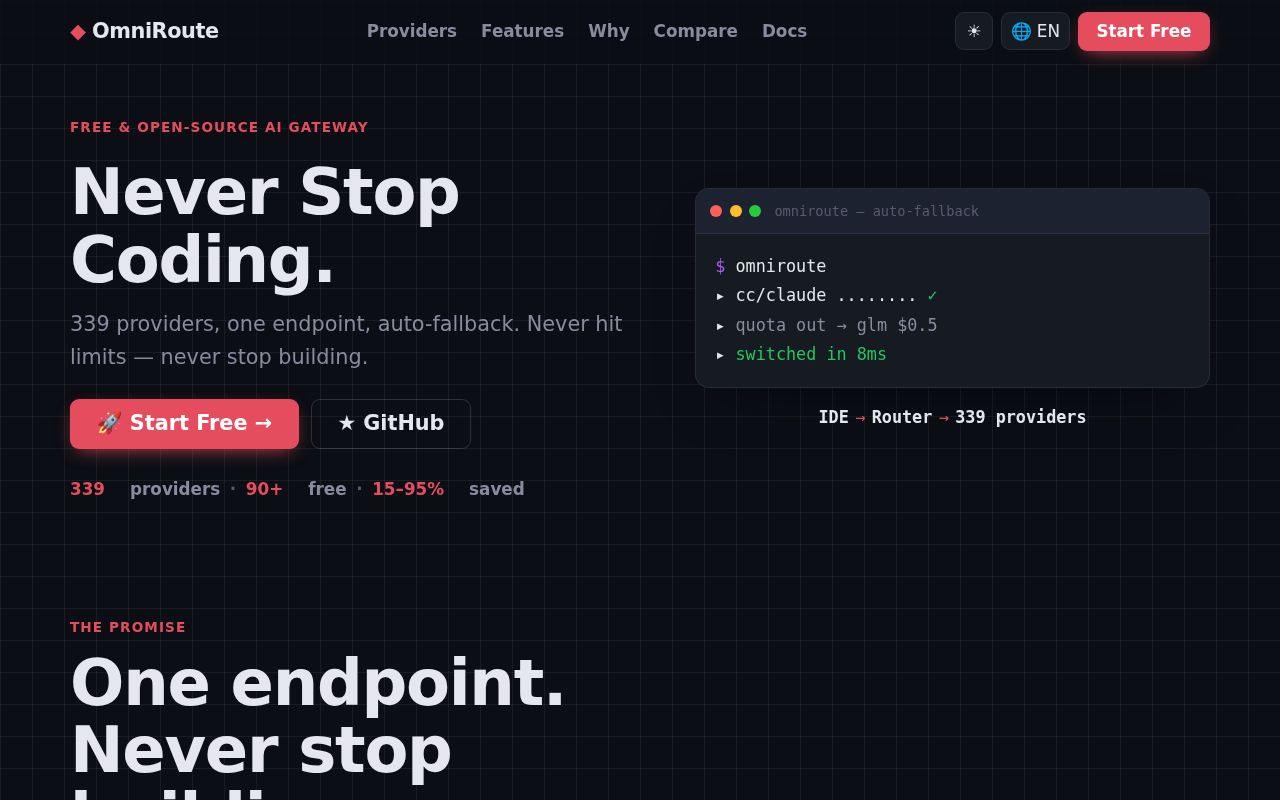
OmniRoute presents OpenAI-compatible model, chat, Responses, and related routes on a local server. A coding client points to that endpoint and uses an OmniRoute-issued key instead of holding every provider credential. The gateway can select a target, apply a routing strategy, watch quotas and cooldowns, and fall back when another eligible provider is healthy. This helps a developer who already pays for several services or frequently changes models.
The project goes far beyond a thin proxy. It includes a Next.js dashboard, provider catalog, scoped keys, usage records, compression, guardrails, modality conversion, MCP tools, A2A support, desktop packaging, and several installation paths. Each feature adds failure states. Decide whether you need one normalized API or an operator console for provider accounts. LiteLLM or Portkey may be easier for the first case.
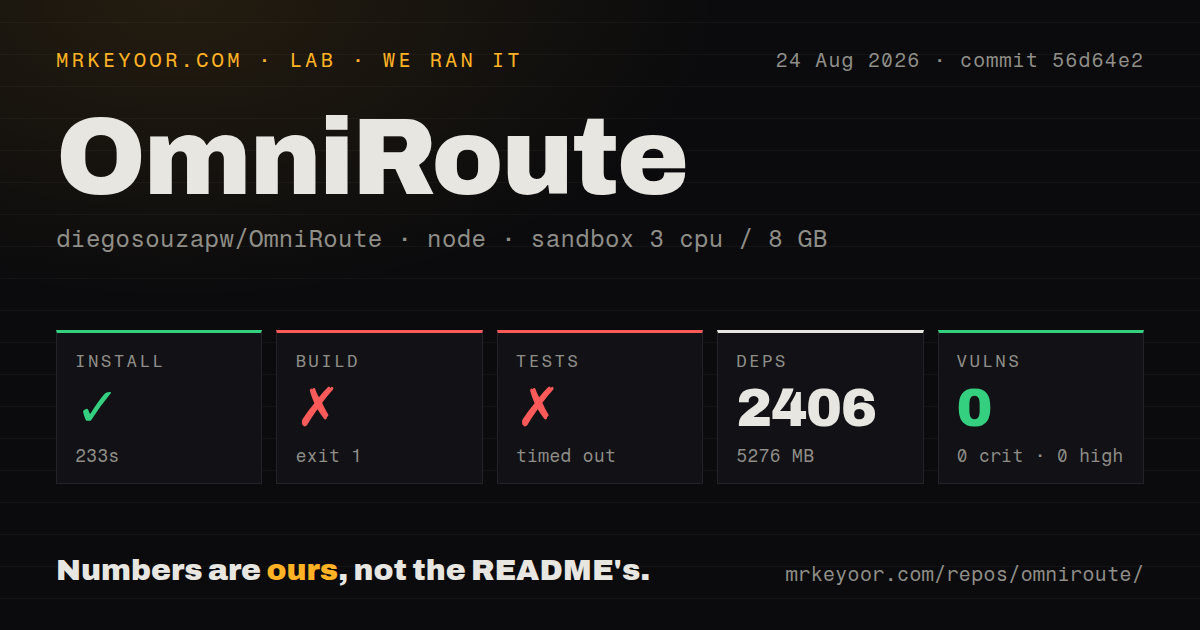
The 5,276 MB install did not produce a successful build
We cloned commit 56d64e2 into an unprivileged Debian container with 3 CPUs, 8 GB of RAM, and Node 22. The checkout contained 12,880 files, about 1,787,784 source lines, and occupied 221 MB. Npm installed 2,406 packages in 233 seconds and left 5,276 MB on disk. Npm audit reported 0 known vulnerabilities across critical, high, moderate, and low severities.
The workspace monorepo has 25 CI workflow files, a Dockerfile, a Compose file, and a tests directory. Its installed footprint is large before provider state and logs. Official routes include npm, Docker, pnpm, Bun, Nix, Devbox, and desktop builds. Choose one release artifact and test its upgrade path instead of mixing package managers.
What happened when we ran it
Our production build failed with exit code 1 after 64 seconds. The tail showed MDX generation, Next.js configuration, missing-build-cache advice, enabled experiments, and Creating an optimized production build .... It contained no final compiler diagnostic or stack trace. The supplied log does not establish whether memory, code, a child process, or another condition ended the build.
The test command reached our 900-second cap. Its tail showed several individual checks passing, including compressed-request behavior, then printed SQLite errors saying the database directory did not exist and no driver could open /tmp/.../storage.sqlite. There is no final test summary, so we do not know how many cases ran or whether the suite would have completed. A timeout is an incomplete result even when the last visible checks passed.
Local-first keeps the gateway local, not the prompts
OmniRoute's control plane runs on the user's machine, and telemetry is disabled by default according to the README. Provider credentials are encrypted at rest. Requests still travel to whichever upstream model the router selects. A prompt may cross a different company's service boundary after a fallback, which matters for confidential code, data residency, retention promises, and provider logging. Routing should constrain providers by data class, not price alone.
Client API keys can be scoped, management endpoints require stronger authority, and remote MCP access needs a management-scoped bearer key. Some local-only runtime paths can spawn subprocesses and remain unavailable through that bypass. The authorization guide says database errors fail closed. For remote deployment, verify login bootstrapping, rotate initial credentials, restrict network access, terminate TLS, and confirm ordinary client keys cannot reach management routes.
Free-tier math cannot replace a terms review
The README advertises a large aggregated monthly token figure, but its reference document calls the numbers upper-bound estimates and says free tiers change constantly. It separates recurring pools, signup credits, uncapped services, and theoretical rate-limit ceilings. That methodology avoids treating every model row as an independent allowance. It still describes possible account capacity, not a promise that every provider will accept gateway traffic or deliver stable service.
The same document has a terms-attention table for personal-use, proxy, automation, redistribution, and resale restrictions. Its flags are advisory and do not disable routing. Some providers may allow a developer API while forbidding a consumer OAuth session through third-party software. Check current official terms for each connection, record the approved use, and exclude questionable accounts from automatic combos.
Fallback can misclassify a provider response
Open issue 11695 documents an Antigravity 429 that the reporter could trigger with one system-prompt sentence while the same accounts served other requests. OmniRoute treated it as quota exhaustion, rotating accounts and consuming the retry budget. The report asks for separate diagnostics because waiting or selecting another account did not address that content-dependent response.
A status code may mean something different across vendors, and aggressive fallback can turn one request into several billable attempts. Log the chosen route, response class, retries, cooldown decision, and final provider. Put a ceiling on attempts and cost. For sensitive prompts, decide whether the gateway may resend the same content to another company.
Release activity is high, while packaging still moves
GitHub showed 56,314 stars, 129 open issues and pull requests, and a last push on August 27, 2026. Release v3.8.50 arrived August 26 after a large development cycle. The combined open count includes pull requests, so it is not a defect count. Fast movement calls for pinned versions, migration notes, database backups, and a staging instance using the same providers and client protocols as production.
Open issue 11747 reports the v3.8.50 workspace manifest and package-lock.json disagreeing on browser-pool dependency versions, which breaks cache-only offline installs. That report is separate from our networked 233-second install, which succeeded. Together with our failed build and 900-second test timeout, it argues for a narrow trial: connect one permitted provider, one client, and one routing policy, then prove upgrades and restore before adding accounts.