v3.7.3 automates the Windows client through its visible interface
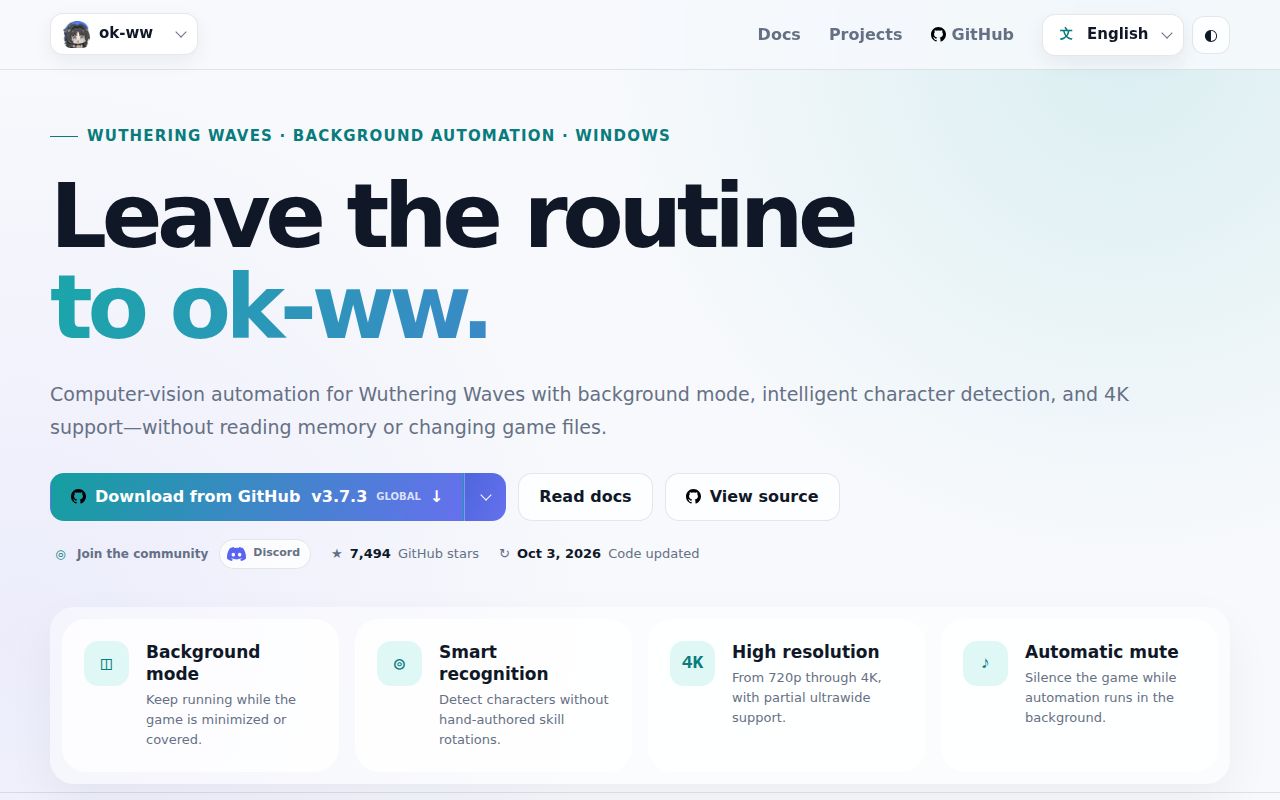
ok-wuthering-waves watches the Wuthering Waves screen, recognizes interface elements and characters, then simulates ordinary Windows input. The project says it does not read game memory or modify game files. Its tasks cover automatic combat, daily routines, and Echo farming. Background mode lets the game stay minimized or covered, and the app can mute it while a task runs.
The project is primarily written and discussed in Chinese. An English documentation page mirrors the installation steps, features, disclaimer, troubleshooting list, source setup, and command-line options. Most international users can install and troubleshoot from that page, but the issue tracker and many release notes still assume Chinese fluency. That matters when a game update changes a button or character behavior overnight.
The English disclaimer puts account suspension on the table
The technical method does not remove the policy risk. The project's English disclaimer reproduces the publisher's position that third-party macro scripts and automated farming are prohibited and says penalties may include lost gains, suspension, or a permanent ban. The project then tells users they accept the potential risk. That warning should drive the decision before feature coverage does.
Image recognition may feel less invasive than memory injection, but the documented rule covers automated play itself. A main account with purchases, rare characters, or years of progress is a poor place to test that distinction. The software may be useful for studying desktop computer vision, and its source is available under AGPL-3.0. Neither fact changes what the project's own warning says about game-account enforcement.
What happened when we ran it
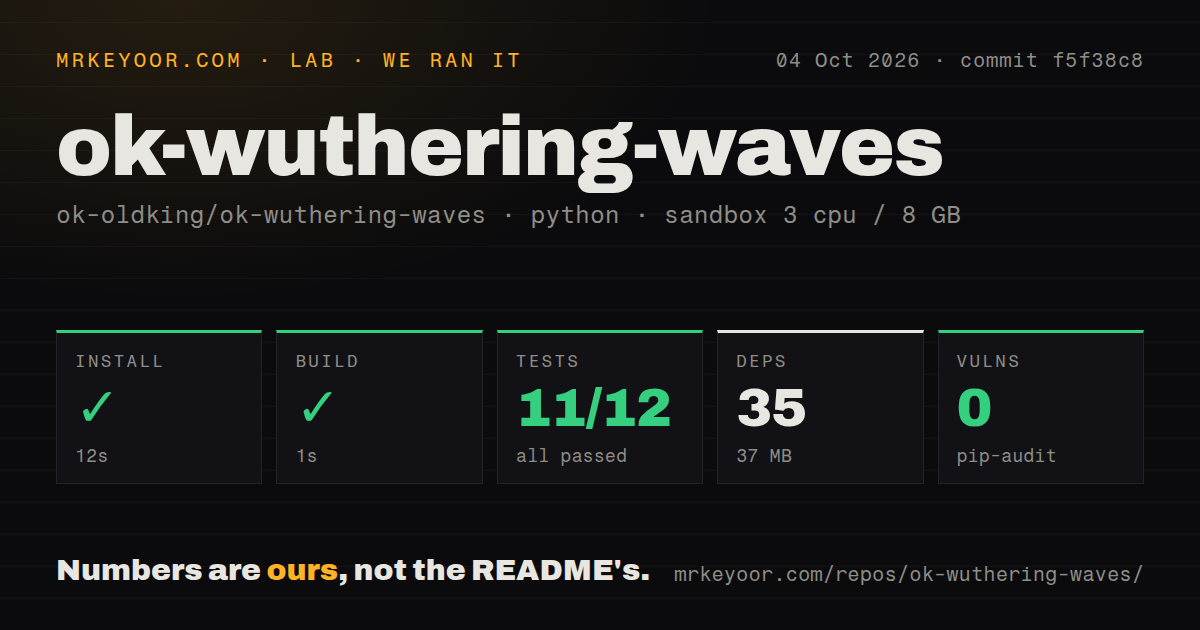
Our sandbox installed commit f5f38c8 in 12 seconds. It added 35 packages and used 37 MB on disk. The build completed successfully in 1 second. The repository checkout was much larger at 970 MB, spread across 454 files and about 24,560 lines of source. Our scan found 10 CI workflow files, no Dockerfile, and a dedicated tests directory.
Pytest exited 1 after 2 seconds. The summary reported 11 passed, 0 failed, 1 collection/setup error out of 12, and 5 subtests passed in 0.37 seconds. Collection reached tests/test_rover.py, imported src/char/BaseChar.py, and stopped because Python could not import cv2. The log says only ModuleNotFoundError: No module named 'cv2'; it does not establish why that module was absent.
Pip-audit reported 0 known vulnerabilities in the installed environment. These checks ran in a fresh Debian container with 3 CPUs, 8 GB of RAM, Python 3.12, no secrets, and no elevated privileges. They do not test the Windows interface, image recognition against a live game, combat logic, or background input. The failed collection remains useful: the documented source path did not produce a complete test run in our clean environment.
16:9 at 60 FPS is the supported operating envelope
The Windows installer is the sensible route for players. Developers can use Python 3.9 or newer, though the README recommends 3.12, install the requirements, and run main.py. The application still depends on the game presenting a predictable image. The guide asks for at least 1280x720, supports 16:9 up to 4K, and says only some functions work on ultrawide screens.
Recognition also assumes stable 60 FPS, default in-game brightness, no graphics-driver filters, and no screen overlays such as frame-rate counters. Custom keybinds must be copied into ok-wuthering-waves, and every party character needs a main Echo equipped for automatic combat. Those are practical failure conditions, not cosmetic preferences. Change one layer of the image or input map and a click can land on the wrong state.
Open issue 1665 gives the resolution limit a concrete edge. It reports that 16:10 displays such as 2560x1600 fail the configured 16:9 check and can break daily tasks, dungeon farming, and Echo farming. The suggested workaround is to run the game at a supported 16:9 size. Laptop owners should test their exact window and scaling setup before trusting an unattended task.
v3.7.3 is actively maintained because game updates keep moving the target
GitHub showed 7,537 stars, 129 open issues, and 26 open pull requests on October 4, 2026. The repository was pushed on October 3, and v3.7.3 shipped that day with fixes for Wuthering Waves 3.7 behavior. Ten recent releases appeared between August 18 and October 3, including beta builds. This is active maintenance, paired with a substantial support queue.
The issue stream shows the maintenance burden. Issue 1725 reports a v3.7.2 Tacet Suppression flow that could not find the challenge button and had to be terminated manually. Issue 1726 reports one cold start that waited on a new login screen until the user clicked the login control. Both reports concern v3.7.2, so they are not proof that v3.7.3 has the same defects. They show how tightly the automation follows the game's current screens.
For a spare environment where the account risk is acceptable, ok-wuthering-waves has far more coverage and maintenance than the small alternatives we found. For a primary account, the recommendation is simpler: the project's own disclaimer supplies the reason to walk away. Developers interested in the engineering can study ok-script directly without automating live game progress.