One vault stores six kinds of work as Markdown
Obsidian Mind puts six everyday records into an Obsidian vault: projects, people, decisions, incidents, goals, and performance notes. They remain ordinary Markdown with wikilinks and frontmatter. Claude Code, Codex CLI, and Gemini CLI receive instructions for reading and updating that record. This is a good fit for developers who distrust opaque chat memory and would rather see exactly what an agent believes about their work.
The vault expects Obsidian 1.12 or newer and Node 22 or newer. ShardMind provides the recommended installation wizard and upgrade path, while a direct clone remains supported. Version 9.0.0 added a Claude Code mod that delivers session context as an instruction file. The release says this survives compaction and reaches general-purpose subagents, addressing limits in the older hook-only path. Codex and Gemini continue to use hooks.
Five hooks turn conversation into a maintained vault
The template wires 5 lifecycle hooks. SessionStart loads goals, active work, tasks, recent changes, and a file listing. UserPromptSubmit classifies incoming material. PostToolUse validates Markdown writes, PreCompact saves a transcript, and Stop reports vault drift. Commands then cover work such as standups, brain dumps, incident capture, weekly reviews, and vault audits. The agent decides what a note means; TypeScript code handles repeatable checks and routing.
Context has an explicit budget rather than dumping every note into the prompt. The README describes lightweight startup excerpts, targeted retrieval, roughly 100-token classification hints, and about 200 tokens after Markdown writes. On Claude Code, the v9 mod gives its instruction file a default 20,000-byte budget. Those are project claims, not figures from our lab. They do show that prompt size is treated as a design constraint instead of an afterthought.
What happened when we ran it
Our lab preflight recorded 0 execution results for commit 969d372. It classified the project as TypeScript, for which this batch had no supported ecosystem runner, and found no Dockerfile to provide another route. Installation, building, and tests never started. Any claim that the hooks worked in our Debian sandbox would be false. The repository's own v9.0.0 release reports its checks, but those are upstream results and stay separate from ours.
This gap should change how you trial the project. Clone it into a disposable vault, inspect the scripts, and exercise the same agent and operating system you plan to use. The current README requires Node 22 or newer because hook scripts run TypeScript through Node's type-stripping flag. A vault can keep working without QMD, but adding semantic search downloads three local models listed at about 328 MB, 1.28 GB, and 640 MB.
QMD adds local retrieval, and MCP reaches other repos
Without QMD, Obsidian Mind falls back to lexical search and the Obsidian CLI. With QMD, queries combine keyword and vector retrieval, while local models expand and rerank results. New notes enter the keyword index immediately, and vector generation happens later. That arrangement keeps writing responsive, though full semantic queries cost more time and disk than plain search. No hosted search credential is required for the documented local path.
The om MCP server lets a session in another repository search the vault, follow links, recall scoped lessons, and record new work. Repository identity defaults to the folder name, so two folders called api collide unless you add a .om-project identifier. Exposure rules can withhold selected roots and private notes. This is powerful, but it also turns one personal vault into a source available across projects, which makes access rules and logging worth reading before registration.
Unsandboxed code and Windows hooks are the present risks
The v9 Claude Code mod runs without a sandbox and with the user's permissions. The README says so directly and provides a validation command plus a setting to disable the plugin. That is the right warning. It does not remove the obligation to inspect what the mod runs, keep the vault under Git, and test an update before letting it touch years of notes. Agent-written memory is still user data, not disposable cache.
Open issue 268 reports that Codex and Gemini hooks fail to launch on Windows because their command paths use POSIX parameter expansion. The reporter verified the Codex failure with codex-cli 0.160.0 and reproduced the Gemini path problem. macOS and Linux are reported as unaffected. Until the issue closes with a tested release, Windows users should assume the advertised shared-hook experience does not apply to those two agents.
Version 9.0.0 is active, but adoption still needs a private trial
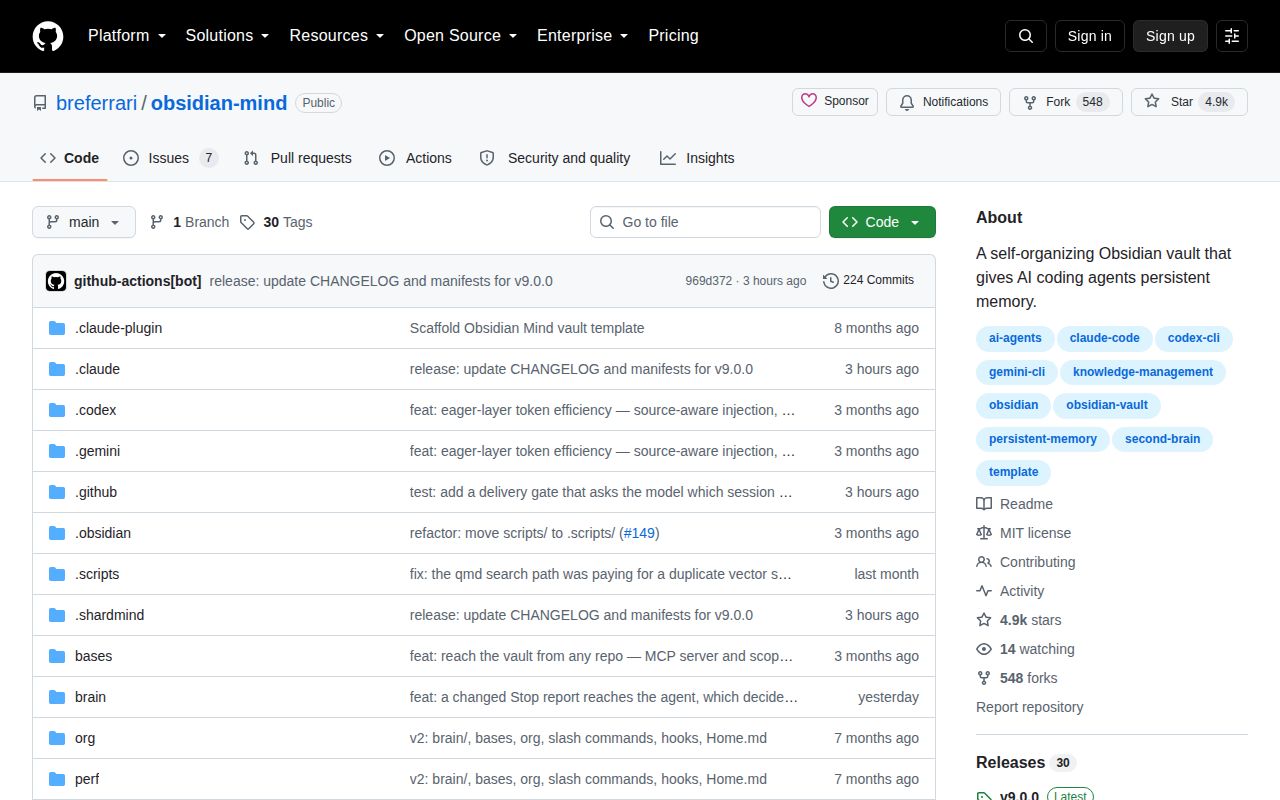
GitHub showed 4,872 stars, 7 combined open issues and pull requests, and a push on October 3, 2026. Version 9.0.0 was released the same day. The issue queue also received updates that day, including reports about filenames and wikilinks. That pattern indicates active maintenance. It also reflects a system where small Markdown and path rules can affect whether stored knowledge remains reachable.
Obsidian Mind has a clear opinion: memory should be files you own, with agent behavior encoded beside them. That is more inspectable than a hidden profile and more demanding than installing an Obsidian theme. Our missing lab run prevents a setup endorsement. If the model fits your work, prove it in a copied vault first, especially on Windows, then decide whether the hooks and MCP access earn permission to reach the real one.